


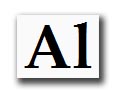
 In my most recent post, I unwittingly confused three-quarters of my readership by including in the title the two-letter word shown at left. This is not “AI” (Artificial Intelligence) or “A1” (as in the steak sauce).
The word is “Al” (as in the man’s name). This is how it looks in Palatino Linotype, the font I selected for titles in this blog. (Text is displayed in a font called Georgia.) Which brings me to the topic of font design, good and bad.
That some letters of our alphabet are easily confused with numbers is a bothersome thing we find out when we begin to read. It has been thus ever since base-ten numerals arose in India around 200 B.C. Historians speculate that symbols for 1, 2, 3 and 4 derived from tally marks; symbols for 5 through 9 borrowed the first letter of the name for the number. While we have lived with letter-number confusion a long time, we have had ample time (milennia, no less) to come up with a design solution.
Before we get into this, let me point out that I am a typeface enthusiast. I have not (yet) set out to design my own font, but I have thought about it. I probably picked this up from my father — I remember the lettering he would sketch, it looked something like this:
 Sometimes he would fill in the open faces with red pencil. He had a neat mechanical pencil: one end wrote in black and the other end wrote in red. I wonder where that pencil is now.
Anyway, my father, like all machine draftsmen, used only capital letters when he printed. This sidesteps one source of confusion (upper-case I vs. lower-case L) but does not address other common problems such as letter O vs. numeral 0 and lower-case L vs. numeral 1. Good typeface designers will strive to make such errors rare — bad designers don’t care.
Let’s take a look at how two fonts, Palatino Linotype and Georgia, distinguish upper-case O from numeral 0, and upper-case I vs. lower-case L vs. numeral 1: As most fonts do, Palatino distinguishes numeral 0 from upper-case O by making its zero more narrow. Georgia takes a different approach: its numerals 0, 1 and 2 are short, like lower-case letters. Georgia would rather have you confuse its zero with lower-case O.
In both Palatino and Georgia, lower-case L is a touch taller than upper-case I, but the main design cue setting them apart is the shape of the top serif. This is also what distinguishes numeral 1 from lower-case L in most, but not all, fonts.
Some font designers seem intent on providing only the fewest and most subtle visual cues, as you see in the examples below: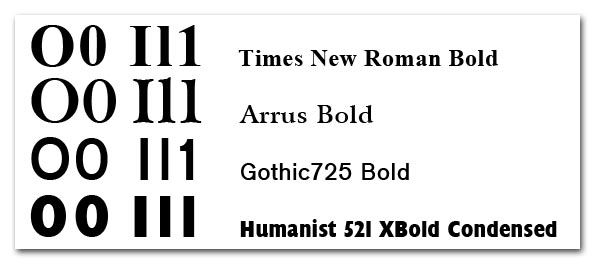 In Times New Roman and Arrus, one cannot count on letter-height to tell upper-case I from lower-case L from numeral 1 — it all depends on the shape of the serif. Even then, one must ask why the Arrus lower-case L, with its sloped serif, and the numeral 1, with its nearly horizontal serif, should not in fact be swapped for each other.
When we consider sans serif fonts like Gothic and Humanist, our confusion only worsens. The Gothic725 zero is only slightly narrower than O, while the Humanist521 Extra Bold Condensed zero is almost identical to O. When it comes to upper-case I, lower-case L and numeral 1, the ineptly-named Humanist521 calls for inhuman perception. Its upper-case I is the widest of the three strokes, with a width-to-height ratio of 29.9%. The next widest is numeral 1 at 26.8%; the narrowest is lower-case L at 25%. If these characters appeared in the headline of a typical newspaper story, the difference in width between the widest and narrowest of them would be about 1/50th of an inch.
It’s a good thing, then, that there are not more newspaper stories about Illinois residents who go bargain-hunting for olive oil: It may be that we cannot design better typefaces, and that we will always have to rely on context to understand half of what we read. Maybe I should have provided more context in the title of my last post, calling it “Whatever Happened to Al Ray?” If I had done that, we wouldn’t be talking about either steak sauce or olive oil today.


Every now and then, and probably more often than others, I come down with a case of the whatever-happened-to’s. Whatever happened to Ellen, the little girl up the street who had ice-cream stains on her tee-shirt? Or to the kid I shared the paper route with? Whatever happened to my high-school calculus teacher? To my college creative-writing professor? And, in the most recent case, whatever happened to Al Ray?
Al (real name Elbert) Ray was a co-worker of mine in the late 1970s and early 1980s, when I was cutting my teeth in Kodak’s membrane technology lab. He was a tall and wide man with thinning hair, a sandy, baritone voice and a quirky sense of humor. I remember Al as a creative but agitated individual, always somewhat off-balance. He was fun to be around and he was tiresome to be around. In the early days we shared an office, which proved to be my front-row seat to the workings of Al’s mind.
It wasn’t long before I was inspired to write a short piece about Al for my self-published, low-circulation, bio-literary magazine.¹ When I shared it with Al, he seemed baffled by the magazine and why I wanted to include him in it. But here it is, verbatim, from 1976:
____________________________________________________________
Al is a thirty-six year old dissatisfied industrial chemist. He has wanted to change jobs for years, hoping that a transfer would help him obtain an adequate salary ($50,000 a year ² would do, he says). So far, all of his applications have been turned down. Feeling trapped, Al has developed the attitude that it is man’s fate to get screwed.
But all is not lost for Al, for he considers himself an inventor who will someday beat the system with that million-dollar idea. Thus Al sits in his office, chain-smoking low-tar cigarettes and writing down anything that comes to mind. His notebooks are filled with the scraps of paper on which he records his ideas and inventions, usually accompanied by rough sketches. Al believes that the contents of these notebooks will, in effect, assure him a future of total satisfaction.
According to Al, his idea factory dates back to his childhood. Even then, he says, Al observed many systems which he knew he could improve, although he cannot now recall what those improvements were. His more recent ideas do, however, provide a good indication of his lifelong thrust. The following is a brief compilation of Al’s most notable efforts.
Make-It-At-Home Kits — Noting the popularity of home wine-making kits, Al proposes cheese-making, sausage-making, pickling, beer-making, candy-making, candle-making, sake-making, champagne-making, soap-making, perfume-making, cigar-making, meade-making, mushroom-growing, honey-growing, tobacco-growing, soul food, maple syrup and cosmetics kits. As with most of his ideas, Al is aiming for a broad consumer market, with potential for high volume and even higher profits.
Convenience Items — For instance, a pipe with preformed tobacco slugs, as easy to smoke as cigarettes. Or an ultraviolet beach screen, which would allow a person to tan while sitting in a cool and shady spot.
Energy Conservation — Another area of high market interest which Al plans to tap. He proposes wind-up cigarette lighters, wind-up flashlights, and yard lights powered by small windmills. For large scale energy needs, he extends the “bobbing-duck” toy to mammoth proportions, with electricity being generated by the continuous dipping of the duck’s beak. Al also claims to have independently discovered the principle of nuclear fusion.
A Better Mousetrap — The Sonic Mouse Evictor, as Al calls it, would emit a high frequency sound intolerable to mice, driving them from the premises. For simple mouse-catching, bait contained in his Electric Mouse Trap would lure the rodent to a trap-door box. In attempting to reach the bait, the mouse would fall through the trap-door and be electrocuted by hot wiring inside the box. Al admits that obtaining UL approval for this device would be difficult.
Far-Reaching Theories — In order to explain why 0! equals 1, Al has postulated a negative zero smaller than negative infinity and greater than infinity. In the field of cosmology, Al holds that matter is merely perturbations in an etherous time-space. And on the subject of reality itself, Al writes:
There are but two basic realities, existence and nonexistence. If there is but one existence, there is no reference. If there are two existences, there is reference, and a third basic reality emerges . . . reference.
Al considers no one idea his best, but the most notorious of them is certainly his concrete-wheel, rubber-road highway system. This is the standard used by Al’s fellow employees in assigning merit to his newest proposals. Al usually ignores outside opinions of his ideas, confident that he is on his way to a better world.
____________________________________________________________
Most of Al’s ideas have come to pass in the 35 years since this piece was written (as you can see in the various links above). No doubt many of his ideas existed well before he “discovered” them. Either way, Al didn’t follow through on any of them, as far as I know.
Eventually, Al came to be regarded as a malcontent. Our supervisor suspected that Al was trying to cook up a reason to file a lawsuit against Kodak. The supervisor called me into his office and asked me to “keep an eye on” Al’s activities in the lab. It was disgusting that my boss would ask me to spy on a co-worker and it was sad that I did it. I was 25 or 26 then.
I don’t recall how that particular situation ended but, some years after we parted ways, Kodak fired Al along with two other employees, claiming the three were using proprietary information to set up a membrane technology business to compete against Kodak.³
According to the newspapers of the time, Al threatened to file a countersuit against Kodak. But there the internet trail goes cold. I found nothing that suggested how this case ended, or what Al or Kodak decided to do next. I lost track of Al until now.
Searching some obscure internet sites, I found that Al died in 2000, at age 57. I have not been able to locate his obituary. I wish I knew what happened to him.
I have now outlived Al in terms of years but not in terms of life’s labors. Al packed a lot of drama into his days here. I doubt he planned it that way, but that’s who he was: a man who wanted more from his life than what it delivered. A troubled man, asking for trouble.
_______________________________________________________________
¹ The name of my so-called underground magazine was Reader’s Disgust — borrowed from the pages of MAD Magazine back in 1964. I wrote the final issue in 1980. For all intensive purples, Reader’s Disgust was the precursor of this blog, but it was lightweight by comparison. [Return to Text]
² A $50,000 salary in 1976 would be equivalent to $204,000 today. [Return to Text]
³ From the Syracuse Post-Standard, Syracuse, New York, November 27, 1985. According to the article, “…one of the former employees [Al] said … that he and his colleagues had only informally discussed the products they would make — including a children’s riding toy, stained-glass windows and faucet filters.” [Return to Text]