


Asked & Answered 17.0
I was an amateur inventor of games from my childhood to mid-adulthood. Looking back, all my games were way too lame for anyone but close friends to accede to play. That they did so anyway (as some readers may remember!) makes me both wince and smile.*
For some odd reason — especially odd because the last time I attended a party was over a decade ago — I was recently inspired to think up a dice-based party game. I’ll call it POP!
The party-attendees/players would be divided into teams. Each team would, in their turn, toss a set of dice that would specify a pop-culture question to be answered — for example, name a film with a three-word title that starts with P. The dice decide the category (film), the number of words in the answer (three), and the first letter of the answer (P).
[Aside: Did you just now pause to rack your brain for films with three-word titles starting with P? If so, my apologies, because the only one I came up with — in desperation — was Peter the Great (USSR, 1937). This shows why POP! should be played by teams and then strictly adjudicated by Wikipedia.]
There would be a time limit for the team to answer, to keep the game moving along and to afford the chance of failure. The team would score points (“POP”) if it came up with an answer within the allotted time, and nothing (“PLOP”) otherwise. Answers could only be used once a game.
In POP!, the arts category would be selected by a six-sided die with the faces FILM – TV – PLAY – MUSIC – BOOK – ANY. If the player rolls ANY, the team may choose any form of art or entertainment including those (say POETRY or BALLET) not shown on the die.
The number of words in the team’s answer would be chosen by another six-sided die with the faces 1 – 2 – 3 – 4 – 5 – ANY. Since long titles are rarer and harder to recall, the team’s score (if successful) would be based on the number of words in the title — say, 10 points a word, with a 10-point bonus for five-plus words. So, One Flew Over the Cuckoo’s Nest would be a very profitable film or book answer if the team’s starting letter was O.
Which brings us to the matter of deciding the starting letter, and my impetus for writing this article. The challenge of an amateur game-designer like me is how one might “best” use a die or dice to select a letter from the 26-letter English alphabet. (I will touch upon what “best” means as we go along.)
Selecting a starting letter would be trivial if we were simply content to ask a computer, “Pick a number from 1 to 26 and name the corresponding letter of the English alphabet.” But that computation takes place deep inside some data center where no light penetrates. Humans don’t trust results that emerge from the dark — we like to see physical processes play out, to convince ourselves of their “fairness.” This is how humans came to use solid, scrutable objects like dice to turn chance into outcome.
Enough Already! Just Use a 26-sided Die!
The first and most obvious solution is for POP! players to roll an object that resembles an ordinary die except that it has 26 faces, with letters printed on the faces. You can even buy such dice on Amazon:
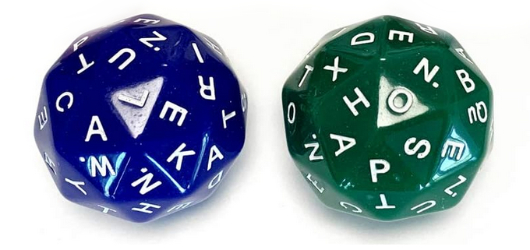 Problem solved, we’re done here, yes? Well, yes, if I were anyone else but the unfortunate perfectionist I am. The issue with dice like these is that they are intrinsically not fair — some faces come up more often than others, not that I can predict which ones. But still…
Mathematicians have long known that only certain shapes qualify as fair. The foremost of those are the five Platonic solids shown below, having 4, 6, 8, 12 and 20 faces:
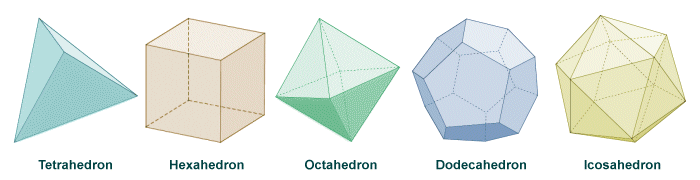
Image Credit: www.technologyuk.net
Besides these, a group of solids known as isohedrons are also geometrically fair, but none happen to have 26 sides. This means that alphabet letter-picking hairsplitters like me are out of luck when it comes to POP! So what are my alternatives?
A. Manufacture and spin a 26-sided teetotum
As I recently learned, a teetotum is a top with flat sides that commonly replaced dice in devil-phobic times and cultures. The player spins the teetotum and reads the side that faces up when it comes to a stop. Here are some examples, including the Jewish dreidel:
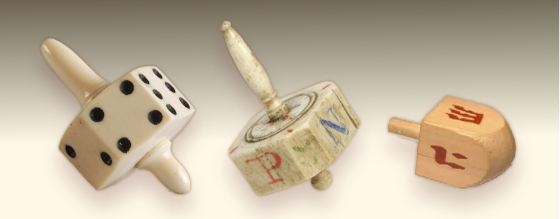
So why not just make a 26-sided teetotum — or the equivalent, a 26-sided barrel-shaped object with a different letter on each face — then spin it (or roll it) and call it a day?
Here’s-Why-Not No. 1: A 26-sided object would be so smooth — 99% of a circle — that it might just roll around forever before it came to a stop (see cross-section below).
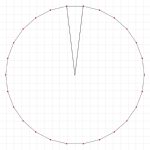
Dice-Tossing Principle No. 1: A die must eventually come to a stop.
Here’s-Why-Not No. 2: Size and readability. In order to read a 26-sided teetotum or barrel-shaped die, each face would need to be about 1/4-inch tall — which means the object that you spin or roll would be more than two inches in diameter. Come on.
It is my opinion, as a grizzled game-inventor, that such an object would be far too clunky (not to say inelegant) to do the delicate job of selecting a letter from the English alphabet. Who’s with me on this? Let’s find a better way.
B. Use fair die/dice with extra faces and discard some outcomes
If a 26-sided die isn’t fair and a 26-sided barrel-shaped die is too clunky, then POP! could use dice of other shapes, alone or in combination, to pick the starting letter. One option is the rhombic triacontahedron, a fair D30 (short for 30-sided die) made by Koplow Games:
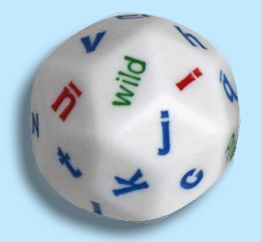
Conveniently for our purposes, this die is imprinted with the 26 letters of the alphabet plus four “wild” faces, and it is not clunky — at 1.25 inches diameter, the die is about the size of a plump cherry tomato, or the “OK” circle you make with your thumb and forefinger.
Although this die is fair, its wild faces work against our original goal, to ensure each letter has an equal chance of being selected. If we stick to that principle, then a player who rolls a wild should have to re-roll. This would mean 2 re-rolls every 15 tosses — inconvenient, yes, but not an overwhelming burden for purists like me.
Even so, POP! could have a rule that a player could pick any starting letter if he/she rolled two wilds in a row. (There’s less than a 2% chance of that on any turn.) This would be a lemonade-from-lemons kind of rule, and why not.
C. Use six-sided alphabet dice with a selector
You can buy nicely-designed six-sided alphabet dice like these on Amazon and elsewhere:
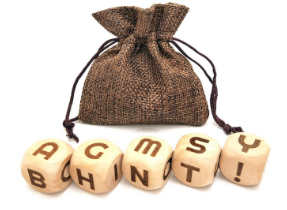
Such dice may be pleasing to roll but they leave something to be desired for POP! players. First off, this set of dice has the same issue as the D30 we just discussed — four of the faces have no letter and thus would require a re-roll. Secondly, and more to the point, there’s no obvious way to select one letter out of the five letters facing up.
I can think of a few creative ways to select one of the five letter dice:
- Toss the dice against a backboard, then select the die that comes to rest closest to the backboard, provided some dice bounce back. (And assuming you have a long table.)
- Paint the letter dice different colors, then roll a blank multi-color die to select the letter die that shares that color. (More design, more cost, see below.)
- Use a spinner to select one of the five dice. (But I thought this was a dice game!)
- Pull a die at random out of a bag and roll that one. (One more accessory!)
- Toss all the dice in the air, and have another player grab one and roll it. (Dangerous!)
- Put all the dice in your mouth, then spit one out onto the table. (Ick!)
In the end, six-sided letter dice involve too much chaos — rolling a D30 is much simpler, so that’s the solution I would favor, even with the occasional re-rolls.
Also, putting all the dice in your mouth would be a choking hazard and I would get sued.
D. Or, one last variation…
Maybe the real problem here is my insistence that each letter have an equal chance of being selected. If rolling an X, Q or Z always results in a plop, how much fun is that?
So here’s my final proposal — in this version, the player will use three D8 dice, not much larger than D6 dice, to select the starting letter of the answer. This reduces the volume of dice tossed, makes play a bit easier, and offers fun elements of both chance and choice. (What more could one ask for — world peace?)
We will fit the 26 alphabet letters on the 24 die faces of those D8’s by combining X and Z on one face and Q and V on another face. We will also dispense with the selector die — instead, we will let the player choose any of the three face-up letters as the starting letter. Why make the game more difficult than it already is?
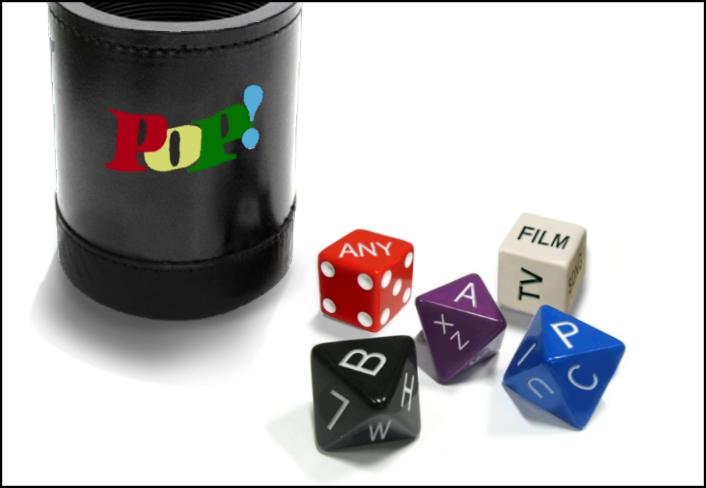
Now, as to making the game: I can procure the custom dice and dice cup shown here, plus a toy hourglass, for around $90 on Etsy. While I could print my own labels and glue them onto blank dice, the game would look amateurish and nobody will play it — as opposed to looking slick and professional and nobody will play it.
I think I’ll save my money.
So, let’s raise a cup of imaginary dice to another one of my fantasy games — POP!
Appendix: The Messy Details
I glossed over a few design details and play mechanics that I would need to address before the game was played for its first and only time. The most important of these questions is, how to deal with titles that start with A, An or The. Example: whereas Sopranos feels like an acceptable alternative to The Sopranos, I don’t feel the same about The Way We Were. Sometimes the leading article seems integral to the title, sometimes not.
In an attempt to settle this, I consulted the National Film Registry Listing maintained by the Library of Congress. Their listing is sorted alphabetically, and they alphabetize titles according to the word that follows the article. So The Wizard of Oz is a four-word entry among the other W entries, as if the The wasn’t there, except that it is.
OK, but POP! needs explicit, written rules. I would rule that The Sopranos starts with S, but your answer could be one word (Sopranos) or two (The Sopranos). The same goes for The Way We Were — a W title that has either three or four words, depending on whether you include the The in your answer. This bugs me, but I can live with it.
This brings me to how to design the three D8 letter-dice so that an “interesting” array of starting letters is offered to the player. I wouldn’t want all of the most-common starting letters to be on the black die and all the least-common on the blue die — no one would ever select the blue die. It would be more fun if the letter choice varied in difficulty depending on how the dice were rolled.
This called for research on my part as to the most-common starting letters in the titles of works of art. Since it is impossible to list and alphabetize the titles of all works of art ever created, I used the Library of Congress film registry as a representative (get it?) sample. The chart below shows how those film titles are distributed:
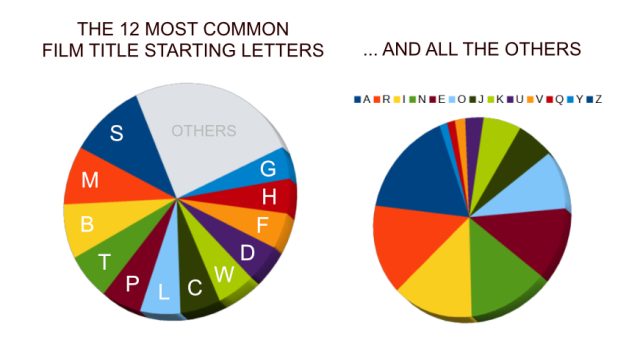
I was surprised to see S, M, B and T were the four most-common starting letters, but was not surprised that Z, Y, Q and V were the least-common — except X, which did not appear at all, not a tiny bit. Had I surveyed song titles along with films, I’m sure there would have been many more titles starting with I (for I) and Y (for You), but the film title order was a good enough starting point for me.
So here is how I would design the three D8 letter dice to offer variety in difficulty level:
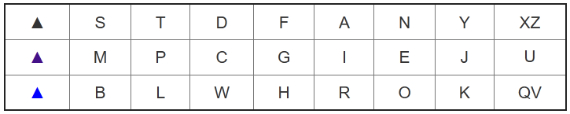
Your odds of rolling the XZ/U/QV combination (or any other combination for that matter) would be 511-to-1. Pretty high odds, but your opponents would be rooting for this combo every time you roll.
The last little detail I have yet to figure out is how the game ends. I think the best way is, when everyone gets tired of it. That way, like the idea itself, it can stop before it begins.
___________________


I think you could solve your dice problem with a 3D Printer. Here is a helpful link for you to get started:
https://library.unca.edu/craftstudio/3dprinting
You slay me, neighbor! You did this as a child? Woah.
Here’s one from me:
Pee Wee Herman
“Pee-wee’s Big Adventure” would count!