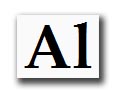
 In my most recent post, I unwittingly confused three-quarters of my readership by including in the title the two-letter word shown at left. This is not “AI” (Artificial Intelligence) or “A1” (as in the steak sauce).
The word is “Al” (as in the man’s name). This is how it looks in Palatino Linotype, the font I selected for titles in this blog. (Text is displayed in a font called Georgia.) Which brings me to the topic of font design, good and bad.
That some letters of our alphabet are easily confused with numbers is a bothersome thing we find out when we begin to read. It has been thus ever since base-ten numerals arose in India around 200 B.C. Historians speculate that symbols for 1, 2, 3 and 4 derived from tally marks; symbols for 5 through 9 borrowed the first letter of the name for the number. While we have lived with letter-number confusion a long time, we have had ample time (milennia, no less) to come up with a design solution.
Before we get into this, let me point out that I am a typeface enthusiast. I have not (yet) set out to design my own font, but I have thought about it. I probably picked this up from my father — I remember the lettering he would sketch, it looked something like this:
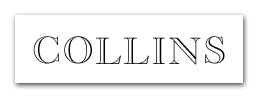 Sometimes he would fill in the open faces with red pencil. He had a neat mechanical pencil: one end wrote in black and the other end wrote in red. I wonder where that pencil is now.
Anyway, my father, like all machine draftsmen, used only capital letters when he printed. This sidesteps one source of confusion (upper-case I vs. lower-case L) but does not address other common problems such as letter O vs. numeral 0 and lower-case L vs. numeral 1. Good typeface designers will strive to make such errors rare — bad designers don’t care.
Let’s take a look at how two fonts, Palatino Linotype and Georgia, distinguish upper-case O from numeral 0, and upper-case I vs. lower-case L vs. numeral 1: As most fonts do, Palatino distinguishes numeral 0 from upper-case O by making its zero more narrow. Georgia takes a different approach: its numerals 0, 1 and 2 are short, like lower-case letters. Georgia would rather have you confuse its zero with lower-case O.
In both Palatino and Georgia, lower-case L is a touch taller than upper-case I, but the main design cue setting them apart is the shape of the top serif. This is also what distinguishes numeral 1 from lower-case L in most, but not all, fonts.
Some font designers seem intent on providing only the fewest and most subtle visual cues, as you see in the examples below: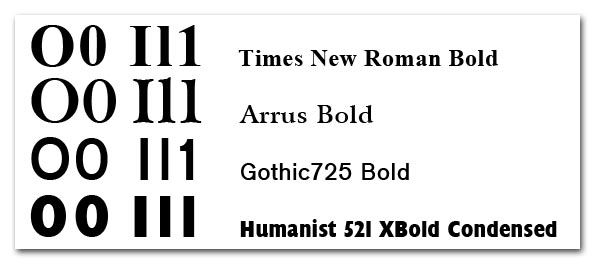 In Times New Roman and Arrus, one cannot count on letter-height to tell upper-case I from lower-case L from numeral 1 — it all depends on the shape of the serif. Even then, one must ask why the Arrus lower-case L, with its sloped serif, and the numeral 1, with its nearly horizontal serif, should not in fact be swapped for each other.
When we consider sans serif fonts like Gothic and Humanist, our confusion only worsens. The Gothic725 zero is only slightly narrower than O, while the Humanist521 Extra Bold Condensed zero is almost identical to O. When it comes to upper-case I, lower-case L and numeral 1, the ineptly-named Humanist521 calls for inhuman perception. Its upper-case I is the widest of the three strokes, with a width-to-height ratio of 29.9%. The next widest is numeral 1 at 26.8%; the narrowest is lower-case L at 25%. If these characters appeared in the headline of a typical newspaper story, the difference in width between the widest and narrowest of them would be about 1/50th of an inch.
It’s a good thing, then, that there are not more newspaper stories about Illinois residents who go bargain-hunting for olive oil: It may be that we cannot design better typefaces, and that we will always have to rely on context to understand half of what we read. Maybe I should have provided more context in the title of my last post, calling it “Whatever Happened to Al Ray?” If I had done that, we wouldn’t be talking about either steak sauce or olive oil today.