Category Archives: Book Notes

I am way behind on my reading.  I keep ordering books I want to read, and they arrive at my door, and then they sit for awhile on the shelf of my end table, their titles looking up at me now and again with their cat-like eyes, pleading for me to pay just a little attention to them, reminding me what a deliberate reader I am.  If they could, these books would rub their pages up against my legs and purr.  Which would be pretty fucking weird.

With that, here are the books I intend to finish in 2015:

The Sleepwalkers by Christopher Clark.  This was widely hailed in 2014 as the book to help one understand the zeitgeist at the start of World War I.  I’m a third of the way through and it has already given me a better perspective.  But why World War I?  The Guardian explains:

The first world war and the treaties that followed it redrew the map of the Middle East by creating new states and new political realities on the territory of the defeated Ottoman empire.  Rivalry between Britain and France, the growth of Arab nationalism, Zionist ambitions in Palestine and the emergence of modern Turkey all changed the face of the region. 

European arrogance in the early 20th century shaped events, distorted cultures and impacted tens of millions of people for many decades.  It contributed to the rise of the various Al Qaeda groups, ISIS and other violent fundamentalists vying for power and territory in Asia, Africa and elsewhere.  I have read Paris 1919The Ottoman Empire: 1700-1922 and The First World War: To Arms.  This will be my last read on the topic.

The Oxford Handbook of Philosophy of Time edited by Craig Callender.  I am curious how the universe works on a fundamental level.  I enjoy reading physics and I enjoy reading about time.  Philosophy, not so much.  I have made my way through a few chapters in this book — they have been heavy on symbolic logic and arguments about what constitutes a true sentence.  For example, I just learned that “necessary truths are actually true; that necessary truths are necessarily necessary; and that ψ is necessarily possible if it is possible.”   It is actually possible that the entire book will consist of this punctilious crap, but not necessarily.  I will not know for sure until I have finished reading it and have thereby transformed a possible future into the immutable past.  Stay tuned.

Lilith’s Brood by Octavia Butler.  I started this thick science-fiction read over a year ago but got bogged down one-fifth of the way in.  Unlike the Serial podcast, this novel maintains an uneven hold on my attention, but I’m going to give it another shot and see what goes.

Meet You in HellCarrie Furnace by Les Standiford.  I picked up this book  on a visit to the Frick House in Pittsburgh last year.  It is the story of the turn-of-the-century steel empires of Andrew Carnegie and Henry Clay Frick, the feud between the two men, and the (mis)treatment of their workers, which is the aspect I’m most interested in.  By chance, on that same trip to Pittsburgh, I had toured an abandoned blast furnace built by Andrew Carnegie in 1884 and which operated until 1982.  The hot, strenuous and dangerous work conditions described by our tour guide, a former employee, were incredible enough — it is hard for me to imagine what that same work would have been like a century earlier.

Racisms: From the Crusades to the Twentieth Century by Francisco Bethencourt.  I know that racism existed before the enslavement of Africans by European colonists, but I am ignorant of its origins and how it spread.  I am hoping Bethencourt’s book gives me a better idea of the depth and breadth of this ongoing tragedy of human history.  There are many books on racism I could have picked — I settled on this one to get started.
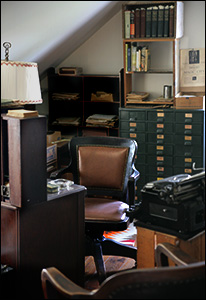
Carl Sandburg's Writing RoomThe People, Yes by Carl Sandburg.  After all those weighty reads, the last book on my list for 2015 (should I be lucky enough to finish them all) will offer some respite.  This book-length poem was a birthday gift from my wife — we often visit the Carl Sandburg House in nearby Flat Rock when we have out-of-town guests.  The photo at right shows his second-floor writing room.  Sandburg was a much more diligent reader and writer than yours truly.

Except for pet photos, there probably isn’t anything more boring to share than one’s reading list.   But at least you now know that my dance card is full — just in case you were thinking of inviting me to join your book club.

Be the first to comment | Read other posts in Book Notes

As I mentioned in an earlier post, David Walton was an English professor at Carnegie-Mellon University in the early 1970s while I was a student there.  His creative writing class introduced me to works such as Slaughterhouse Five, Catch-22, Trout Fishing in America and One Flew Over the Cuckoo’s Nest.  Once I had Slaughterhouse Five in my head, all I wanted to do was to write like Vonnegut — start my sentences with “So” and end them with “it goes” and stuff the middles with the resigned sound of nothing.  But I digress.

I treasured that class.  It seemed to embody everything college was supposed to be about, as depicted in college admission brochures.  I remember several beautiful fall afternoons in Pittsburgh when our class gathered on the lawn next to the Fine Arts building, the eighteen or so of us sitting in a circle and sharing our thoughts about our readings and writings.  And I remember Walton’s habit of tapping the filter end of his cigarette on his classroom desk for a minute or so, to pack down the tobacco before he lit up.  As I was also a smoker at the time, I copied his habit.  I was young, impressionable and looking for impressions to try on for size.

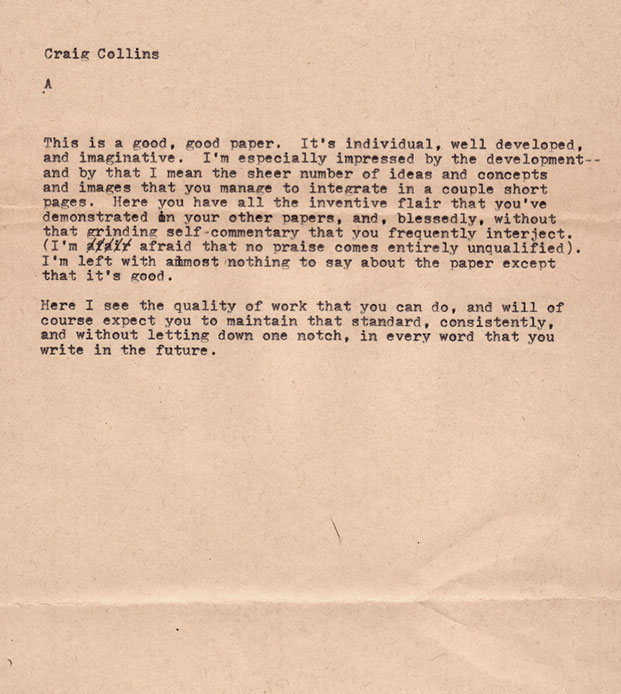
A Grade from WaltonI didn’t ace his class but it didn’t matter.  I pretty much wrote what I pleased.  I took some risks, and I was also complacent and self-absorbed, befitting a seventeen-year-old.  Befitting his role, Walton gave me personal and detailed feedback, some positive and some not.  His complaint about my frequent “grinding self-commentary” would not discourage me from signing up for his advanced writing class three years later.  I took it as a minor point-of-pride that I was the only engineering student in his class.  (I guess we were supposed to prefer being in the lab or doing some nerdy thing with slide-rules.)

David Walton was the only professor that I sort-of-wished I could have had a friendship with as an adult.  But that is the stuff of fantasy, as he knew little about me except for my writing, and I knew next-to-nothing about him, save for his attitude, his mannerisms and his critiques, typewritten on unbleached paper, which I have kept to this day.

Some weeks ago, I had the idea of contacting David Walton and inviting him to visit my blog, to show him how grown-up and all I have become over the past forty years, and how the grinding self-commentary he so lamented persists to this day.  (Yep, that shows him!) But then I had a rare moment of other-thinking: how could I ask David Walton to read more of my writings without having read a single word of what he has written?

To resolve this inequity, I did a search and found that David Walton has not only won the Flannery O’Connor Award for Short Fiction but has published three works, the latest being Ride in 2003.   So I bought a paperback copy of Ride.  And I have just finished it.

 • • • • •

This is where the trouble starts.  I figured I would read his book, share my impressions in this blog, and then contact David Walton and refer him to this post, where he would not only read my tribute to his novel but discover here the more than three-hundred splendid examples of how I write these days.  He would be thoroughly entertained, I would be duly flattered, and who knows, maybe it would lead to us having a beer together in Pittsburgh someday.

But questions arose.  First, how could I write an objective review of his novel if I had read it mainly to gain favor with him?  But let’s say I managed to be critical.  How could I ask him to visit my site, only for him to be greeted by a bad review, after which he is expected to read and lavish his comments on my blog?   And what qualifies me to review his book anyway?  I am no English professor.  I never tried to write a book.  David Walton has written books, short stories and reviews.  Who am I to tell him anything about character development or the difference between a story and a plot?  Whatever I had to say, I would only be putting myself in the position of having him review the soundness of my review.

As a result, I decided I am not going to write a review.*   This does not mean, however, that I no longer care what David Walton thinks about the blog.  I still intend to contact him and ask him to check it out, including this post.  He probably will not be entertained, and I will more likely be embarassed than flattered, but who knows, maybe it will lead to us having a beer together and exchanging a few pleasantries in Pittsburgh (or Asheville) someday.

_________

* Just a footnote.  I moderately enjoyed the novel.  The main character is Ray, an out-of-work history professor trying to teach developmentally-disabled people how to ride the bus from their group home in Pittsburgh to their West Versailles workshop and back.  I did not find Ray all that admirable — he came across to me as self-important, self-absorbed and ironically, considering the nature of his assignment, directionless.  Someone with grand thoughts and mundane ambitions.  Quite human.  As I read, I kept wondering what if anything of Ray’s character or situation was autobiographically inspired.
I appreciated the references to Pittsburgh landmarks, but I found the details of the bus rides — who got on, who got off, what Ray saw out the window — tedious after a while.  Too many bit-part characters to remember, especially when most of them did not participate in the story other than sit on the bus.  And my favorite character, the nearly-blind Morris, was written out of the storyline three-quarters of the way through, leaving Ray and his client Elliott to do what they needed to do to mop up the ending.
Ray (or should I say, Elliott) accomplishes his task in the end, but the narrative was so understated that I did not feel a sense of satisfaction reading about it.  I even started to hope for a Rod Serlingesque plot twist, where it is discovered that Ray is actually a resident of the group home, has an obsessive-compulsive fascination with bus routes, and relentlessly drills the other clients on this topic, with the remaining details revealed to have been a product of Ray’s juvenile imagination.  But no, no such surprise — the novel ends with Ray reflecting on the “lesson from his travels.”
I had other quibbles, but this footnote is not the place to air them.  Well, maybe one.  Describing Ray taking “a welcome and protracted dump” in a department store men’s room — I don’t think that detail was essential to the story.  Really, I don’t want to read about anyone’s bathroom activity or even acknowledge that people spend time there.  I know that I don’t.
All in all, it wasn’t a bad book.  Its premise had promise.  If you plan to read it, I would recommend you do so in three sittings or less.  This, I think, will keep you engaged in the main storyline and help you motor past the numerous loose ends that dangle and blind alleys that beckon.
If David Walton ever reads this footnote, I fear that any chance of my having a beer with him in Pittsburgh will have been poured down the drain.  So it goes.
Be the first to comment | Read other posts in Book Notes

I have at last finished reading all 448 pages of “The Language Instinct” by Steven Pinker.  (This count does not include the 78 pages of notes, glossary and index, which I was more than happy to skip over.)

As usual, I do not intend to review this book but will just share a few general impressions.  This is the second Steven Pinker work I have read — the other was “The Stuff of Thought” in 2007.  I had enjoyed “The Stuff of Thought” and so I was looking forward to this read.   But I did not realize when I started “The Language Instinct” that Pinker wrote it in 1994.  The content felt dated to me and the arguments too familiar.  “The Stuff of Thought” was  tighter and more interesting, and I would recommend it over “The Language Instinct.”

One other note.  The older I get, the more impatient I am with writers who use more words than necessary to get to the point (writers who are not concise, that is!)  Pinker tends to use many more illustrations and examples to support an argument or convey an idea than I think are necessary, and I doubt that I am more quick-witted than his average reader.  Yes, assertions need to be supported, but after a while, Pinker’s elaborations grow less and less entertaining and feel more like padding.  Douglas Hofstadter and Jared Diamond are two other authors who I have found do the same.

With non-fiction, what I look for is some unusual insight or new way of thinking about a given topic.  I only need the work to be entertaining enough so it does not put me to sleep before I have a chance to learn something from it.

My next read?  Well, I changed my mind — it will not be about the causes of World War I.   I need a break from non-fiction!  My next read will be “Ride,” a novel by David A. Walton, my creative-writing professor in 1970 (and again in 1973).  I thought it was about time that I returned the favor by reading something he has written.  His novel, published in 2002, has been favorably reviewed but I will soon let you know how I, his former student and therefore expert on such matters, liked it.  Can you wait?

Read 2 comments and add yours | Read other posts in Book Notes