Category Archives: Book Notes

“The Art Spirit” is a loose collection of thoughts, lecture notes and criticisms by the artist and teacher Robert Henri  (1865-1929).  My studio friend J. P. Sullivan gave me a copy of this book, which is one of his favorites (and now mine).  It is inspirational and educational, not so much about specific technique but more the mindset of an artist.  Again, rather than review the book, I cite some of my favorite passages.  It was hard to select just these few.

__________________________________

• He paints like a man going over the top of a hill, singing.

• For an artist to be interesting to us he must have been interesting to himself.

• I once met a man who told me that I always had an exaggerated idea of things.  He said, “Look at me, I am never excited.”  I looked at him and he was not exciting.  For once I did not over-appreciate.

• The picture that bowls you over at first sight and the next day loses even the power to attract your attention is one that always looks the same.  It has a moment of life but dies immediately thereafter.

• [Brush] strokes carry a message whether you will it or not.  The stroke is just like the artist at the time he makes it.  All the certainties, all the uncertainties, all the bigness of his spirit and all the littleness are in it.

• The picture that looks as if it were done without an effort may have been a perfect battlefield in its making.

• Don’t worry about your originality.  You could not get rid of it even if you wanted to.  It will stick to you and show you up for better or worse in spite of all you … can do.

• I would like to be in many activities.  I think that anyone who has had the pleasures of study and work for years may be full of regret because he cannot practice in all the arts.

__________________________________

• I have seen a whole gallery of pictures condemned with a sweep of the eye.  I remember hearing a prominent artist on entering a gallery declare, “My eight-year-old child could do better than this.”  [These] were pictures by Matisse, Cézanne and others.

• I cannot interest myself in whether [paintings] will pass juries or not.  More paintings have been spoiled during the process of their making, through such considerations, than the judgments of juries are worth.

• To award prizes is to attempt to control the course of another man’s work.  It is a bid to have him do what you will approve.  It affects not only the one who wins the award, but all those who in any measure strive for it.  Let the work they do get its honor in being what it is.  Prizes generally go amiss.  We must realize that artists are not in competition with each other.

• I am not interested in art as a means of making a living, but I am interested in art as a means of living a life.
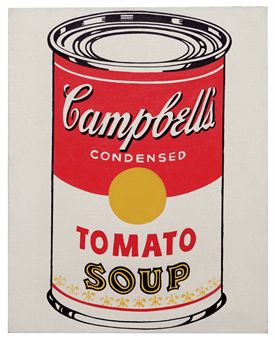
Andy Warhol (1962)

• I was once asked by a young artist whether he could hope to make any money out of his work if he continued in his particular style of painting.  He happened to be a man of considerable talent and had great enthusiasm in his work.  But I knew there was no public enthusiasm for such work.  I remembered he had told me that before he got really into art he had made a living by designing labels for cans, tomato cans and the like.  I advised him to make tomato-can labels and live well that he might be free to paint as he liked.

[Footnote: Henri died when Andrew Warhola was not yet one year old.]

__________________________________

• All things change according to the state we are in.  Nothing is fixed.  I lived once in the top of a house, in a little room, in Paris.  I was a student.  My place was a romance.  It was a mansard room and it had a small square window that looked out over housetops, pink chimney pots.  I could see l’Institut, the Pantheon and the Tour Saint Jacques.  The tiles of the floor were red and some of them were broken and got out of place.  There was a little stove, a wash basin, a pitcher, piles of my studies… My bed was a cot.  It was a wonderful place.  I cooked two meals and ate dinner outside.  I used to keep the camembert out of the window on the mansard roof between meals, and I made fine coffee, and made much of eggs and macaroni.  I studied and thought, made compositions, wrote letters home full of hope of some day being an artist.

It was wonderful.  But days came when hopes looked black and my art student’s paradise was turned into a dirty little room with broken tiles, ashes fell from the stove, it was all hopelessly poor, I was tired of camembert and eggs and macaroni, and there wasn’t a shade of significance in those delicate little chimney pots, or the Pantheon, the Institut or even the Tour Saint Jacques.

• Today must not be a souvenir of yesterday, and so the struggle is everlasting.  Who am I today?  What do I see today?  How shall I use what I know, and how shall I avoid being victim of what I know?  Life is not repetition.

• The best art the world has ever had is but the impress left by men who have thought less of making great art than of living full and completely with all their faculties in the enjoyment of full play.  From these the result is inevitable.

• Go in and find out.  The future is in your hands.

__________________________________

Henri would have me forget about originality and popularity — satisfaction lies in seeing and expressing.  “The true artist regards his work as a means of talking with men, of saying his say to himself and to others.”  Yes, that is exactly what I aspire to do.

Be the first to comment | Read other posts in Book Notes, The Arts

True to my word, I have finished this month’s book, “Thinking Fast and Slow” by Daniel Kahneman, a Nobel Prize winner in economics.  The work is a tour-de-force that unifies the main findings of Kahneman’s long career studying the psychology of decision-making.  It reminds me somewhat of Douglas Hofstadter’s “Gödel, Escher, Bach” not only in its breadth and depth but how much it reveals the mind of its author.

Since the book is essentially a distillation of Kahneman’s life’s work, I recommend that you not put it down for long periods lest you lose the tenor of his story.  The book offers much food for thought and must be read at a moderate pace to allow it to be digested.  A lot of books wear out their welcome after the first few chapters, but this one is not front-loaded: the later sections are as interesting and informative as the earlier ones, so be patient.

I am not going to review the book but I do offer a few excerpts that intrigued me.

_______________

For example, here is a simple puzzle.  Do not try to solve it but listen to your intuition:

A bat and ball cost $1.10.
The bat costs one dollar more than the ball.
How much does the ball cost?

A number came to your mind.  The number, of course, is 10 cents.  The distinctive mark of this easy puzzle is that it evokes an answer that is intuitive, appealing, and wrong.

_______________

Anchoring effects explain why, for example, arbitrary rationing is an effective marketing ploy.  A few years ago, supermarket shoppers in Sioux City, Iowa, encountered a sales promotion for Campbell’s soup at about 10% off the regular price.  On some days, a sign on the shelf said LIMIT OF 12 PER PERSON. On other days, the sign said NO LIMIT PER PERSON. Shoppers purchased an average of 7 cans when the limit was in force, twice as many as they bought when the limit was removed.

_______________

An experiment that Amos [Tversky] carried out … at Harvard Medical School is the classic example of emotional framing.  Physician participants were given statistics about the outcomes of two treatments for lung cancer: surgery and radiation.  [Long-term] survival rates clearly favor surgery, but in the short term surgery is riskier than radiation.  Half the participants read statistics about survival rates, [while] the others received the same information in terms of mortality rates.  The two descriptions of the short-term outcomes of surgery were:

The one-month survival rate is 90%.

There is 10% mortality in the first month.

You already know the results:  surgery was much more popular in the former [group] (84% of the physicians chose it) than in the latter (where 5o% favored [it]).  The logical equivalence of the two descriptions is transparent, and a reality-bound decision maker would make the same choice regardless of which version she saw.  But … 90% survival sounds encouraging whereas 10% mortality is frightening.  An important finding of the study is that physicians were just as susceptible to the framing effect as medically unsophisticated people (hospital patients and graduate students in a business school).  Medical training is, evidently, no defense against the power of framing.

_______________

[The following excerpt has been condensed from a much longer discussion of the illusion of skill in the financial industry — the chapter is well worth reading in its entirety.]

Some years ago I had an unusual opportunity to examine the illusion of financial skill up close.  I had been invited to speak to a group of investment advisers in a firm that provided financial advice … to very wealthy clients.  I asked for some data to prepare my presentation and was granted a small treasure: a spreadsheet summarizing the investment outcomes of [twenty-five] advisers, for each of eight consecutive years.  Each adviser’s score for each year was his (most of them were men) main determinant of his year-end bonus.  It was a simple matter to … determine whether there were persistent differences in skill among them and whether the same advisers consistently achieved better returns for their clients year after year.

… I was surprised to find that …  consistent correlations that would indicate differences in skill were not to be found.  The results resembled what you would expect from a dice-rolling contest, not a game of skill.

… Our message to the executives was that, at least when it came to building portfolios, the firm was rewarding luck as if it were skill.  This should have been shocking news to them, but it was not… I have no doubt that both our findings and their implications were quickly swept under the rug and that life in the firm went on just as before.  The illusion of skill is not only an individual aberration; it is deeply ingrained in the culture of the industry… Given the professional culture of the financial community, it is not surprising that large numbers of individuals in that world believe themselves to be among the chosen few who can do what they believe others cannot.

_______________

Here’s a man I’d like to meet.  If you decide to read his book, let me know what you think.

Be the next to comment | Read other posts in Book Notes

You may note that I have cleared out the seldom-updated “Reading List” section on the sidebar of this blog.  The reason?  Here are the books I finished reading in 2013:

That’s it — all three of them.  I never even got to the books whose titles begin with B.

Seriously, this is pathetic.  While there are several other books I started to read last year, the results speak for themselves.

I resolve to do better.  Why is this important?  First, I always learn something from reading, fiction or non-fiction.  Books expose me to new ideas and different ways of thinking about the topics that interest me.  Even if a book only serves to validate my currently-held points of view, the author’s formulation is usually more coherent than mine.  Second, reading more books will peel my eyeballs away from the computer screen and perhaps reverse the decline in my attention span.  Third, reading books of all types can only help improve my writing.  Good books serve as examples of how to use words and organize ideas.  Bad books, annoying as they are, have value as counterexamples.

So, my aim is to finish one book each month, for the rest of this year.  This may seem like a modest goal to you, but it represents a four-fold improvement for me.  I will count a book as “finished” if it turns out to be a bad book and I make a conscious decision to stop reading it.  The clock starts now.  I intend to finish “Thinking Fast and Slow” by Daniel Kahneman in the next two weeks.  I will then turn my attention to “The Art Spirit” by Robert Henri and go from there.  You can follow my progress in the 2014 Reading List (see sidebar).

If any of you have must-read book suggestions, let me know.  My non-fiction-to-fiction ratio has historically been about 20:1 but don’t let that stop you from mentioning a good novel.

Be the first to comment | Read other posts in Book Notes