“The Art Spirit” is a loose collection of thoughts, lecture notes and criticisms by the artist and teacher Robert Henri (1865-1929). My studio friend J. P. Sullivan gave me a copy of this book, which is one of his favorites (and now mine). It is inspirational and educational, not so much about specific technique but more the mindset of an artist. Again, rather than review the book, I cite some of my favorite passages. It was hard to select just these few.
__________________________________
• He paints like a man going over the top of a hill, singing.
• For an artist to be interesting to us he must have been interesting to himself.
• I once met a man who told me that I always had an exaggerated idea of things. He said, “Look at me, I am never excited.” I looked at him and he was not exciting. For once I did not over-appreciate.
• The picture that bowls you over at first sight and the next day loses even the power to attract your attention is one that always looks the same. It has a moment of life but dies immediately thereafter.
• [Brush] strokes carry a message whether you will it or not. The stroke is just like the artist at the time he makes it. All the certainties, all the uncertainties, all the bigness of his spirit and all the littleness are in it.
• The picture that looks as if it were done without an effort may have been a perfect battlefield in its making.
• Don’t worry about your originality. You could not get rid of it even if you wanted to. It will stick to you and show you up for better or worse in spite of all you … can do.
• I would like to be in many activities. I think that anyone who has had the pleasures of study and work for years may be full of regret because he cannot practice in all the arts.
__________________________________
• I have seen a whole gallery of pictures condemned with a sweep of the eye. I remember hearing a prominent artist on entering a gallery declare, “My eight-year-old child could do better than this.” [These] were pictures by Matisse, Cézanne and others.
• I cannot interest myself in whether [paintings] will pass juries or not. More paintings have been spoiled during the process of their making, through such considerations, than the judgments of juries are worth.
• To award prizes is to attempt to control the course of another man’s work. It is a bid to have him do what you will approve. It affects not only the one who wins the award, but all those who in any measure strive for it. Let the work they do get its honor in being what it is. Prizes generally go amiss. We must realize that artists are not in competition with each other.
• I am not interested in art as a means of making a living, but I am interested in art as a means of living a life.
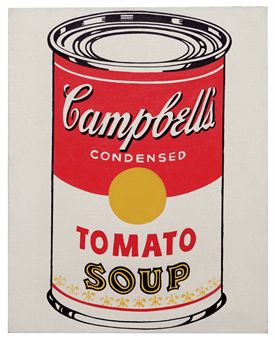
Andy Warhol (1962)
• I was once asked by a young artist whether he could hope to make any money out of his work if he continued in his particular style of painting. He happened to be a man of considerable talent and had great enthusiasm in his work. But I knew there was no public enthusiasm for such work. I remembered he had told me that before he got really into art he had made a living by designing labels for cans, tomato cans and the like. I advised him to make tomato-can labels and live well that he might be free to paint as he liked.
[Footnote: Henri died when Andrew Warhola was not yet one year old.]
__________________________________
• All things change according to the state we are in. Nothing is fixed. I lived once in the top of a house, in a little room, in Paris. I was a student. My place was a romance. It was a mansard room and it had a small square window that looked out over housetops, pink chimney pots. I could see l’Institut, the Pantheon and the Tour Saint Jacques. The tiles of the floor were red and some of them were broken and got out of place. There was a little stove, a wash basin, a pitcher, piles of my studies… My bed was a cot. It was a wonderful place. I cooked two meals and ate dinner outside. I used to keep the camembert out of the window on the mansard roof between meals, and I made fine coffee, and made much of eggs and macaroni. I studied and thought, made compositions, wrote letters home full of hope of some day being an artist.
It was wonderful. But days came when hopes looked black and my art student’s paradise was turned into a dirty little room with broken tiles, ashes fell from the stove, it was all hopelessly poor, I was tired of camembert and eggs and macaroni, and there wasn’t a shade of significance in those delicate little chimney pots, or the Pantheon, the Institut or even the Tour Saint Jacques.
• Today must not be a souvenir of yesterday, and so the struggle is everlasting. Who am I today? What do I see today? How shall I use what I know, and how shall I avoid being victim of what I know? Life is not repetition.
• The best art the world has ever had is but the impress left by men who have thought less of making great art than of living full and completely with all their faculties in the enjoyment of full play. From these the result is inevitable.
• Go in and find out. The future is in your hands.
__________________________________
Henri would have me forget about originality and popularity — satisfaction lies in seeing and expressing. “The true artist regards his work as a means of talking with men, of saying his say to himself and to others.” Yes, that is exactly what I aspire to do.