


As I mentioned in an earlier post, David Walton was an English professor at Carnegie-Mellon University in the early 1970s while I was a student there. His creative writing class introduced me to works such as Slaughterhouse Five, Catch-22, Trout Fishing in America and One Flew Over the Cuckoo’s Nest. Once I had Slaughterhouse Five in my head, all I wanted to do was to write like Vonnegut — start my sentences with “So” and end them with “it goes” and stuff the middles with the resigned sound of nothing. But I digress.
I treasured that class. It seemed to embody everything college was supposed to be about, as depicted in college admission brochures. I remember several beautiful fall afternoons in Pittsburgh when our class gathered on the lawn next to the Fine Arts building, the eighteen or so of us sitting in a circle and sharing our thoughts about our readings and writings. And I remember Walton’s habit of tapping the filter end of his cigarette on his classroom desk for a minute or so, to pack down the tobacco before he lit up. As I was also a smoker at the time, I copied his habit. I was young, impressionable and looking for impressions to try on for size.
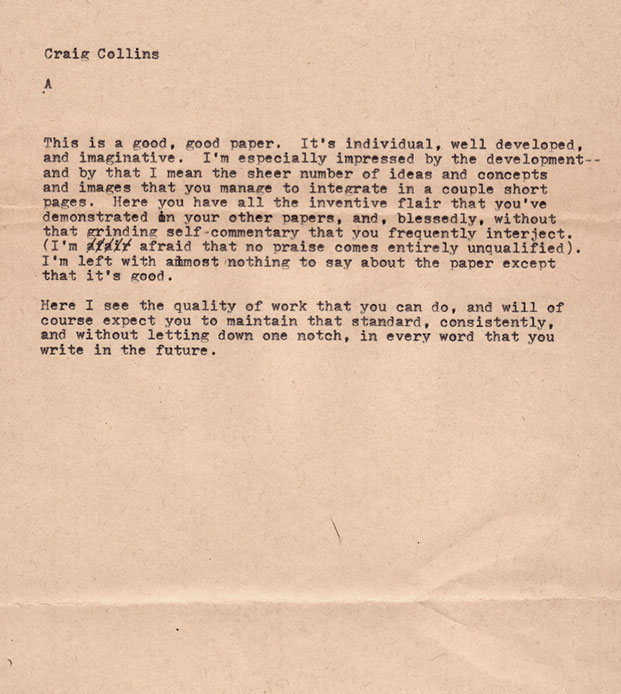 I didn’t ace his class but it didn’t matter. I pretty much wrote what I pleased. I took some risks, and I was also complacent and self-absorbed, befitting a seventeen-year-old. Befitting his role, Walton gave me personal and detailed feedback, some positive and some not. His complaint about my frequent “grinding self-commentary” would not discourage me from signing up for his advanced writing class three years later. I took it as a minor point-of-pride that I was the only engineering student in his class. (I guess we were supposed to prefer being in the lab or doing some nerdy thing with slide-rules.)
David Walton was the only professor that I sort-of-wished I could have had a friendship with as an adult. But that is the stuff of fantasy, as he knew little about me except for my writing, and I knew next-to-nothing about him, save for his attitude, his mannerisms and his critiques, typewritten on unbleached paper, which I have kept to this day.
Some weeks ago, I had the idea of contacting David Walton and inviting him to visit my blog, to show him how grown-up and all I have become over the past forty years, and how the grinding self-commentary he so lamented persists to this day. (Yep, that shows him!) But then I had a rare moment of other-thinking: how could I ask David Walton to read more of my writings without having read a single word of what he has written?
To resolve this inequity, I did a search and found that David Walton has not only won the Flannery O’Connor Award for Short Fiction but has published three works, the latest being Ride in 2003. So I bought a paperback copy of Ride. And I have just finished it.
• • • • •
This is where the trouble starts. I figured I would read his book, share my impressions in this blog, and then contact David Walton and refer him to this post, where he would not only read my tribute to his novel but discover here the more than three-hundred splendid examples of how I write these days. He would be thoroughly entertained, I would be duly flattered, and who knows, maybe it would lead to us having a beer together in Pittsburgh someday.
But questions arose. First, how could I write an objective review of his novel if I had read it mainly to gain favor with him? But let’s say I managed to be critical. How could I ask him to visit my site, only for him to be greeted by a bad review, after which he is expected to read and lavish his comments on my blog? And what qualifies me to review his book anyway? I am no English professor. I never tried to write a book. David Walton has written books, short stories and reviews. Who am I to tell him anything about character development or the difference between a story and a plot? Whatever I had to say, I would only be putting myself in the position of having him review the soundness of my review.
As a result, I decided I am not going to write a review.* This does not mean, however, that I no longer care what David Walton thinks about the blog. I still intend to contact him and ask him to check it out, including this post. He probably will not be entertained, and I will more likely be embarassed than flattered, but who knows, maybe it will lead to us having a beer together and exchanging a few pleasantries in Pittsburgh (or Asheville) someday.
_________

