


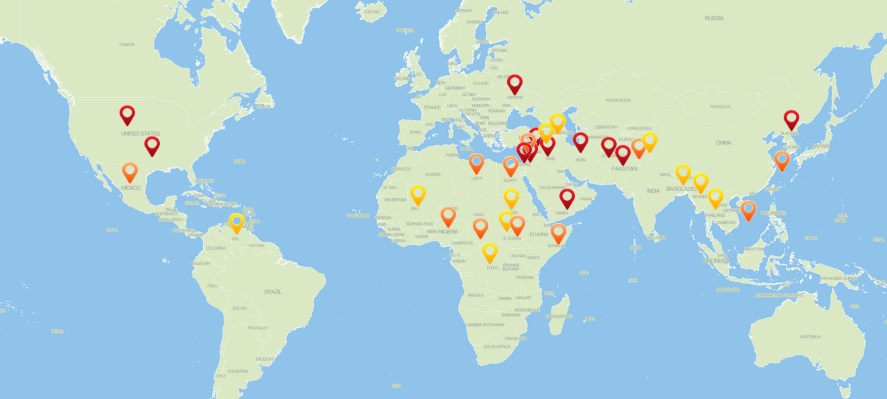
 This is the 100th anniversary of the outbreak of World War I. There has been an ongoing fascination with this war, how it was caused, whether it could have been avoided, and the trappings of the war itself. As one contributor to the U. S. Militaria Forum writes:
On one hand you have mounted troops, horse drawn artillery, lancers and communications by pigeon and signal flag. On the other you have the intoduction of machine guns, aircraft, chemical warfare, and tanks.
Also, I think the uniforms, especially the wool ones with bullion SSI’s are really compelling and artistic in their own way.
Not to mention small, unartistic details like the sixteen million or so deaths from that war.
Some still ask, “How could people do this to each other?” as if there were not thousands of years of human behavior serving as precedent, as if borders on a map have ever been able to contain or restrain human conflict. Was Hobbes (1660) so wrong about our nature?
From [man’s] equality of ability ariseth equality of hope in the attaining of our ends. And therefore if any two men desire the same thing, which nevertheless they cannot both enjoy, they become enemies; and in the way to their end (which is principally their own conservation, and sometimes their delectation only) endeavour to destroy or subdue one another.
The map at the top of this post is called The Global Conflict Tracker, and is published by the Council on Foreign Relations (CFR), a foreign-policy think-tank founded at the close of World War I. I counted thirty-four wars and conflicts on this map — and those are only the ones listed as “conflict prevention priorities” by CFR’s Center for Preventive Action.
The Center for Preventive Action says its mission is “to help prevent, defuse, or resolve deadly conflicts around the world and to expand the body of knowledge on conflict prevention.” I wonder, looking at the map and considering human history, how many conflicts this think-tank thinks it is going to prevent.


Best book of the year on this (from a European perspective at any rate) is “The Sleepwalkers”. Christopher Clark. Massively researched all the way back to the early years of the century, but amazingly, readable. Answers the questions: was it inevitable? Who or what country if any really caused it? Could it have been avoided? How could anyone have wanted it (some did)?
Angela Merkel had Clarke visit here and her Foreign Minister in Berlin when the Crimea/Ukraine crisis erupted. Doubt ANY other leaders would have read it.
There certainly is a huge amount of conflict in the world, and thanks to the news media and the internet, we can see and hear more than we would wish to hear in real time. Every human life is valuable, but it’s amazing to me that CNN emailed me breaking news updates on a single Israeli officer who was captured, no wait, he was killed, in the current Gaza fighting. There are reasons for that magnified attention, I know. But judging from the news, it certainly seems that violence is ubiquitous, and possibly growing. But is it?
One of the Kindle books I keep coming back to after many book interruptions is “The Better Angels of Our Nature: Why Violence Has Declined” by Steven Pinker. Relative to population, all forms of violence have declined, and we live in what may be the most peaceful time in human history (and likely pre-history). Plane crashes are newsworthy because they are scary, but mainly because they are so rare. Car crash deaths are awful too, and sadly common, but few are reported beyond local obituary pages. Violence is something like this. In addition to our greater connectedness, violence (from violent crime through war) has become rare enough to be newsworthy. Violence in all forms has actually declined over long periods of time, and in most places in the world, non-violence is the rule. Civilization has done this for us. As Pinker says in his intro, “No matter how small the percentage of violent deaths may be, in absolute numbers there will always be enough of them to fill the evening news, so people’s impressions of violence will be disconnected from the actual proportions.”
Of course with the coming ability to “push” genetic modifications into natural populations, we may be just a few molecular biology experiments away from death for everyone. This adds to the garden variety weapons of mass destruction that are available to small groups and even individuals with violent intentions. So we aren’t out of the woods yet. But for the moment, I am trying to enjoy this period of “default non-violence” for however long it may last, without turning off my internet and cable subscriptions.