Category Archives: Finance

The Republican-controlled U.S. House of Representatives voted last week to repeal the federal estate tax, a 40% levy applied to individual estates of $5.4 million and more.  The estate tax as it now stands is projected to bring in about $27 billion annually — about seven-tenths of one percent of our $3.9 trillion federal budget.

For years, Republicans have chosen to call this revenue source a Death Tax.  Their aim is to stigmatize the estate tax by casting it as a heartless and oppressive government levy on life events that are the province of God, not man.  And when that doesn’t fly, Republicans resort to the argument that the estate tax hurts everyday mom-and-pop concerns who only want their sons and daughters to carry on the family pizza business — or more likely, that 20,000-acre ranch with mineral extraction rights — without having to pay an onerous tax that forces the sale or liquidation of the operation.

You may be surprised to learn that I also oppose the estate tax as it stands.  I understand the justification for progressive income taxes, sales taxes and property taxes, balanced so that the burden of financing government is shared among people of all income levels.  But a tax on wealth alone seems arbitrary to me — more like a taking than a tax.

To illustrate, let’s pretend that Alice and Bob, whiz-bangs in the world of high-finance, each accumulated $10 million during their careers.  Upon her retirement, Alice chose to spend her millions on luxury consumables such as penthouse rents, country club dues, casino trips and expensive cars, and she died practically broke with no heirs.  Bob, on the other hand, father of three, saved and invested his gains so that his $10 million account doubled to $20.4 million by the time he died several years later.  In the end, Alice basically paid sales tax rates (if that) on her $10 million of spending — if we assume her sales tax rate was 7.5%, she would have paid about $750,000 in taxes.  But Bob’s executor had to pay the IRS $6 million (40% of $15 million, the portion of the estate above $5.4 million). The bottom line is that Bob, by having chosen not to spend his wealth, paid $6 million in taxes vs. $750,000 in taxes (at most) that Alice paid to live her chosen lifestyle.

So Republicans don’t need to spin mom-and-pop business fables to argue that estate taxation — and wealth taxation in general — has a shaky foundation.  It is unclear to me what public good is served by taxing a dollar saved at a higher rate than a dollar spent.  This is the basic illogic of the estate tax that, curiously, Republicans never seem to invoke.

Wealth differs from income in a fundamental way: for any given level of income, wealth results from choices and circumstances that arise after the money comes in.  Sometimes, people with low incomes have been able to accumulate significant wealth by showing extraordinary restraint on their spending.  Should the wealth of those persons be taxed the same as other wealth, with a blind eye to how it was accumulated?  If our answer is no, then wealth taxes should be rejected per se and we should rely on income taxes instead.

As a democracy, we can pass any (constitutional) laws we deem fit, including estate taxes and other types of wealth taxes.  But the estate tax still feels like a taking, an undemocratic relic of a long-ago time when wealthy landowners were forced to pay tribute to the king — not because they loved the king more but because that is where the money was.

We shouldn’t soak the wealthy just because they are where the money is.  While doing so may satisfy our passions, we should remember: the rich are people too.  (That’s right, you read that here.)  Our principles of what is just and what is not should apply to everyone, regardless of status, otherwise they are not very strong principles.

Wealth is money waiting to be spent — when it is spent, then it can be taxed.  Our society can afford to wait for it to be spent, as all wealth eventually is, and we can extract our tax on it at that time.  We will not suffer by waiting.

• • • •

Ideally, a person’s choice whether to spend one’s wealth, save it, or give it away should be tax-neutral.  On this basis, I could argue that Republicans should not abolish the estate tax entirely but instead treat an estate as if it had been spent during the decedent’s lifetime, taxing that amount at a sales tax rate (under 10%).  This would put Alice and Bob on more equal footing.  Few could claim that an estate sales tax would be unfair or confiscatory.

If former U.S. Representative Barney Frank were reading this blog (and that would be incredible), he would quickly raise an objection.  Barney would first point out that most large estates probably have substantial untaxed capital gains.  Then he would argue, if you agree to treat a decedent’s estate as if all of it had been spent in his last year of life, then you must also pretend that the decedent had to sell his stocks, bonds and property before he could spend the proceeds.  Since selling stocks and other property can create taxable capital gains, the decedent’s estate should have to pay tax on those gains, in addition to that 10% sales tax proposed here.

I hate it when I have to do Barney Frank’s heavy mental lifting for him, and I hate it worse when I think he may be right.  So how about we agree to do estate tax light: 10% on the whole estate (after, say, the first $500,000) and another 15% on that part of the estate that represents untaxed capital gains.  This is still a lot less than 40%, isn’t it?  And it does have a certain logic to it, yes?  Barney?  Are you still there?  Damn, lost him already.

• • • •

Such considerations notwithstanding, I still think we can dispense with estate taxes, even the light version, while achieving tax fairness and maintaining revenue.  I proposed this idea almost four years ago, in my post Making Wall Street Pay.   In short, I would raise the Securities & Exchange Commission (SEC) fee on stock transactions from its current $18.40 per million dollars (less than two-thousandths of one percent!) to something closer to a sales tax, let’s say a mere one-tenth of one percent.  An SEC fee of 0ne-tenth of one percent applied to the $25 trillion worth of stock traded annually on the New York Stock Exchange would bring in $25 billion a year — replacing the estate tax almost dollar for dollar, and doing so without having to wait for anyone rich to die.  This is also one of the few ways I know to enact a progressive sales tax, one where the burden is felt more by the well-to-do than by the working class.

So, Republicans, you don’t like death taxes?  No problem!  You can just pay them while you’re alive.  That would be fine with us.

Be the next to comment | Read other posts in Finance

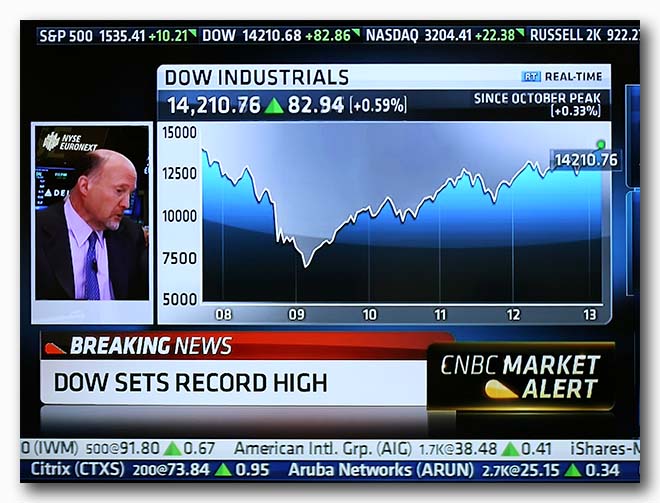
As the panting and sweaty reporters on the cable business channel CNBC reported today, the Dow Jones Industrial Index has reached a new peak of ecstasy, one that it has never felt in its 116-year lifetime.  Stimulated by swelling prices of stocks such as Cisco Systems  (up 2.19%) and Boeing (up 2.06%), Jones ascended to a shuddering high of 14286.37 at 11:16 am, and was able to achieve a second, albeit slightly less intense, peak of 14285.16 only 2 hours later at 1:36 pm, before sighing and falling back to close the hot-and-heavy hours-long session at a level of 14253.77.

Wall Street traders watched Jones’ crescendo with voyeuristic pleasure.  As the decisive moment neared, the floor of the New York Stock Exchange filled with frenzied shouts of “My shares are going higher!  Higher!” and “Oh God! Buy now! Buy now!”  After the peak was reached, smokers poured onto the sidewalk to have a satisfied puff and bask in the glow.

Here are some reactions from other sources:

Jeffrey Kleintop, a market strategist at LPL Financial, suggested to Bloomberg News that “a big part of the rally to all-time highs has been powered by the Fed’s very aggressive stimulus.”  David Herman of The Globe and Mail added, “It worked, but what happens when the Fed withdraws the stimulus?”

The New York Times reported that Richard Bernstein, CEO of money management firm Richard Bernstein Advisors, is confused about why more investors are not buying stocks. “I just don’t understand why people don’t want to play,” he said.

MarketWatch.com published an article titled, “Dow’s Back on Top — But Are You?

HeraldExtra.com published an article titled, “Dow Surges to Record … and Keeps Going

Finally, according to Forbes.com, “Seth Setrakian, co-head of … equity trading at First New York Securities, thinks a reversal is coming in the short-term.  The rally is ‘getting tired,’ he says, and he’s positioned accordingly.”

Some say that the index is not the best way to measure the stock market’s ups and downs.  We remind them that there are four other fingers one may employ in the endeavor.

[Correction:  In an earlier version of this story, we stated that we overheard a stock trader whispering to a hedge fund manager, “I like your stocks.  Are you long?”  In stock-market parlance, “being long” means to hold stocks as a long-term investment.  When the couple returned to the floor of the exchange after lunch, we learned that the trader had not in fact said the word “stock” but another similar word.  We apologize for the error.]

Be the first to comment | Read other posts in Finance, Humour
The Trend

The news media has been giving a lot of play to the recent highs in the U.S. stock market.  With all due credit to Burton Malkiel and his book “A Random Walk Down Wall Street” (which I just finished), I would like to put some of the hype into perspective.

While I am not a financial expert, I am determined to manage our own retirement savings because I am unconvinced that the “experts” know much more than I do.  I have arrived at a pretty simple conclusion about investing — I call it “The Trend.”  It is hardly original.

The S&P 500 Index represents the total stock market value of the largest 500 companies in the U.S.  In the chart above, I show how the value of this index has risen over the years 1950 to 2012.  Note that the vertical scale is an “equal-percentage” scale — values double from one tick mark to the next.  Plotting the numbers this way lets me draw a straight line through the price data and calculate how much the index increases, on average, from one year to the next.  That number is 7.1% per year.  This is “The Trend.”

[Note: the average annual return on an investment in the S&P 500 index would be more than 7.1% per year, because many of those companies pay dividends.  On the other hand, inflation erodes the value of an investment by about the same amount.]

In a nutshell, The Trend reflects the long-term profit-making ability of U.S. corporations.  As a company’s profits rise, so does the price of a share of its stock — generally.  But there are long periods of time when stock prices are lower than usual and equally long periods when they are higher.  (In the chart, I shaded those areas in red and green, respectively.)  For example, the S&P 500 Index was higher than its long-term trend for 15 years, from 1955 to 1970.  The index followed the trend line for a few years, then it fell and remained below the trend for another 15 years.  Rinse and repeat for a decade or two.

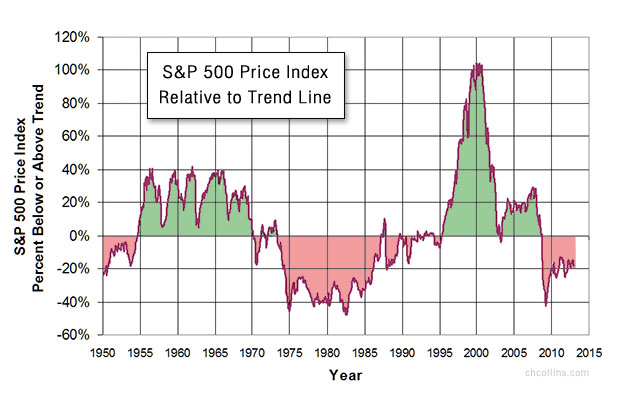
The second chart shows the same data, except plotted in terms of the percentage that the index is above or below The Trend.  As you see, it is not unusual for stock prices to deviate 20% to 40% from than the long-term trend.  Sometimes 50%.  Even 100%.

Plotted this way, the dot-com bubble of the late 1990s clearly stands out — at its peak, stock prices were nearly double what one would expect based on The Trend.  Such levels were not sustainable, and the index returned to the trend line within a few years.

Where do we stand since the Great Recession and the recent recovery?  The current price of the S&P 500 Index is 1495.  If we were on The Trend, the index would be 1725, about 15% higher than where we are now.  Good time to buy stocks, yes?  Well, not so fast.

Let’s say you invested in an index mutual fund 40 years ago, at the end of January 1973.  The price of the S&P 500 index at that time was 118 — right on the long-term trend line.   The index would return to this price level many times, doing so for the final time in September 1982, over nine years later.  If you had been forced to sell your investment at that point, you would have made nothing on your money for nine years (other than the dividends minus inflation).  The Trend does not promise quick payoffs.

However, if you had held onto that 1973 investment for 40 years and sold it this month, you would have made about 6.6% per year, before dividends and inflation.

In August 2000, the S&P 500 Index closed at a price of 1485.  If you bought an index fund that month, when the price was 103% over The Trend, you would be just about even today, twelve years later.  Some people probably did just that.

One might conclude that a person should never invest in the stock market unless the price is below the trend line.  That too would be a mistake.  In the summer of 1956, the index was running 30-40% above The Trend.  If you had decided to wait for the stock market to fall below The Trend before investing, you would have waited until February 1970.  Stocks returned about 4.2% per year, on average, during that 14-year period.  While you might have made just as much money from treasury bonds in that timeframe, the point is that you would not have lost money either.

Here is the best way, in my opinion, to view The Trend.  Invest in the market with the idea that you are going to hold onto your shares as long as you can — 30, 40, 50 years or more.  (It is not just marketing when mutual fund companies tell you to invest for the long term.)  Remember that stock prices go up and go down but will eventually return to the trend line. If you buy shares when the price is below The Trend, you could think of it as a discount — but you will only get the discount if you sell the shares when the price is above The Trend.

The stock market is unpredictable.  No one can say when it will rise or fall or by how much or how long it will stay there.  If someone tells you otherwise, just pretend you didn’t hear.  But it is a characteristic of the market that the index is usually within 40% of The Trend (look again at the second chart).  If the index is more than 40% above The Trend, it may signal a bubble — probably a good time to sell (or at least not buy).  Similarly, if the index is more than 40% below The Trend, it may be a good time to buy (or at least not sell).

Summary: Invest in index funds, as much as your personal situation and comfort allows, then hold onto the shares the rest of your life.  Sell only when you must, preferably when the price is above The Trend.

Be the first to comment | Read other posts in Finance