Category Archives: Asked & Answered

Asked and Answered 14.0

If you’re in love with Wordle — as so many of us are ♥ ♥ ♥ ! — wouldn’t it be wise to learn everything you can about your object of desire before you discover something about them that causes you to walk out on the relationship in anger and disappointment?  Of course you would.  That’s why I am here to offer some Wordle relationship advice before it gets to that point… that is, the crying point 💧💧💧.

We all hate falling into those Wordle rabbit holes like SLATE-SPATE-STATE-SKATE or PAINT-SAINT-TAINT-FAINT, games that could end in six guesses just as easily as three.  The games that make you want to dive off a barren, rocky cliff into a cold, turbulent sea.  Well, perhaps I exaggerate.  There could be a patch of grass on that cliff.

Don’t worry, what I’m about to reveal is not going to spoil your Wordle fun, but it might be helpful for you to know something about the set of 2,300 words that are Wordle solutions.  The solution set has been available since Wordle was launched, and some players feel that having the solution set at hand is part and parcel of playing the game.  While I disagree, there are times I would appreciate knowing whether I am on Wordle’s wavelength when considering my next guess.

So, I downloaded the Wordle solution set — without looking at the list of words — and then created a spreadsheet that allowed me to ask and answer five general questions about the nature of the words that are Wordle solutions.  (If you feel that even general knowledge about the solution set would ruin the game for you, then stop reading now.)

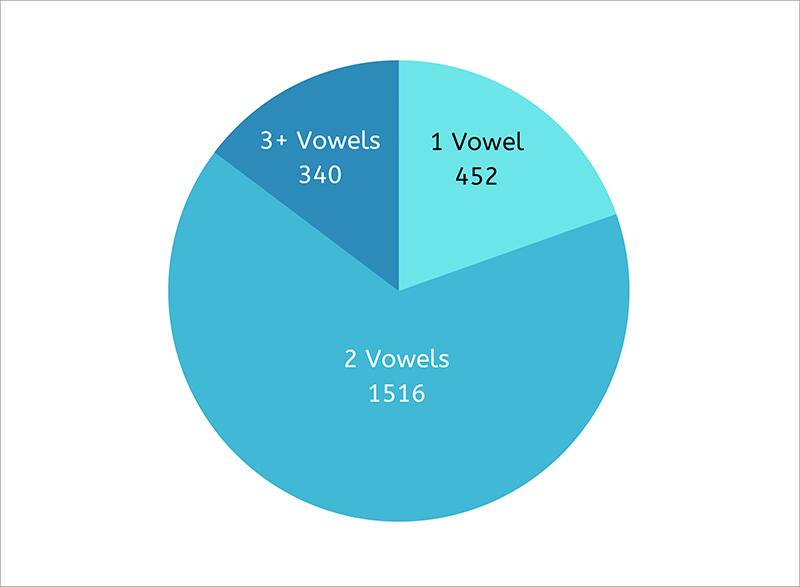
My first question was, how many vowels does the typical Wordle word have?  The answer (below) is that about two-thirds of the solutions have two vowels.  Of the remaining third, the solution is more likely to contain a single vowel than three vowels:

FIGURE 1: NUMBER OF VOWELS IN SOLUTION

Pie Chart - the number of vowels in Wordle solutions

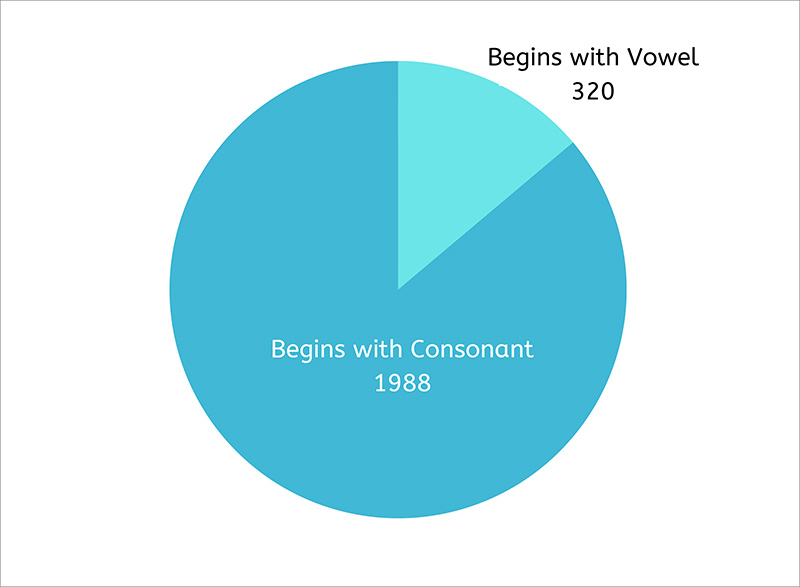
Next, I wanted to know the likelihood that a given Wordle solution starts with a vowel, which I always find annoying.  This turns out to be a bit less than one out of seven.  So, once a week we should expect IRATE, ETHER, or ALERT?  As Charlie Brown would say, AAUGH!

FIGURE 2: FIRST LETTER OF SOLUTION

Pie Chart - the starting letter in Wordle solutions

Third, it certainly feels like a substantial number of Wordle words end in E, more so than other vowels and consonants.  I didn’t tally up the endings letter-by-letter, but I did find that about a third of the solutions end in E or Y, with E being a bit more likely:

FIGURE 3: FINAL LETTER OF SOLUTION

Pie Chart - the ending letter in Wordle solutions

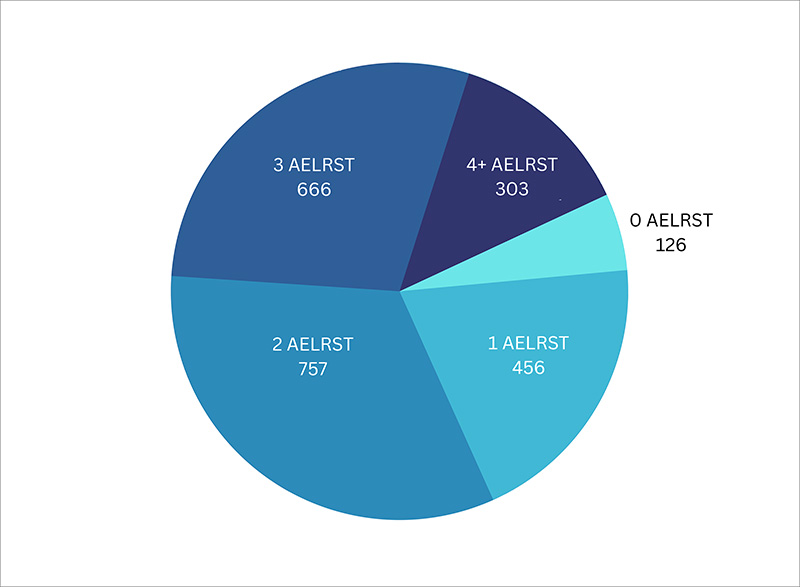
Which brings us to the letter frequency of the Wordle solution set.  I was curious to know how often the two most common vowels AE and the four most common consonants LRST appear in Wordle words.  I found that only 5% of the solutions do not contain any of the letters AELRST.  One-third of Wordle solutions contain exactly two AELRST letters, while three-quarters of the solutions contain two, three, four or more.  This means that your Wordle blind date is likely to be bland, letter-wise.  Even STALE.  Or bore you to TEARS.

FIGURE 4: SOLUTIONS CONTAINING LETTERS AELRST

Pie Chart - the number of AELRST letters in Wordle solutions

Lastly, how likely is it that your latest Wordle crush is from a Slavic-European country?  By that I mean, how many of the solutions contain one or more of the rare (according to Words with Friends) letters JKQVXZ?   Surprisingly, the answer is about one in five:

FIGURE 5: SOLUTIONS CONTAINING LETTERS JKQVXZ

Pie Chart - the number of JKQVXZ letters in Wordle solutions

So now you know a little more about the game you’ve been spending so much time with and often grumbling about.  Maybe this will help you find the day’s solution more quickly and put a little more love ♥ ♥ ♥ into your love-hate relationship with Wordle.

_______

Update: One reader commented that her strategy is to start with consonants that did not appear in the previous day’s solution.  (Her rules were actually much more complicated, but too hard for me to analyze.)  So I looked at the solution set in order of publication date to see whether use-fresh-consonants is in fact a good strategy.  Here is the data:

Consonants Found in
Previous Day’s Puzzle
Number of
Puzzles
Percent of
Puzzles
0 1112 48%
1 869 38%
2 289 12%
3 43   2%
4 3 ~0%

Almost half the time, there are no shared consonants between the current solution and the previous day’s solution.  Furthermore, it is rare to have three or four shared consonants. So the odds seem to be definitely in your favor if you re-use zero or maybe one consonant from the previous day.

Read 4 comments and add yours | Read other posts in Asked & Answered

Asked & Answered: 13

When I became a Damn Yankee [1] back in the aughts, one of the first things I noticed was the outsize presence of Christian radio here, both AM and FM, and both music and talk.  There are more religious radio stations in the Asheville area (15 within a 30-mile radius) than NPR stations in the entire state of South Carolina (nine) or Tennessee (also nine).

I soon found an easy way to locate (and bypass) Christian stations — just set the car radio to “scan” and listen for giveaway words like righteous, almighty, rejoice, praise, miracle, glory and power, along with the instant-bingos Jesus, Savior and God.  At least one of the above is sure to be heard in any six-second fragment of any Christian radio broadcast here.

The abundance of God’s Radio-Spoken Word in these parts led me to wonder: are there so many religious radio stations here because there is so much sin to stamp out, or because there is so much righteousness to self-congratulate?  Is there any correlation at all between the reach of religious radio in a region and the size of its cesspool of sin?

Before we get to the answer (after all, this is an Asked & Answered article), let’s talk about the possible types of correlation between one thing and another [see illustrations below].

As shown in the first diagram, direct correlation is when one factor increases along with the other.  If sin and religious radio were directly correlated, then one would tend to find more sin in areas that have more religious radio stations.  There would be several ways to explain such a correlation:

(a) Religious broadcasters might be drawn to set up shop in high-sin communities, because that is where The Word is needed the most (cf. the Willie Sutton Rule).

(b) Or it might be that sinners hear the Sunday sermons, feel the full power of the Lord’s forgiveness, and then figure, “Hey, the slate is clean, this gives me a whole new week of sinning to do.”

(c) Or maybe religious broadcasts actually encourage sin!  But that could only be true if they made listeners believe things like vaccinations are deadly, children need to be “delivered” from same-sex households, and if you convert to Islam you may beat your wife.  Since these are all unthinkable, this hypothesis may be a bit shaky.

This brings us to inverse correlation (second diagram) where as one factor rises, the other tends to fall.  If that were the case here, then we could say: the more religious stations, the fewer the citations.  What might explain such a catchy correlation?

(a) Perhaps religious radio broadcasts reach into the hearts of hardened men and subdue their wayward impulses.  Listeners might say to themselves, “Nah, I don’t need to rob that bank today.  It’s Sunday, the Lord’s day, and they’re closed.”

(b) Or it could be that religious radio strengthens the wills of the righteous, who then elect law-and-order politicians, who then pass punitive laws, which mandate long prison terms for sinners, who decide to flee to other states.  Could be that.

But it is also possible there is no correlation at all (third diagram) between the number of religious radio stations and the amount of sinning in a given area.  How would one know?  Asked — and now answered.

METHODOLOGY

I started by selecting fifteen cities at random from five US regions (Northeast, Southeast, Central, Texas-Oklahoma, California) and three population ranges (Large = 3-6 million, Medium = 1-2 million, and Small = 0.5-1.0 million).  The population figures for each area (see table below) were based on the estimated number of residents within a 30-mile radius of city center.  [Sources:  Free Map Tools and MCDC (Missouri Census Data Center).]

Now, I needed a proxy for the amount of sin in a given area, since the true definition of sin is known only to God.  (As we will all find out on Judgment Day, won’t we!)  For my proxy I chose the crimes homicide, robbery and assault — purposely ignoring property crime — and then totaled the respective rates for each city, with each crime given equal weighting.  [My main source here was the FBI although all my other sources cited FBI statistics.]

Finally, I counted the number of religious radio stations, AM and FM, within 30 miles of the center of each city.  [Source: radio-locator.com.]  I included stations whose format was listed as religious, gospel, Christian contemporary or Spanish Christian (found primarily in California and Texas).  The bar chart below shows the number of religious radio stations (and the percentage of the total they represent) for each metro area, grouped by region.

RESULTS AND COMMENTARY

What surprised me about the radio station data was that most of the selected metro areas had about the same number (12.5 ± 1.3) of religious stations, regardless of population or region.  Cities with significantly more religious stations were Austin (22), Kansas City (23) and Houston (31).  Spanish Christian was by far the dominant religious format in Houston but represented only a handful of the religious stations in Austin and Kansas City.

The percentage of religious-format stations in a given metro area was typically 18-22%, again irrespective of population or region.  The notable outliers were Kansas City (40%), Houston (39%), Austin (33%) and Asheville (33%).  By comparison, religious radio in Chicago (13%) was a bit light, at least on a percentage basis.

Let’s now consider the original question — does religious radio have sin-fighting power?  To get a visual sense of the correlation, if any, I plotted each city’s rate of violent crime (selected crimes per million residents) vs. the prevalence of religious radio (stations per million residents) within 30 miles of city center.  I then calculated the best-fit curve [2] through these data points:

Hallelujah! as Leonard Cohen might say if he were alive today and subscribed to this blog.  It looks like the more religious radio stations per capita, the lower the crime rate, right?  Go tell it on the mountain, people — mount a transmitter on every steeple!

Or maybe not.  On closer inspection, this graph reveals a somewhat different correlation: the large cities are all on the left side of the graph, the medium cities are all in the middle, and the small cities skew to the right.  It is almost as if the rate of violent crime and the concentration of religious radio stations both depend on population density. 

In fact, we already noted that the raw number of religious stations within a 30-mile radius of a city does not depend on its population.  (Perhaps it has more to do with the available frequencies on the radio dial.)  That being the case, small cities will naturally tend to have the greatest concentration of religious radio stations, when expressed in terms of stations per million residents.  So this graph, in many ways, says nothing at all!  Or more precisely, while there are differences in crime rates, there is not a strong correlation between crime and religious radio, at least for this sample of cities.

To be able to say the same thing mathematically, I decided to analyze this data set with a statistical tool called multiple linear regression (MLR).  This tool helps identify which factors are strongly correlated and which are not, so that one can select a model that best fits the data.  I evaluated many models with various combinations and powers of the factors, but none of them fit the data better than the following two-factor model:

C = 64.5 + 1.22 P 2 – 1.04 S

where C is the crime rate (crimes per year per million people), P is the local population (millions) and S is the local concentration of religious radio (stations per million people).  This model suggests that crime rises with the square of the population but falls as the concentration of religious radio increases.

To illustrate the workings of this model, let’s pretend that Chicago doubled the number of religious radio stations in the area, from 12 to 24.  (This means S for Chicago would rise from 2.0 to 4.0.)  The model predicts that this would lead to a 2-point drop in the rate of violent crime, or twelve people a year who are not murdered, robbed or assaulted.  If you lived in Chicago, wouldn’t you want to be one of those twelve?

But before we start building a bunch of radio towers, we need to check the goodness-of-fit of the model to see what its predictions are worth.  According to the MLR analysis, the correlation coefficient for this model is only 0.5 (1.0 would be a perfect fit).  This means there is a weak-to-moderate correlation between the crime rate and the factors proposed to explain it.

Finally, the MLR analysis reports a 91% chance that P is a significant variable, but only a 69% chance that S is significant.  In other words, the religious radio effect is probably just a lot of noise, as you likely suspected before you even read this article.

I hope you at least learned something today that you wouldn’t normally hear on a Sunday.  Now, go thy way, and from henceforth sin no more.

________________

[1]  I learned the local definition of Damn Yankee — a Northener who moves to the South and stays there — when I was only half-jokingly called one in a 2007 job interview here.
[2]  Here I need to insert a note about the crime rate data for Scranton, PA, the town where Joe Biden lived until he was 10.  Whereas the other crime rates in this study were based on the most recently available data (2018 and 2019), the 2018 crime rates in Scranton took an incredible leap — I figured that this must reflect some kind of change in reporting methods or coverage area.  So, even though my graph shows 2018-2019 crime data for Scranton, I used an average of Scranton’s 2016 and 2017 violent crime rates for the purpose of calculating the best-fit curve.
Be the next to comment | Read other posts in Asked & Answered

Asked and Answered 3.4

Hello, and here we are again.  I thought I was done with this series on hanging pictures, but it seems physics never dies — it just gets more complicated.

Some commenters on my previous articles (Why Frames Tilt Forward, The “Hang It with Two Hooks” Calculator, and The Physics of Hanging Pictures) asked how they could hang items on wall studs, if the studs are off-center from the desired hanging spot.  This seemed to be a rather specialized topic, and beyond the scope of my series, so I deferred until now.  But a recent commenter rekindled my interest and finally inspired me to take a look.

Before I proceed, however, I must mention that I’m not the first to address this problem.  The number-one result (as of now) I found in searches for “hang item on off-center studs” is this article on instructables.com by an author named MolecularD.  The author describes the principles involved and offers a set of equations (minus the math) that are meant to show the reader where to place the wall hooks.  Unfortunately, some readers commented that they did not get the desired result when they followed the author’s instructions.

The solution provided in the inscrutables.com article is such a complicated equation that there is no way for me to verify it without essentially solving the problem myself.  Which is what I will do now, taking a somewhat simpler, more intuitive approach.

The four consecutive views in Figure 1 demonstrate the concept:

FIGURE 1: THE CONCEPT

Concept of Hanging a Frame on Two Studs

View (A) depicts a frame hanging on a wall, centered at our desired position (dotted line), using a wire on a single hook.  Because of the symmetry of the system, there is no tendency for the frame to rotate one way or the other.  Ignore for now the fact that the wire extends above the top of the frame.

View (B) shows the studs in the wall behind the frame (we use a stud-finder to spot them).  The two studs are different distances from the center of the frame.  We drive a nail into the center of each stud, just touching the underside of the wire.  This does not cause the frame to rotate.

In View (C), we attach a piece of wire (blue) to the original wire, from the point where the first nail touches the wire to where the second nail touches the wire, without any slack.  The load is now shared between the central hook and the nails in the studs.  But this still does not cause the frame to rotate.

In View (D), we snip away the original wire where it touched the nails, leaving our new wire in place.  The nails in the studs now assume all the load, with the higher nail bearing more than the lower.  Still the frame does not rotate, so we have found the solution.

Obviously, I don’t expect readers to repeat these steps to hang their pictures — this was just a demonstration of concept.  Instead I will offer a calculator, with instructions for taking measurements, placing the hooks and cutting the wire, to help the reader achieve the final result.

That is, if you really insist on using studs.  Personally, I think it would be easier in most cases to forget about the studs and use the Hang-It-With-Two-Hooks calculator that I presented in my earlier article.  You would fasten the hooks to the wall with toggle bolts, which can hold a significant amount of weight when paired with the appropriate hooks.  (This video shows how to install them.)  But in the end, it’s your call.

The Setup

Oh, you’re still here!  This must mean that you really, really want to use two studs to hang your item.  Okay then, onto the intricate details.  Please consult Figure 2 (below) to get a sense of the important lengths and measures:

FIGURE 2: USING TWO STUDS TO HANG A PICTURE
Diagram of Frame Hung on Two Studs

Start by measuring the height H and the weight of the item you want to hang.  Then mark the spot 0n the wall corresponding to the top-center of the item.  All other measurements will refer to this point.

Next, use your stud-finder to measure XA, the distance from top-center to the center of the closest stud, and XB, the distance from top-center to the center of the next-closest stud.

Now inspect your hanging hardware.  You want to (ideally) hide all your hardware behind the item you are hanging, which means the higher hook (A) should not show.  Therefore, you should choose a value for ZA, the distance from the top of the frame to the bottom of Hook A, that is slightly greater than the length of the hook.

While you are it, measure the length (D) of the D-rings attached to the item.  If you plan to attach the wire directly to the item, then this length is zero.

Your next measurement is WD, the distance between the D-ring attachment points.  If you have not yet attached the D-rings to your item, then mark the spots where you think they should be attached, and measure the distance between those marks.

Note that I have not asked you to specify Y, the distance from the top of the frame to the D-ring attachment point, or ZB, the distance from the top of the frame to the bottom of Hook B, or S, the length of wire to cut.  These values will be returned by the calculator.

There is one last thing you may have noticed on the diagram: to make the item hang true, you need to install a guide hook below Hook A to equalize the slack in the wire — and the forward tilt — on the left and right sides.  More on this later.

The Calculator

My geometric/algebraic solution may be found in this attachment.  Additional comments  and assumptions about the problem are provided in the appendix at the end of this post, for those who are interested.  But I’m sure most of you want to get right to the calculator, so here we go.

First enter the height and weight of the frame, then enter the position of the studs closest to the top center.  The calculator will identify which hook (left or right) is A and which is B. Now enter the remaining four values.   The default wire angle of 30 degrees should be fine in most cases.

Results update when a new value is entered and are reported to the nearest eighth-inch.  The calculator advises how to position the guide hook on the A side, and how to attach the wire to the frame.  The length of wire S includes 6 extra inches — 3 inches per side — for tying the wire ends to the D-rings.

If the calculator flags one of your entries as out-of-bounds, don’t ignore it.  The calculator will not report any results if the ratio Y/H is greater than 1/3 (that is, the attachment point is too low) and it will warn you if the estimated wire tension exceeds 25 lbs.  If the default wire angle results in a reasonable value for Y/H (1/3 to 1/5) then go with it, assuming the wire tension is not too high.

Words to the Wise

You ask, do I have to use the guide hook?  If your item weighs much of anything, then yes.  The farther that Hook B is from the center, the more the item will tilt forward at Hook A,  since there is more slack in the wire on that side.  And the more front-heavy the item, the more uneven the forward tilt will be.  The guide hook helps keep the wire close to the wall on the A side.

It may be a challenge to hang your item on three hooks.  I suggest you find a helper, if only for you to have someone to kvetch to while trying it.  (Nonetheless, watch your language.)  You might start by feeding the slack of the wire through the guide hook and onto Hook A.  Then slide the item toward Hook B and feed the wire over Hook B.

I end with my usual disclaimer.  My calculator makes it easier for a person to hang an item on two off-center studs using hooks and wire.  But whether this method is suitable in your situation is a judgment only you can make.  You assume full responsibility for your project, including selecting the appropriate hardware.  I offer this calculator as a convenience but accept no liability for damage of any kind, even if the suggestions offered here are followed exactly.  If you’re not confident how things are going to work out, you can do a mock-up in your garage before marking your walls.

With that out of the way, good luck.  I would be interested to hear about your successes, failures or problems.  As always, your suggestions and feedback are welcome.

[ A NOTE FROM THE AUTHOR ]

If you find value in this post and would like to express your appreciation,
you can buy me a coffee or martini!  Click below to add a tip to my coffee fund.

This takes you to my Buy Me A Coffee page. Thanks! – CHC

If you have found this post informative or entertaining, you might enjoy the other posts on this blog.  Check out my favorite posts and consider signing up for update notices.

Appendix: Notes on the Calculations

The result we are most interested in is:

ZB = ZA+ (XBXA) tan θ

where θ is the wire angle, tan θ = (Y ZA)/(WC XA) and WC = ½ WD.

The formula for ZB assumes that Y, the D-ring attachment point, is a given.  But I don’t ask the user to specify Y directly, as this involves a judgment call.  Ideally, the ratio Y/H would be about 1/5 (the “one-fifth rule”) to minimize forward tilt of the item.  But in some cases, this might lead to too small a wire angle and create too much tension in the wire.

So, what I did in the calculator is have you specify the wire angle, with 30° as the default. The minimum entry is 20° and the maximum is the angle corresponding to Y/H = 1/3 (the “one-third rule”).  The wire angle is used to calculate Y as described in the attachment.

Read 9 comments and add yours | Read other posts in Asked & Answered, The Arts