Asked and Answered 14.0
If you’re in love with Wordle — as so many of us are ♥ ♥ ♥ ! — wouldn’t it be wise to learn everything you can about your object of desire before you discover something about them that causes you to walk out on the relationship in anger and disappointment? Of course you would. That’s why I am here to offer some Wordle relationship advice before it gets to that point… that is, the crying point 💧💧💧.
We all hate falling into those Wordle rabbit holes like SLATE-SPATE-STATE-SKATE or PAINT-SAINT-TAINT-FAINT, games that could end in six guesses just as easily as three. The games that make you want to dive off a barren, rocky cliff into a cold, turbulent sea. Well, perhaps I exaggerate. There could be a patch of grass on that cliff.
Don’t worry, what I’m about to reveal is not going to spoil your Wordle fun, but it might be helpful for you to know something about the set of 2,300 words that are Wordle solutions. The solution set has been available since Wordle was launched, and some players feel that having the solution set at hand is part and parcel of playing the game. While I disagree, there are times I would appreciate knowing whether I am on Wordle’s wavelength when considering my next guess.
So, I downloaded the Wordle solution set — without looking at the list of words — and then created a spreadsheet that allowed me to ask and answer five general questions about the nature of the words that are Wordle solutions. (If you feel that even general knowledge about the solution set would ruin the game for you, then stop reading now.)
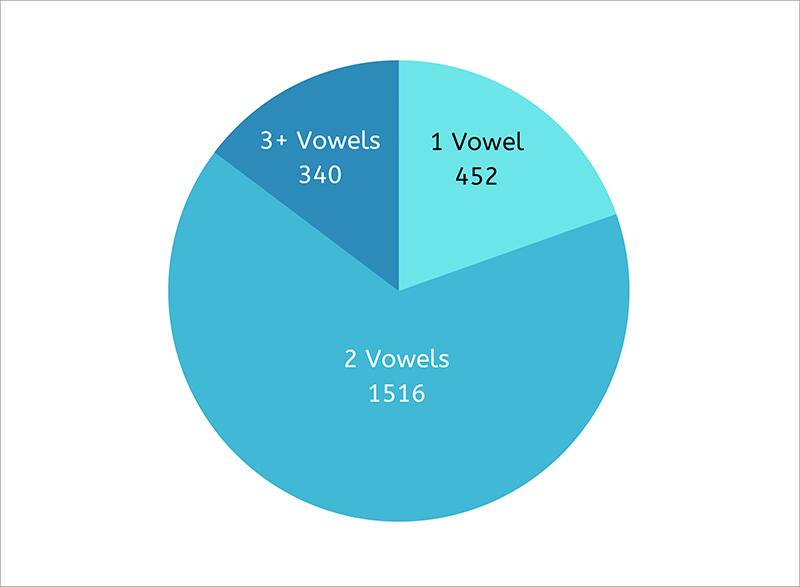
My first question was, how many vowels does the typical Wordle word have? The answer (below) is that about two-thirds of the solutions have two vowels. Of the remaining third, the solution is more likely to contain a single vowel than three vowels:
FIGURE 1: NUMBER OF VOWELS IN SOLUTION
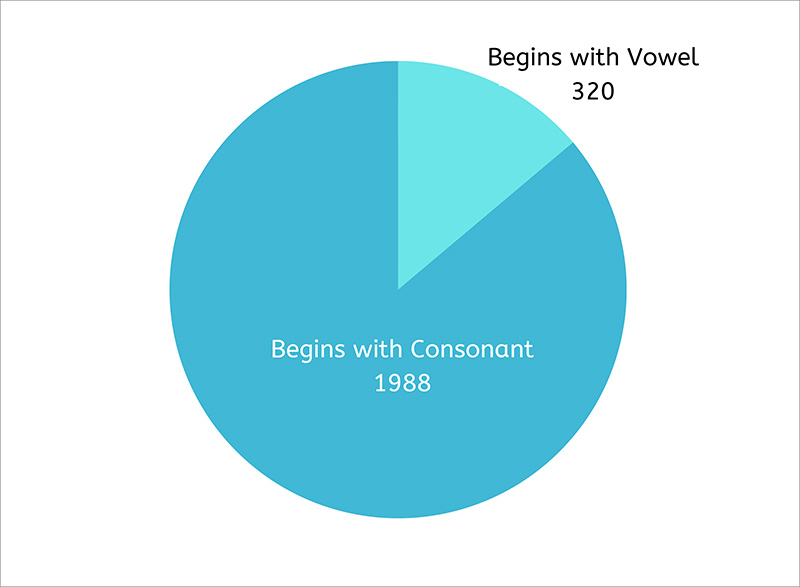
Next, I wanted to know the likelihood that a given Wordle solution starts with a vowel, which I always find annoying. This turns out to be a bit less than one out of seven. So, once a week we should expect IRATE, ETHER, or ALERT? As Charlie Brown would say, AAUGH!
FIGURE 2: FIRST LETTER OF SOLUTION
Third, it certainly feels like a substantial number of Wordle words end in E, more so than other vowels and consonants. I didn’t tally up the endings letter-by-letter, but I did find that about a third of the solutions end in E or Y, with E being a bit more likely:
FIGURE 3: FINAL LETTER OF SOLUTION

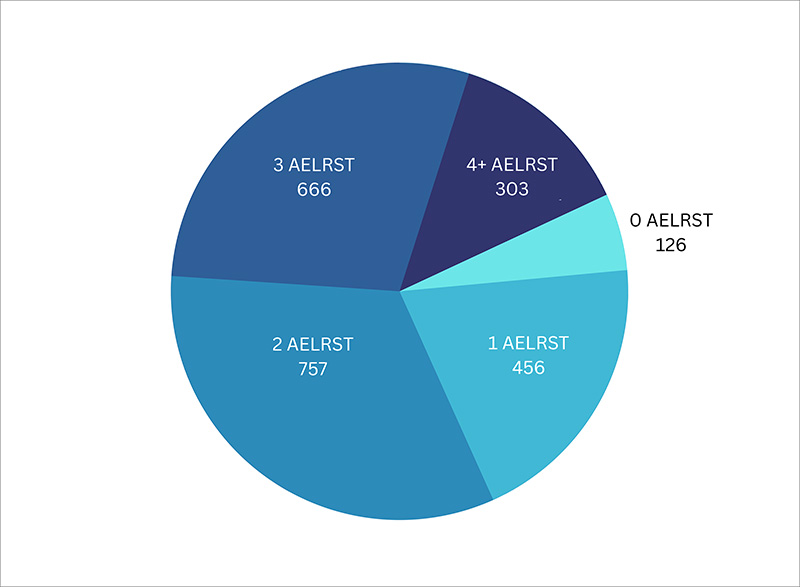
Which brings us to the letter frequency of the Wordle solution set. I was curious to know how often the two most common vowels AE and the four most common consonants LRST appear in Wordle words. I found that only 5% of the solutions do not contain any of the letters AELRST. One-third of Wordle solutions contain exactly two AELRST letters, while three-quarters of the solutions contain two, three, four or more. This means that your Wordle blind date is likely to be bland, letter-wise. Even STALE. Or bore you to TEARS.
FIGURE 4: SOLUTIONS CONTAINING LETTERS AELRST
Lastly, how likely is it that your latest Wordle crush is from a Slavic-European country? By that I mean, how many of the solutions contain one or more of the rare (according to Words with Friends) letters JKQVXZ? Surprisingly, the answer is about one in five:
FIGURE 5: SOLUTIONS CONTAINING LETTERS JKQVXZ

So now you know a little more about the game you’ve been spending so much time with and often grumbling about. Maybe this will help you find the day’s solution more quickly and put a little more love ♥ ♥ ♥ into your love-hate relationship with Wordle.
_______
Update: One reader commented that her strategy is to start with consonants that did not appear in the previous day’s solution. (Her rules were actually much more complicated, but too hard for me to analyze.) So I looked at the solution set in order of publication date to see whether use-fresh-consonants is in fact a good strategy. Here is the data:
Consonants Found in
Previous Day’s Puzzle |
Number of
Puzzles |
Percent of
Puzzles |
| 0 |
1112 |
48% |
| 1 |
869 |
38% |
| 2 |
289 |
12% |
| 3 |
43 |
2% |
| 4 |
3 |
~0% |
Almost half the time, there are no shared consonants between the current solution and the previous day’s solution. Furthermore, it is rare to have three or four shared consonants. So the odds seem to be definitely in your favor if you re-use zero or maybe one consonant from the previous day.





Here we are again, the silly season in which seniors are targeted on snail-mail, online ads, TV commercials, you name it, to sign up for health care plans that promise everything and cost nothing. Welcome to the October-December marketing world of Medicare.
We have been Medicare Advantage people from the outset and I have chosen those plans since we retired. Their appeal to me is the certainty of a maximum out-of-pocket cost that one doesn’t get with traditional Medicare, plus the fact that Medicare Advantage is not a health-rated plan, as opposed to Medicare Supplement plans which take your health status into account when they set your rates.
I understand that Medicare Advantage limits us to a network of providers in North and South Carolina (which I double-check every fall) but how far do we want to travel anyway? I feel like I already drive too many miles as it is to get credible health care. Perhaps that reflects where we chose to live. That said, should retirees base all their life and location decisions on how many miles it is to the nearest x-ologist?
In any event, what inspired this post was how our 2022 (current year) BCBS Medicare Advantage plan touted its new and supposedly improved dental coverage. In past years, one could be reimbursed for $300 worth of preventive dental services, just by submitting said claims to BCBS of North Carolina. But this year, BCBSNC dumped its subscribers into the Liberty Dental Plan, where an insured could submit claims for all kinds of dental services — as long as they were delivered by a Liberty Dental network provider.
What wasn’t mentioned by BCBSNC in early 2022 was that only 8 practices in our area would sign up for the Liberty Dental network. Liberty went through the motions of asking subscribers to “nominate” their dentists to be part of their network. An empty gesture, as my dental practice and most others didn’t choose to sign up.
So I wrote to BCBSNC about the fact that their 2022 dental coverage was, as far as I was concerned, less generous than before. Here was their response:
On behalf of everyone at Blue Cross Blue Shield of North Carolina (Blue Cross NC), I want to thank you for trusting us with your healthcare needs.
I do understand your concerns about Liberty Dental. Your preferred dentist can join the Liberty Dental network if they choose to. You do have the option to explore an individual dental plan as well.
As you have expressed your dissatisfaction, you can file a grievance about this…
Ha. Now there’s customer service. Instructing you how to file a grievance. Is it just me, or does it seem like they really didn’t care?
Blue Cross Blue Shield of North Carolina knew exactly what they were doing in 2022 when they hired Liberty to manage their Medicare Advantage dental coverage. BCBSNC wanted to limit their liabilities, period. That mission may have been accomplished, but apparently not without blowback — because here is the dental coverage BCBSNC is offering its Medicare Advantage subscribers in 2023:
$2,000 yearly allowance for services including oral exams, cleanings, X-rays, fillings, extractions and dentures. Certain limits apply. For services obtained out-of-network, you will be responsible for 20% plus additional costs up to the provider billed amount.
So the way I interpret this, BCBSNC will kick in something toward my dental bills in 2023, whether my dentist is in “network” or not. Guess I should be grateful, but to me it reflects the money sloshing around in the Medicare Advantage business and what insurers feel they need to do to retain their “customers.”
I’ll sign up, by default, yet again. Hard to argue with $0 monthly premiums.