Yearly Archives: 2022

In the stoppage-time minutes of the Iran-USA World Cup match last week (USA won the match 1-0), a desperate Iran player blatantly grabbed the jersey of a USA player trying to advance the ball downfield.  The referee rushed to the scene of the crime, brandishing a yellow card as if it were some kind of soccer taser.  While his card did not deliver a shock, it otherwise served its purpose: play resumed, USA held on to win, and Iranian players lay on the field afterwards in disgust and despair.

But this post is not about the geopolitics of soccer.  It is about how different sports handle infractions of their rules, and what that might say about their participants and audiences.

• • • 

Let’s start with baseball.  In baseball, quaintly enough, it is harder to bend the rules than to break them.  By this I mean, the innately slow pace of the game allows for transparency of play and hawkish oversight by its umpires.  As such, misdeeds in baseball tend not to be spontaneous acts (e.g., basepath interference) but premeditated ones such as altering bats, sign-stealing, spitballs and body-juicing, violations that are harder to detect in real time.

Baseball’s balk rule, which penalizes deceptive pitching moves when runners are on base, may be the most common in-game foul — but even then, only 122 balks were called in the 2430 MLB games played this year, and no team had more than 8 in the 162-game season.  By comparison, each NFL team last year had an average of 21 offensive holding penalties  over a 17-game season, which goes to show how relatively law-abiding baseball is.

Real-time rule violations rarely affect the outcome of baseball games.  The foul most likely to impact a team is when a star player or manager is ejected for arguing with the umpires or participating in the occasional bench-clearing brawl.  There are several notable brawls every season, but rare enough that you can place bets on when the next one will happen.  Penalty-wise, baseball is rather tame and lame.

• • • 

On the other side of the behavior spectrum lies basketball, a supposedly non-contact sport which sees no irony in allowing players five free personal fouls a game (the sixth causing a player’s ejection).  Foul management and intentional fouls dominate end-game strategy.  Star players sit on the bench late in the game in fear of getting their sixth fouls.  The final two minutes of barely-competitive games consist of the behind-team purposely fouling the ahead-team, hoping the ahead-team will not sink their foul shots and the behind-team can score ten unanswered points.  Such games invariably end in a whimper of free throws.

I am not a big basketball fan anyway (can you tell?) so all the fouling is just another nail in the game’s coffin to me.  Offensive infractions like charging and traveling are rarely called, which encourages star players to make foul-inducing drives to the basket, giving them a chance to score three or even four points on a two-point play.  I guess this is the sport the NBA wants — a playground game with a pro veneer and fan-pleasing point totals.

• • • 

Basketball has its slap-your-arm-while-you-shoot fouls.  The equivalent penalty in NHL hockey is called a high-stick.  In the interest of letting words speak for themselves, this is how high-sticking is described in Wikipedia:

A penalty is assessed if a player strikes another player with a high stick.  The player is given a minor penalty unless his high stick caused an injury, in which case the referee has the option to assess a double-minor, major, game misconduct or match penalty.  It is the referee’s discretion which penalty to assess: the rule calls for a double minor for an accidental injury, or a match penalty for a deliberate attempt to injure (whether the opposition player was actually injured).  Injury is usually decided by the high stick causing bleeding, but the presence of blood does not automatically mean an extra penalty is awarded.  Some referees have been known to award an extra penalty without the presence of blood if the referee determines that the injury sustained was sufficient to warrant a double-minor penalty.

Yes, we all know hockey is violent, but when the presence or absence of blood determines the severity of a penalty, can the sport be thought of as anything more than a fight on ice?  There is even a dedicated Wikipedia article on “Fighting in Ice Hockey” in which they note that the NHL does not eject players for fighting per se but for certain in-fight violations, whatever those might constitute.

One might suppose that hockey fans attend games to see the physicality, but a recent study disputes that, citing a negative correlation between fighting and attendance.  We shall see.  The 2022-2023 NHL season has already given its fans 116 fights (as documented here) in just over 400 games.

Hockey has a smattering of rules about blue lines, red lines, icing and other technicalities, but hockey fans don’t know or care much about that stuff.  Just get to the punch line.

• • • 

Then there’s golf.  Golf is clearly not a contact sport (not when it comes to my golf swing) and so you would think that rule infractions would be both minor and rare.  And they are, for the most part.  But the Golfing Gods, perhaps taking their cue from the heavenly ones, expect golfers to call violations on themselves!  Who would have come up with that twist except the inventors of a game designed to be played by masochists?

“I hereby penalize myself because I breathed too hard as I was preparing to hit my ball!” Which is basically what happened to Tom Kite in the Hall of Fame Classic in 1979 while he was getting ready to putt.  Kite noticed that his ball had moved, he informed his opponent, and then he assessed himself a one-stroke penalty.  Kite wound up losing the tournament by, yes, one stroke.  Poor Tom.  Welcome to golf.

I can fathom penalties for carrying more than the allowed number of clubs (14) or striking a moving ball (Phil Mickelson’s signature shot).  But it does get silly when a ball wobbles due to unseen forces and the player is held to be at fault.  This leads me to conclude that golf is essentially a fundamentalist religion.  No wonder the Saudis wanted a piece of it.

• • • 

Did you know that golfers (see Tom Watson, 1980) are obliged to take a two-stroke penalty if they give advice to another player?  (Which might be a good idea in real life!)  Again, compare this to the NFL, where player-to-player advice is given all the time, mainly the kind that advises one’s adversary where he can stick something.  In-your-face advice of that nature is termed taunting in the NFL, and a taunting penalty (61 of them were called last season) will set your team back 15 yards.  In this case, words aren’t cheap.

Football infractions are divided between the procedural (false starts, illegal formations and shifts, offsides, delay of game) and the physical (holding, pass interference, illegal blocks, roughing, use of the helmet).  On average, each team is flagged for 6 penalties a game and probably commits three times that many.  All told, there are over 130 different ways to get a penalty (see below, from the NFL rulebook) and if you’ve been a fan long enough, you’ve probably seen most of them.
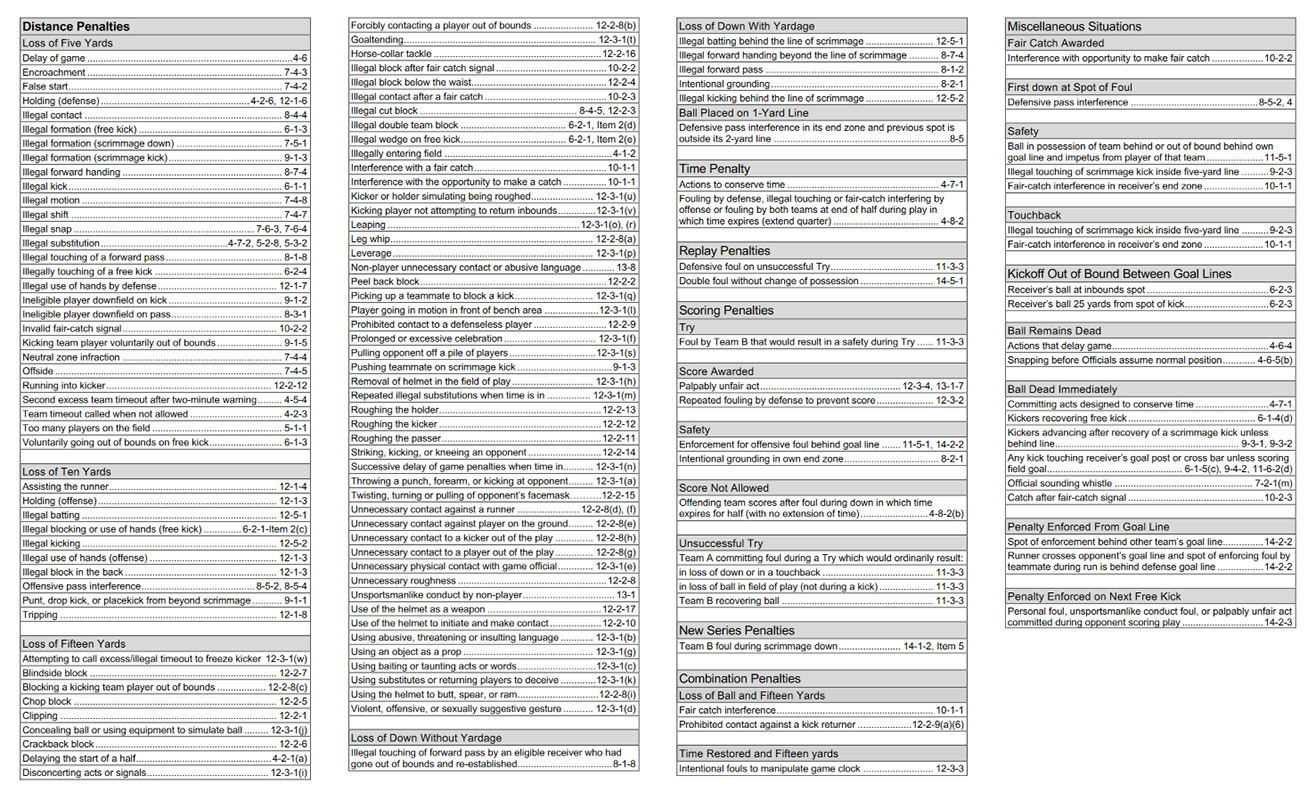
List of NFL Penalties from the NFL RulebookSummary of NFL Penalties

But the in-game penalties are not the end of the story.  So far this season, over 60 players have been fined for unsportsmanlike conduct and injurious on-field acts, a number that is dwarfed by the number of players (102) who have suffered concussions this year.

The penalty — or lack thereof — that confuses me the most is defensive pass interference.  Rule 8.4.3 says … a defender cannot initiate contact with a receiver who is attempting to evade him.  A defender may use his hands or arms only to defend or protect himself against impending contact caused by a receiver.  Ha!  On the passes I see, the defender always seems to have his hands all over the intended receiver as they scramble downfield, and nothing is flagged except the most blatant tugs and shoves.  Maybe Rule 8.4.3 should just say, Boys will be boys.

• • • 

Life also has its rules, and penalties.  Which leads me to ask, which sports rule-book is most like life?  Are our day-to-day infractions largely procedural in nature or are they mostly personal fouls?  When we do make a life mistake, is our penalty self-administered (guilt) as in golf?  Or do we get away with as much as we can until someone throws a flag, as in football?  When we hurt another person, do we make a great show of falling to the ground in pain ourselves, as soccer players do?  In the final minutes of our lives, do we sit on the bench and reflect on the number of fouls we have accumulated, as in basketball?

The game of life we play is not a game, its rules are unwritten and arbitrary, and winning is not its typical outcome.  We invented sports and their varied rules and penalties to help us harness the world and tame just a bit of the chaos we deal with every day.

Be the first to comment | Read other posts in Life

Doing a little tidy-up of items that don’t merit a whole post but might warrant a scintilla of scrutiny, a crumb of contemplation, a mote of mentation…

💡 Over 300 people in the past 100 years have died electively by a process one could call suicide by mountain.  I am referring to the (mostly) men who have perished trying to scale Mount Everest — all avoidable deaths.  Our spectacle-obsessed culture encourages, even celebrates, risky adventures that often end in healthy people dying.  (Don’t even talk to me about the stupidity of air shows.)  At the same time, our culture thwarts the desires of old, worn-out people to choose death rather than spend their last months in an Everest-scale descent through “long-term care.”  I guess their struggles just aren’t gutsy enough.

🗑️ I know, it’s a bad idea to start Thoughts @ Large with a negative item, since it sets a tone that is hard to dispel later.  So let’s do something lighter next!

️✈️ If you did a search for Allegiant emergency landing, what do you think might pop up?  How about these headlines:  2011: Orlando-bound Allegiant Air flight forced to land in Pittsburgh.  2015: Allegiant flight makes emergency landing in St. Pete.  2016: Allegiant Air flight headed to Pittsburgh makes emergency landing due to turbulence.  2018: Allegiant flight makes emergency landing in Cedar Rapids.  2018: Allegiant flight performs emergency landing at McGhee Tyson Airport.  2020: Passenger says Allegiant plane’s NC emergency landing was ‘a little scary.’  2021: Flight 1313 makes emergency landing in Lexington.  2021: Allegiant airplane blows out tire after rough landing at Logan.  2021: Allegiant flight from Sanford lands safely following ‘mechanical issue’ shortly after takeoff.  2021: Bird strike forces emergency landing of Allegiant flight in St. Pete.

That was just the first page of the Allegiant emergency landing search results.

👎 By the way, we are not flying Allegiant to visit New York City after the holidays.  This will be our first foray post-pandemic, and we don’t want to spoil it with little annoyances like emergency landings.

🔠 After weeks of observation, I have developed what I call the “Positive Wordle Theory.”  If there is a choice between a few Wordle answers, then the more likely answer is the one with the more positive emotional connotation.  This means, pick BRIDE instead of BRINE, CHARM instead of CHART, MEDAL instead of PEDAL.  There is a bias.

🥦  I’m the kind of guy who, after buying a new salad dressing and deciding I really don’t like it, will homeopathically add a little of it to every salad I make from then on until the bottle is empty, rather than throw the stuff out.  Be glad you’re not married to me.

🌧️  The 1966 Beatles song Rain is one of my all-time favorites.  I love Ringo’s drumming (this video is fun) and the electro-twangy guitar.  It’s also a great listen while taking your car through the car-wash.  But the point of this item is my mondegreen (misheard lyrics) in Rain‘s refrain.  Where John sings, Ra-ain / I don’t mind / Shi-ine / the weather’s fine, I always heard the last line as the worthless climeWhich I thought made perfect sense for a song that celebrates rain!

☯️  There is no such thing as unconditional trust in another being, mortal or otherwise.  We decide who we trust, and why, and that makes it conditional.

💩 One of the more regrettable articles I got sucked into reading recently is this one, on the features and drawbacks of oil diffusers, titled — for the sole benefit of search engines — Your Diffuser May Be Harming You.  How so, you ask?  The authors of the article, who of course have no vested interest other than selling their own diffuser, present an overview of alternate oil diffuser technologies.  The potential harm to you, they claim, consists of “diffusing harmful chemicals that are in our everyday tap water.”  God help us, I suppose, if we had to breathe the stuff that we already drink.

Strange how people who use oil diffusers do not grasp that they deposit tiny oil droplets on one’s walls, floors and furnishings, and that is how your diffuser may be harming you.

⚙️ From the Only-Half-the-Battle Department:  It is easier to improve yourself than to improve other people’s perceptions of you afterward.

😁 I just finished reading, back to back but on unrelated whims, the autobiographies of the comic-actor/musician Harpo Marx and the comedian/actor/musician Steve Martin.  Harpo’s is the far better read, as it mostly consists of warm and entertaining accounts of his youth, his family and his renowned circle of friends, with amusing details of his career.

The difference in the tone and tenor of Martin’s bio could not be more pronounced — in his stand-up years, Martin was detached from his family, and from himself.  He observes that his is “not an autobiography but a biography, because I am writing about someone I used to know.”  His recollections feel familiar but emotionally hollow.

Steve aimed to be funny; Harpo wanted to make life fun.  Both succeeded.

⏱️ Routine is great in the right settings.  In the military, it helps ensure a fast, predictable response to a superior’s command, or in football to a play called at the line.  Adherence to routine reduces manufacturing defects, piano-playing flubs and errors of unfamiliarity.  Routine offers a sense of security in an uncertain world, like armor that deflects worry.

But all armor is brittle, suitable only for the attacks for which it is designed.  Resilience is more powerful than armor.  Resilience comes from experience, from being vulnerable, from withstanding numerous minor (and hopefully few major) assaults on our beings and  learning/evolving survival skills.

We err when we protect our children with the armor of routine but spare them experiences that would build their resilience.  The ultimate balancing act for a parent.

🛠️  People have their favorite tools for certain tasks.  I have a set of language-helper tools that I often use when writing this blog, and I thought I would share them here:

  • My favorite online thesaurus is now the OneLook Thesaurus.  I like its ability to sort results by closest meaning, alphabetically, or length. The home page of OneLook.com offers a number of additional word-search tools.
  • My favorite rhyme dictionary is the Rhyme Zone, which also offers a variety of ways to find and filter results.  It is not perfect, however — for instance, president is given as a 100% rhyme for resident, whereas resident is only a 72% rhyme for president.  Hm.
  • I use the The Free Dictionary to find idioms/phrases which incorporate a given word. It’s OK but not a treasure trove.  For disco, Free Dictionary returns deader than disco, while other idiom sites return nothing… because disco is dead?
  • What I really need is a tool to help me generate metaphors related to a certain word or concept, say, dance.  Vivid, imaginative metaphors are hard for me to come up with.  Ideas dance around inside my head but then the music stops and they all go home.

The more I read the New York Times, the more shitty the long-term prospects seem for our world and for humanity.  As a result, I’ve been reading less of the New York Times.
🗑️ I know, it’s a bad idea to end Thoughts @ Large with a negative item, since it sets a tone that is hard to dispel later.  So let’s do something lighter next time!

Read 7 comments and add yours | Read other posts in Thoughts @ Large

Asked & Answered: 15.0

The majority of my readers (I would say vast majority but that would imply a vast number of readers) are of, shall we say, advanced age.  Being of advanced age has its benefits — for instance, my age allows me to completely ignore what passes for pop music these days and no one, except maybe James Corden, will criticize me for it — but advanced age also has its drawbacks.  One of them is the ever-growing list of prescription drugs that people my age find themselves ingesting on a regular basis.

Don’t get me wrong, I’m not anti-medical-science.  In fact I feel fortunate when I consider the array of drugs developed in the last 40, 30, 20, 10 years to address the many maladies of civilized life.  These drugs range from lisinopril (high blood pressure, approved in 1987, generic since 2002) to omeprazole (acid reflux, approved in 1988, generic since 2001) to ropinirole (restless legs, approved in 1997, generic since 2008) to aflibercept (wet macular degeneration, approved in 2011 and now costing Medicare $2.9 billion a year) to apixaban (anti-coagulant for atrial fibrillation, approved in 2012 and costing $10 billion a year).

Being of suitably advanced age and other circumstances, I partake of all of these drugs, and more.  Not like it’s fun, but it would be less fun otherwise.

But what I really want to talk about is how these wondrous pharmacologicals are handled inside our bodies.  We down these pills as if they simply melt in our tummies, magically do their respective jobs for the day, and then discreetly leave the scene.  But that would not be the case at all.

I became interested in how drugs are processed in our bodies after a recent, and brief, trial of the diuretic chlorthalidone, a blood-pressure medicine that has been in use since 1960.  In my case, the drug is unreasonably effective.  In just two days, my blood pressure fell nearly 30 points and I lost about 6 pounds, despite drinking lots of water to stay hydrated.  I had to stop the trial to keep my blood pressure and weight from falling even further.

I wondered how chlorthalidone could have such a drastic, powerful effect on me — could there have been some interaction with another of my several prescription medicines?

• • • 

When drug interactions occur, it’s not because the drugs chemically react with one another in your bloodstream, but typically because they (a) have the same effect, (b) have opposing effects, or (c) use the same metabolic path through your gut or liver– in effect, competing with each other for your body’s metabolic resources.  This is actually pretty common.

Another type of interaction is when you ingest something, drug or otherwise, that thwarts the metabolic process itself.  You’ve probably heard, for example, that drinking grapefruit juice is a bad idea when you are taking certain medications.  This is because…

… grapefruit juice inhibits the CYP3A4 enzyme of the cytochrome P450 system in the intestinal mucosa, increasing the bioavailability of drugs with a high first pass metabolism. [British Journal of Medical Practitioners, 2012]

If I may clarify — and please do, you say!  According to the National Library of Medicine, CYP3A4 is the name of a gene on human chromosome 7.  This gene directs various cells to manufacture an enzyme (one of the P450 enzymes) that is “involved in the metabolism of approximately half the drugs in use today, including acetaminophen, codeine, cyclosporin, diazepam, erythromycin, and chloroquine.  The enzyme also metabolizes some steroids and carcinogens.”

Here, metabolism means the process of breaking down a drug into smaller molecules that can be eliminated by the body.  Simply put, the CYP3A4 enzyme helps us deactivate many toxins and drugs.  In fact, drug manufacturers rely on CYP3A4 to remove their drugs from the bloodstream, which allows medicines to be taken on a daily, high-compliance basis.

If your CYP3A4 enzymes get blocked or disabled, then the drugs that are designed to be broken down by CYP3A4 will circulate in your system at higher levels than the drug-maker intended.  This can in turn produce toxic effects.

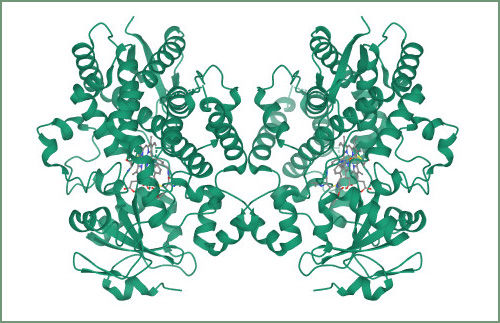
The CYP3A4 enzyme (below, per the RCSB Protein Data Bank) looks like a Rorschach test designed by Jackson Pollock:

Drawing of CYP3A4 enzyme

That mammals, over the eons, evolved a way to manufacture a toxin-neutralizing enzyme as complex as this is beyond my comprehension — and also beyond the scope of this post. But clearly, the evolution of CYP3A4 wasn’t shaped by grapefruit juice.  (The chemical in grapefruit juice, bergamottin, that deactivates the CYP3A4 enzyme was not conclusively identified until 2012.)

Grapefruit juice is not the only inhibitor of CYP3A4 (see this list) and is only one of many food-based inhibitors (fresh-ground black pepper is another).  I don’t use much pepper or drink grapefruit juice, so that would not explain any unusual drug responses I might have.  It would be more likely for my medications to be fighting over my CYP3A4 enzymes.

Curious, I made a list of the 11 (yes, that many) medications and supplements that I take on a daily and/or occasional basis, and then searched the web to see how many of them use the CYP3A4 pathway.  I found that 6 of the 11 rely on CYP3A4 for their metabolism, and two of those can even inhibit CYP3A4.  Just to complicate things.

I have no control which drugs have first dibs on my CYP3A4 reserves.  I guess I have to trust that, if I’m not having issues, then my body is doing its best to handle the drug traffic down there.  But it pays to be vigilant, especially when adding or adjusting medicines.

• • • 

What about my not-so-friendly friend, chlorthalidone?  Turns out that CYP3A4 was not a factor here — chlorthalidone is hardly metabolized at all but instead is very slowly filtered out by the kidneys.  By slowly, I mean that it takes over 40 hours to eliminate half of it.

This is probably one reason why, as I just learned, that diuretics like chlorthalidone are on the American Geriatric Society’s Beers List of “potentially inappropriate drugs” for older (sorry, advanced age) adults.

I know now that the dosage of chlorthalidone I was prescribed (25mg) was way too high; as I discovered, it would have been more prudent for my doctor to have started me out on one-quarter of that dose, given my age.  Doctors know a lot of things, but they can’t keep up with everything.  It doesn’t mean you doubt them, but you have more time and energy to research your specific situation than your doctor does — you can add to her knowledge.

If this post has given you a slightly better sense of what goes on inside you after you take your pills, and helps you appreciate the complexities of medical management for seniors, then great.  Thanks for hanging in here until the end.

Read 5 comments and add yours | Read other posts in Asked & Answered, Life