Yearly Archives: 2022

Asked & Answered: 13

When I became a Damn Yankee [1] back in the aughts, one of the first things I noticed was the outsize presence of Christian radio here, both AM and FM, and both music and talk.  There are more religious radio stations in the Asheville area (15 within a 30-mile radius) than NPR stations in the entire state of South Carolina (nine) or Tennessee (also nine).

I soon found an easy way to locate (and bypass) Christian stations — just set the car radio to “scan” and listen for giveaway words like righteous, almighty, rejoice, praise, miracle, glory and power, along with the instant-bingos Jesus, Savior and God.  At least one of the above is sure to be heard in any six-second fragment of any Christian radio broadcast here.

The abundance of God’s Radio-Spoken Word in these parts led me to wonder: are there so many religious radio stations here because there is so much sin to stamp out, or because there is so much righteousness to self-congratulate?  Is there any correlation at all between the reach of religious radio in a region and the size of its cesspool of sin?

Before we get to the answer (after all, this is an Asked & Answered article), let’s talk about the possible types of correlation between one thing and another [see illustrations below].

As shown in the first diagram, direct correlation is when one factor increases along with the other.  If sin and religious radio were directly correlated, then one would tend to find more sin in areas that have more religious radio stations.  There would be several ways to explain such a correlation:

(a) Religious broadcasters might be drawn to set up shop in high-sin communities, because that is where The Word is needed the most (cf. the Willie Sutton Rule).

(b) Or it might be that sinners hear the Sunday sermons, feel the full power of the Lord’s forgiveness, and then figure, “Hey, the slate is clean, this gives me a whole new week of sinning to do.”

(c) Or maybe religious broadcasts actually encourage sin!  But that could only be true if they made listeners believe things like vaccinations are deadly, children need to be “delivered” from same-sex households, and if you convert to Islam you may beat your wife.  Since these are all unthinkable, this hypothesis may be a bit shaky.

This brings us to inverse correlation (second diagram) where as one factor rises, the other tends to fall.  If that were the case here, then we could say: the more religious stations, the fewer the citations.  What might explain such a catchy correlation?

(a) Perhaps religious radio broadcasts reach into the hearts of hardened men and subdue their wayward impulses.  Listeners might say to themselves, “Nah, I don’t need to rob that bank today.  It’s Sunday, the Lord’s day, and they’re closed.”

(b) Or it could be that religious radio strengthens the wills of the righteous, who then elect law-and-order politicians, who then pass punitive laws, which mandate long prison terms for sinners, who decide to flee to other states.  Could be that.

But it is also possible there is no correlation at all (third diagram) between the number of religious radio stations and the amount of sinning in a given area.  How would one know?  Asked — and now answered.

METHODOLOGY

I started by selecting fifteen cities at random from five US regions (Northeast, Southeast, Central, Texas-Oklahoma, California) and three population ranges (Large = 3-6 million, Medium = 1-2 million, and Small = 0.5-1.0 million).  The population figures for each area (see table below) were based on the estimated number of residents within a 30-mile radius of city center.  [Sources:  Free Map Tools and MCDC (Missouri Census Data Center).]

Now, I needed a proxy for the amount of sin in a given area, since the true definition of sin is known only to God.  (As we will all find out on Judgment Day, won’t we!)  For my proxy I chose the crimes homicide, robbery and assault — purposely ignoring property crime — and then totaled the respective rates for each city, with each crime given equal weighting.  [My main source here was the FBI although all my other sources cited FBI statistics.]

Finally, I counted the number of religious radio stations, AM and FM, within 30 miles of the center of each city.  [Source: radio-locator.com.]  I included stations whose format was listed as religious, gospel, Christian contemporary or Spanish Christian (found primarily in California and Texas).  The bar chart below shows the number of religious radio stations (and the percentage of the total they represent) for each metro area, grouped by region.

RESULTS AND COMMENTARY

What surprised me about the radio station data was that most of the selected metro areas had about the same number (12.5 ± 1.3) of religious stations, regardless of population or region.  Cities with significantly more religious stations were Austin (22), Kansas City (23) and Houston (31).  Spanish Christian was by far the dominant religious format in Houston but represented only a handful of the religious stations in Austin and Kansas City.

The percentage of religious-format stations in a given metro area was typically 18-22%, again irrespective of population or region.  The notable outliers were Kansas City (40%), Houston (39%), Austin (33%) and Asheville (33%).  By comparison, religious radio in Chicago (13%) was a bit light, at least on a percentage basis.

Let’s now consider the original question — does religious radio have sin-fighting power?  To get a visual sense of the correlation, if any, I plotted each city’s rate of violent crime (selected crimes per million residents) vs. the prevalence of religious radio (stations per million residents) within 30 miles of city center.  I then calculated the best-fit curve [2] through these data points:

Hallelujah! as Leonard Cohen might say if he were alive today and subscribed to this blog.  It looks like the more religious radio stations per capita, the lower the crime rate, right?  Go tell it on the mountain, people — mount a transmitter on every steeple!

Or maybe not.  On closer inspection, this graph reveals a somewhat different correlation: the large cities are all on the left side of the graph, the medium cities are all in the middle, and the small cities skew to the right.  It is almost as if the rate of violent crime and the concentration of religious radio stations both depend on population density. 

In fact, we already noted that the raw number of religious stations within a 30-mile radius of a city does not depend on its population.  (Perhaps it has more to do with the available frequencies on the radio dial.)  That being the case, small cities will naturally tend to have the greatest concentration of religious radio stations, when expressed in terms of stations per million residents.  So this graph, in many ways, says nothing at all!  Or more precisely, while there are differences in crime rates, there is not a strong correlation between crime and religious radio, at least for this sample of cities.

To be able to say the same thing mathematically, I decided to analyze this data set with a statistical tool called multiple linear regression (MLR).  This tool helps identify which factors are strongly correlated and which are not, so that one can select a model that best fits the data.  I evaluated many models with various combinations and powers of the factors, but none of them fit the data better than the following two-factor model:

C = 64.5 + 1.22 P 2 – 1.04 S

where C is the crime rate (crimes per year per million people), P is the local population (millions) and S is the local concentration of religious radio (stations per million people).  This model suggests that crime rises with the square of the population but falls as the concentration of religious radio increases.

To illustrate the workings of this model, let’s pretend that Chicago doubled the number of religious radio stations in the area, from 12 to 24.  (This means S for Chicago would rise from 2.0 to 4.0.)  The model predicts that this would lead to a 2-point drop in the rate of violent crime, or twelve people a year who are not murdered, robbed or assaulted.  If you lived in Chicago, wouldn’t you want to be one of those twelve?

But before we start building a bunch of radio towers, we need to check the goodness-of-fit of the model to see what its predictions are worth.  According to the MLR analysis, the correlation coefficient for this model is only 0.5 (1.0 would be a perfect fit).  This means there is a weak-to-moderate correlation between the crime rate and the factors proposed to explain it.

Finally, the MLR analysis reports a 91% chance that P is a significant variable, but only a 69% chance that S is significant.  In other words, the religious radio effect is probably just a lot of noise, as you likely suspected before you even read this article.

I hope you at least learned something today that you wouldn’t normally hear on a Sunday.  Now, go thy way, and from henceforth sin no more.

________________

[1]  I learned the local definition of Damn Yankee — a Northener who moves to the South and stays there — when I was only half-jokingly called one in a 2007 job interview here.
[2]  Here I need to insert a note about the crime rate data for Scranton, PA, the town where Joe Biden lived until he was 10.  Whereas the other crime rates in this study were based on the most recently available data (2018 and 2019), the 2018 crime rates in Scranton took an incredible leap — I figured that this must reflect some kind of change in reporting methods or coverage area.  So, even though my graph shows 2018-2019 crime data for Scranton, I used an average of Scranton’s 2016 and 2017 violent crime rates for the purpose of calculating the best-fit curve.
Be the next to comment | Read other posts in Asked & Answered

§  She wasn’t faking her naiveté… she was a GENUINE INGENUE.

§  “I’ll show you that I can change my spots,” promised the PAROLED LEOPARD.

§  “My grandmother answered a phone call from ‘Microsoft’ and got scammed by some RUTHLESS HUSTLERS.”

§  “The very next day, my grandmother bought a million dollars worth of life insurance from some NAMELESS SALESMAN.”

§  Our friend Xander, the quantum physics major, was the dorm’s NERDIEST RESIDENT.

§  “Your leatherneck buddies have all gone home, but the AIRMEN REMAIN, MARINE!” taunted the drunken top-gun pilot.

§  The corner-cutting electrician often went shopping for DISCOUNT CONDUITS.

§  Felicity Huffman and Lori Laughlin apparently believe in AUCTIONED EDUCATION.

§  Cops say that nabbing the perpetrator at the scene of the crime is the RAREST ARREST.

§  If you don’t want your drinks to wobble, you have to sit at one of the STABLE TABLES.

§  In his Confessions, Augustine of Hippo (354-430 CE) portrayed himself as a sinner but he was SAINTED INSTEAD.

And you thought you wouldn’t have to learn anything today.

Read 10 comments and add yours | Read other posts in Creativity

I was in sixth grade when I started writing my pass-around-the-classroom colored-pencil-and-crayon humor magazine — if we agree to call six or seven sheets of stapled-together notebook paper a magazine — titled Reader’s Disgust.  I took my inspiration (and much of my material, at least at first) from MAD magazine, from Charles Schulz’s Peanuts, from The Saturday Evening Post, from the Steve Allen Show, and even from my mom’s trove of Better Homes & Gardens.  Hey, I had a grade-school imagination (and a like audience), so I did what I could with the materials at hand.

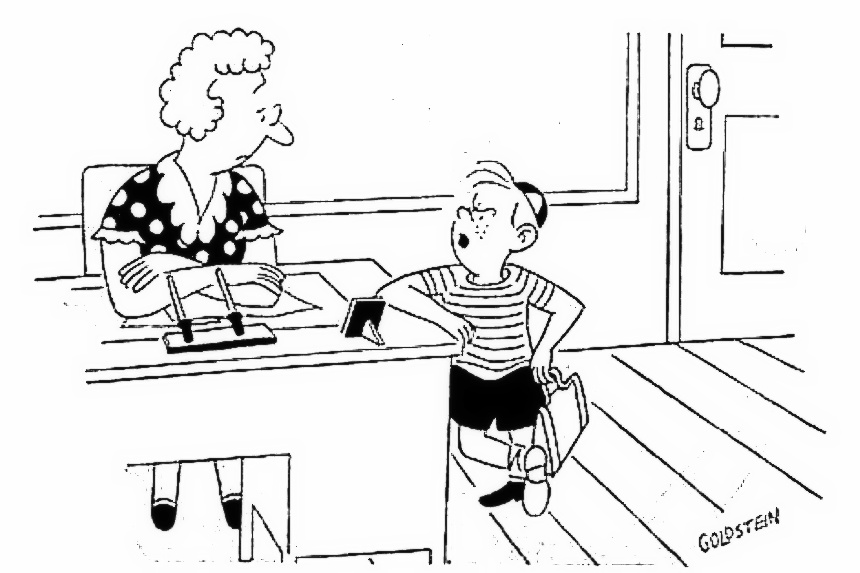
Mad Magazine #33 My homeroom teacher Mr. Smith also read my magazine, but he was more bemused than amused.  The most memorable thing Mr. Smith taught me in sixth grade was the meaning of the word plagiarism.  After his admonishment to me about copying other’s material and passing it off as my own, I did try to produce more original content — but the name of my magazine, lifted from MAD (right), stuck for its 16-year life.

Over the rest of my school-years, it became clear to me that the road to nerd-acceptance was paved with jokes, especially those at the expense of authority figures like teachers and principals or mocking the rust-belt city we lived in.  My magazine’s popularity was in no small part enhanced by the facts that (a) our small-town school was stiflingly boring and (b) the Reader’s Disgust was, by definition, contraband and thus carried an aura of taboo.  I did let a few trusted high-school teachers read the magazine, but I have no idea what was ever said about it in the teachers’ lounge.  That said, there was undoubtedly some talk.*

At any rate, when I retired from engineering and started writing this blog, I pretty much picked up where Reader’s Disgust left off in 1980.  (Lest you wonder, by then I had long given up crayons and had moved onto ink splats, pages with torn corners, and poems that did not rhyme, clear signals of my artistic maturity.)  Trouble is, The 100 Billionth Person did not start out with a captive, receptive audience of utterly bored high-school students; instead, my readership would comprise a handful or so of my and my spouse’s friends with, presumably, more refined tastes. 

Bear with me for this tangent:  I’ve always needed two reasons to be creative.  The first is to entertain myself while at the same time imagining the adulation I might get from those who grok (yes, I used that 60s word!) what I create as much as I do.  The second reason involves actually entertaining people without the ego-feeding element, i.e., creating good work for the sake and worth of doing so.  This aspect is always a lot harder, at least for me, as it usually feels like work.  But if I bear down, stick to business and do things carefully, the results are (well, sometimes, almost) as satisfying as raw adulation.

Often, my spouse (also my biggest fan) has encouraged me to do something to increase the size of my audience, because she apparently thinks I deserve a larger one.  I have no idea what the something I could do would be, as I have no connections… but more importantly, I’ve decided that I’m OK with the way things are.  A classroom-sized audience is probably best for me:  it keeps things personal, and I’m comfortable.  Why strive to be famous?

If I were famous, things would be a lot different around here:

  I would have to hire an agent to find lucrative opportunities.  My agent would insist on being paid.  To pay the agent, I would have to run ads on this site and pay Google to invade your privacy.  Then, bingo, you would be stalked everywhere you went on the internet.  But I wouldn’t care, because I was famous.  So that would sort of be bad.

  I would have to be careful what I say.  If I were famous and I inevitably said something the wrong way (and as we know, the definition of wrong is always evolving), I could get canceled.  I would get hate mail.  I would lose subscribers and advertisers.  In other words, it would be just like now, except I would be famous and hated.  That would be bad too.

  Everything I ever said or did in the past would also be scrutinized.  All those salacious details of my school years and professional career would be unearthed.  (Plagiarism, you say?  Aha!)  While I would lose my core subscribers – sorry to see you go, dear friends! — the notoriety and unjustice of my situation would no doubt attract an anti-PC following, likely the very libertarians I now deride.  I would get a call from Joe Rogan asking me to be on his show, or maybe just get together for an energy drink.  I’d have to think about that.

  I would have to develop my own line of luxe products and promote them on the blog.  CHColors — designer crayons in trendy fashion shades.  (Hot Dog Pink is the new black.)  Flames ReLit — scented candles that automatically regift themselves as thank-you items.  The 100 Billionth Bar — a chocolate bar sort of like the 100 Grand bar, only it would be a million times better, and much more expensive, because I was famous.  All these items would feature the now-heavily-marketed logo of this blog along with a highly flattering near-likeness of me painted by a celebrity-turned-artist (Tony Bennett?  George W. Bush?) done for me as a personal favor.  I would return his favor by giving him a Flames ReLit.

  If I were famous, only my closest friends would know my phone number; no one could just email me.  (You kidding?  Me read emails?  That’s what an agent is for.)  My network would be the people I meet at parties or promotional tours (boring!) or awards ceremonies (also boring but a great opportunity to virtue-signal) but that’s the way it is when you’re famous.  Once you have a million followers, who cares about the 1,000,001st — as long as you all keep checking my Twitter feed and buying my stuff.  That’s what friends are for.

When I add it all up, it’s much easier just being a legend in one’s own mind.  I’m glad I’m not famous.  Thank you for helping me stay that way.

______________

* Now, the mandatory footnote to the story.  The events took place in our high-school newspaper room in the Springtime of Eleventh Grade (wasn’t that a Schubert sonata?) as the latest issue of Reader’s Disgust was being circulated.  The magazine had landed in the hands of our Clubs Editor, Saundra Chiarini, when the newspaper’s teacher-advisor Patrick J. Panella suddenly swooped in, snatched the magazine from her and headed out the door.  Uh-oh, thought I, witnessing the Great Confiscation from just a few feet away. 
I can’t remember whether it was that day or the next when I was called into to see Miss Jessica Jenkins, our high-school Guidance Counselor (who, as far as I recall, neither guided or counseled).  Jenkins had obviously been assigned the task to (a) lecture me along the lines of, do you think this is funny? (uh, yes) and (b) inform me that I was fired from the newspaper staff.  I remember having the temerity to ask her to return the confiscated magazine to me.  I was denied.  So someone out there has a valuable memento.
In retrospect, it seems Panella must have been tipped off, maybe by someone in the teacher’s lounge, but we will never know.  What I do know is that my subversive activities cost me the National Honor Society Award that year (true), the stain of which darkened the rest of my life.  Hey, I might have been famous.

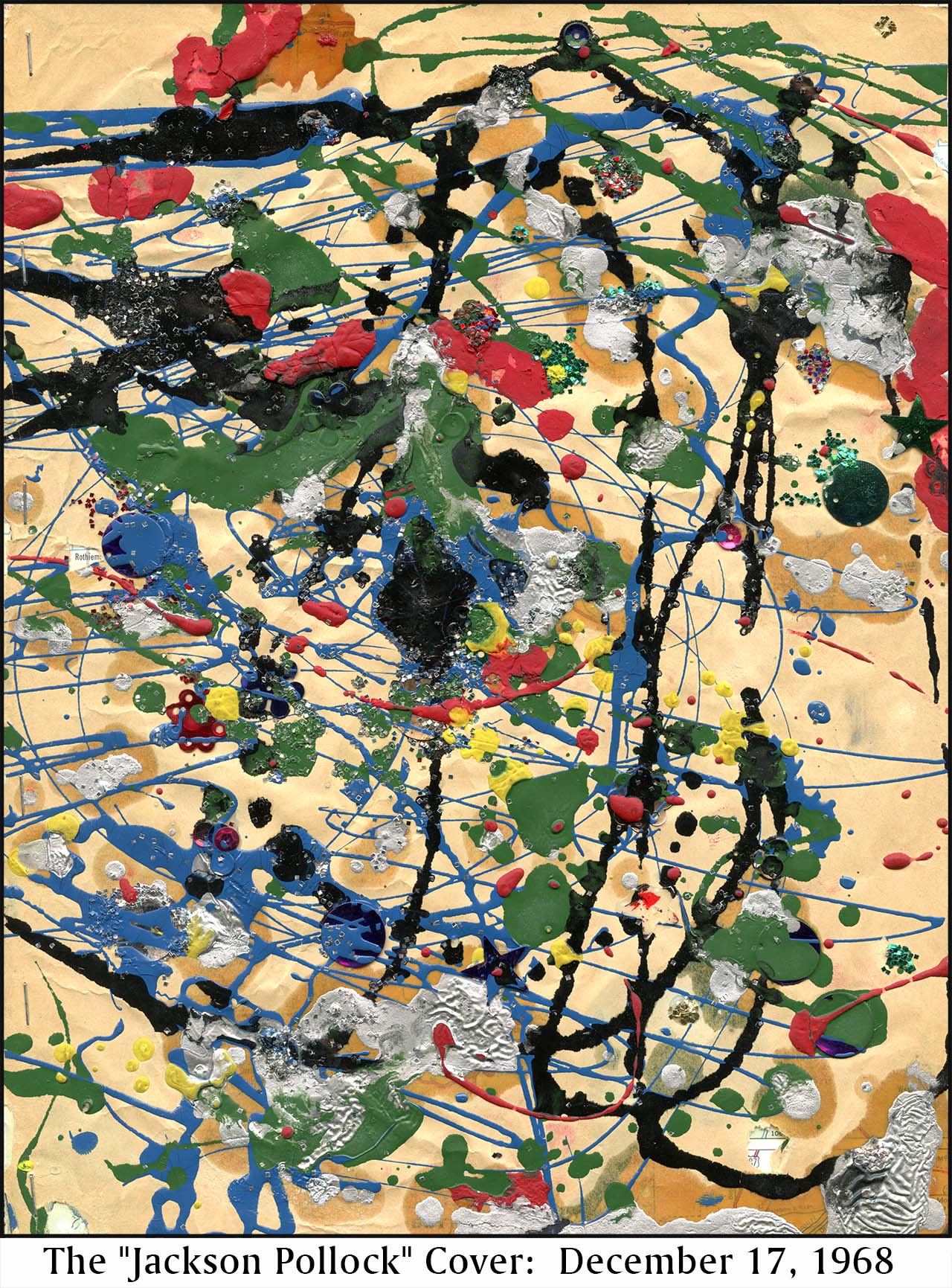
The Jackson Pollock Cover - Reader's DisgustThe Black Squares Cover - Reader's DisgustThe Magical Mystery Cover - Reader's Disgust


Read 4 comments and add yours | Read other posts in Humour, This Blog