The news media has been giving a lot of play to the recent highs in the U.S. stock market. With all due credit to Burton Malkiel and his book “A Random Walk Down Wall Street” (which I just finished), I would like to put some of the hype into perspective.
While I am not a financial expert, I am determined to manage our own retirement savings because I am unconvinced that the “experts” know much more than I do. I have arrived at a pretty simple conclusion about investing — I call it “The Trend.” It is hardly original.
The S&P 500 Index represents the total stock market value of the largest 500 companies in the U.S. In the chart above, I show how the value of this index has risen over the years 1950 to 2012. Note that the vertical scale is an “equal-percentage” scale — values double from one tick mark to the next. Plotting the numbers this way lets me draw a straight line through the price data and calculate how much the index increases, on average, from one year to the next. That number is 7.1% per year. This is “The Trend.”
[Note: the average annual return on an investment in the S&P 500 index would be more than 7.1% per year, because many of those companies pay dividends. On the other hand, inflation erodes the value of an investment by about the same amount.]
In a nutshell, The Trend reflects
The second chart shows the same data, except plotted in terms of the percentage that the index is above or below The Trend. As you see, it is not unusual for stock prices to deviate 20% to 40% from than the long-term trend. Sometimes 50%. Even 100%.
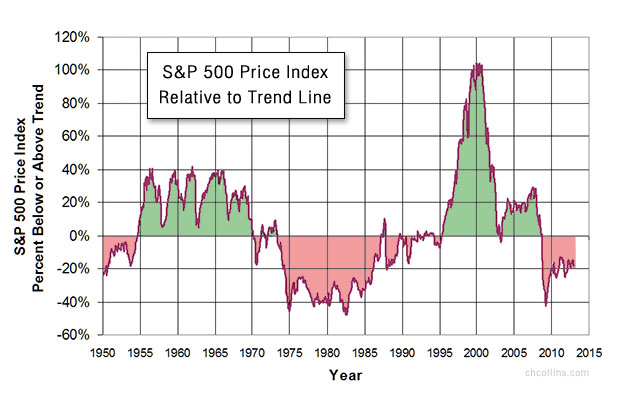
Plotted this way, the dot-com bubble of the late 1990s clearly stands out — at its peak, stock prices were nearly double what one would expect based on The Trend. Such levels were not sustainable, and the index returned to the trend line within a few years.
Where do we stand since the Great Recession and the recent recovery? The current price of the S&P 500 Index is 1495. If we were on The Trend, the index would be 1725, about 15% higher than where we are now. Good time to buy stocks, yes? Well, not so fast.
Let’s say you invested in an index mutual fund 40 years ago, at the end of January 1973. The price of the S&P 500 index at that time was 118 — right on the long-term trend line. The index would return to this price level many times, doing so for the final time in September 1982, over nine years later. If you had been forced to sell your investment at that point, you would have made nothing on your money for nine years (other than the dividends minus inflation). The Trend does not promise quick payoffs.
However, if you had held onto that 1973 investment for 40 years and sold it this month, you would have made about 6.6% per year, before dividends and inflation.
In August 2000, the S&P 500 Index closed at a price of 1485. If you bought an index fund that month, when the price was 103% over The Trend, you would be just about even today, twelve years later. Some people probably did just that.
One might conclude that a person should never invest in the stock market unless the price is below the trend line. That too would be a mistake. In the summer of 1956, the index was running 30-40% above The Trend. If you had decided to wait for the stock market to fall below The Trend before investing, you would have waited until February 1970. Stocks returned about 4.2% per year, on average, during that 14-year period. While you might have made just as much money from treasury bonds in that timeframe, the point is that you would not have lost money either.
Here is the best way, in my opinion, to view The Trend. Invest in the market with the idea that you are going to hold onto your shares as long as you can — 30, 40, 50 years or more. (It is not just marketing when mutual fund companies tell you to invest for the long term.) Remember that stock prices go up and go down but will eventually return to the trend line. If you buy shares when the price is below The Trend, you could think of it as a discount — but you will only get the discount if you sell the shares when the price is above The Trend.
The stock market is unpredictable. No one can say when it will rise or fall or by how much or how long it will stay there. If someone tells you otherwise, just pretend you didn’t hear. But it is a characteristic of the market that the index is usually within 40% of The Trend (look again at the second chart). If the index is more than 40% above The Trend, it may signal a bubble — probably a good time to sell (or at least not buy). Similarly, if the index is more than 40% below The Trend, it may be a good time to buy (or at least not sell).
Summary: Invest in index funds, as much as your personal situation and comfort allows, then hold onto the shares the rest of your life. Sell only when you must, preferably when the price is above The Trend.


 I made the most of my tenure as The Nope. I enjoyed the company of presidents and kings, and when I no longer enjoyed their company, I would just ask my wife to turn off the television. That’s right, I have a wife. You are allowed to have one when you are the Atheist Pope. I think you are allowed to have three if you are the Mormon Pope, but I am not infallible on that.


If I were to write a bible, it would be very short. None of that who-begat-who business or tales of desert tribes wandering in borderless lands. No, my bible would have one chapter and five verses, aspirations rather than commandments:
1. Be kind to others.
2. Be helpful to others, to the best of your ability.
3. Enjoy life and make the most of it, as it is the only one you have.
4. Be sparing in your judgments — no one died and elected you God.
5. Be sparing in your advice — no one died and elected you Dear Abby.*
I think that’s plenty for most of us to aspire to.
_______________________________________________________________
* In the King James version, Dear Abby is replaced by Dr. Phil, but the idea is the same.