Yearly Archives: 2016

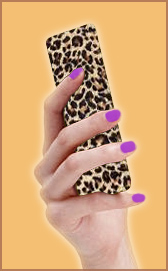
The Girl with the Leopard-Print PhoneA twelve-key rectangular array of thoughts on phones:

 1  Stieg Larsson, author of “The Girl with the Dragon Tattoo” and two other Girl novels, died in 2004, eleven years prior to his ill-fated move from Sweden to Las Vegas, where he would pen the widely-panned novel “The Girl with the Leopard-Print Phone.”  I read it, and I can attest that it’s a good thing it was never written.

 2  If you are a data-lean phone user looking for a cheap upgrade from your flip-phones, I highly recommend Consumer Cellular.  We pay $47 a month (no contract) for two Moto phones ($80 each) sharing 750 minutes and 500 MB data, which is more than enough for our needs.  Consumer Cellular uses the AT&T network: while not as well-regarded as Verizon’s network, it has been good enough for us.  I hate paying big bucks for anything, especially once a month.  Always suspicious of subscriptions.

 3  Here’s another recommendation.  We still need a landline — cell service is spotty in our mountain area — so we endure the usual array of annoying dinner-hour surveys and spam calls.  If you too have a landline, I recommend NoMoRoBo: this service intercepts robocalls and telemarketers on its blacklist and hangs up on them before the first ring.  Best of all, the service is free for residental users.  We have been using it for many months, and NoMoRoBo has not blocked a single false positive (a call that is not spam).

 4  On a more serious tone: the terrorists who attacked the Paris restaurants and bars, soccer game and concert hall last November coordinated their actions via burner phones,  one-time-use prepaid phones that cost about €30 ($35) each.  The fact that one needed a  passport to sign up for those phones did little to impede ready-to-die resident extremists.  One thought that comes to mind: a deposit on cellphone service — say €600, refunded in €50 monthly installments — might make acts of terror more costly to coordinate, more traceable, maybe rarer.  Maybe I’m dreaming.

 5  I did not know this and rather embarrassed that I did not: our unit of sound intensity, the decibel, was named after Alexander Graham Bell, generally credited with inventing the telephone.  Here I thought it had been named after the Liberty Bell or some other noisy or gargantuan bell.  But that would make too much sense.

 6  No matter what you read or hear elsewhere, accept this as true: Trader Joe’s wines taste cheaper than they are.  I have sampled their Velvet Moon Cabernet Sauvignon and their Andean Moon Malbec, both of which sell for $6 here.  Each of these tastes like every last molecule of tannin was filtered out and replaced with pomegranate extract. What does this have to do with phones?  Only this: if you are thinking of calling Trader Joe’s customer feedback line to complain about the wines, forget it, because it doesn’t exist.  Just like those tannins.

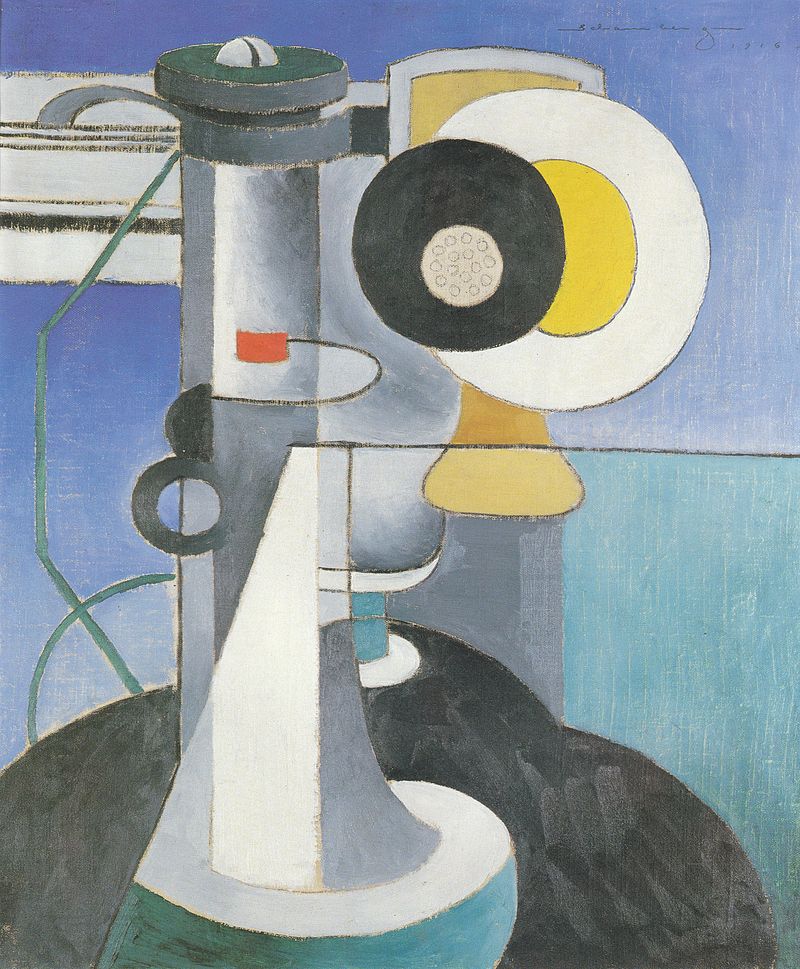
 7  Hello, art lovers.  Here’s a little quiz.  Which of these 20th-century telephone-themed works was created first — Lobster Telephone by Salvador Dali, Le Téléphone II by Tamara Lempicka, or Telephone by Morton Livingston Schamberg?  Click thumbnails to view larger versions.  Answer revealed below.
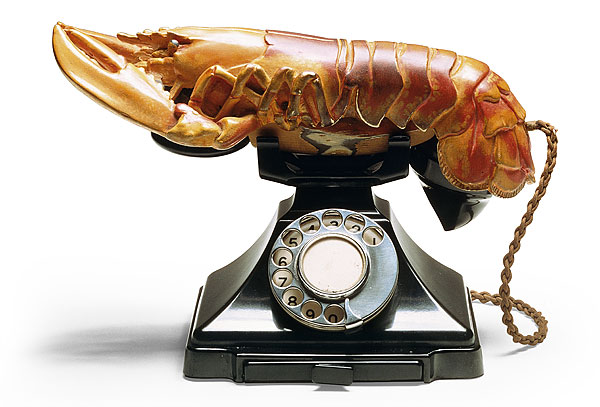
dali-lobster-1936

Dali

tamara-de-lempicka_1930

Lempicka

Morton_Livingston_Schamberg_-_Telephone

Schamberg

The Dali work was completed in 1936, the Lempicka painting in 1930, and the Schamberg painting in 1916, forty years after Alexander Graham Bell uttered his now-famous words, “Mr. Watson, stay there, I want to text you.”

 8  Oops, sorry, wrong number.  I meant 9.

 9  Number Nine, ringoNumber Nine, Number Nine…
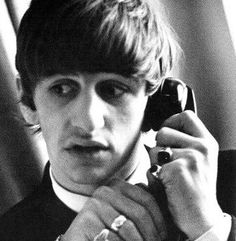
Only one Beatles song (No Reply) features the word telephone in its lyrics.  Four others mention phone, and nineteen include the word call.  By comparison, the word love is found in 98 of their recordings and you in 186.  Credit The Internet Beatles Album.

 *   Having arrived at the star key, I should act naturally and pay tribute to Ringo Starr (see photograph above).  You know, it don’t come easy but I couldn’t let this pass me by.

 0 Help us crack this phone.  Hey, go pound sandReally, help us crack this phone, it’s a national security issue.  Sure, you say everything is a national security issue, but we have customers to considerDamn you, Apple.  We’re cool.  [Long pause.]  You still want us to hack that phone?   No, we’re cool.  Got someone else.  Talk to you later.  Wait a minute… how did you do it?   No, really, it’s cool.  Next time.

Apple vs. FBI: when auras of invincibility meet.

 #  Most agree that the tones generated by telephone keypads (click the link to play the tones) are artificial and annoying.  Nonetheless, some of those two-pitch tones are more pleasing to the ear than others.  What explains this?  To put it simply, or not so simply, as Drs. Bowling and Purves of the Universities of Vienna and Duke, respectively, put it:

In light of present evidence, the most plausible explanation for consonance and related tonal phenomenology is an evolved attraction to the harmonic series that characterize conspecific vocalizations, based on the biological importance of social sound signals.

Sounds good to me, but I’d like to hear from you.  Text AGREE to 28801 if you agree, or AGREE to 28802 if you do not.  Data rates may apply.

Read 6 comments and add yours | Read other posts in Life

• Whenever I eat baby carrots, I feel like I should apologize to the mother.  “Your son is tasteless — but crunchy,” I would say to her, offering a slim ray of hope.

1930s Street Grid, Lower Hill, Pittsburgh, PA• The City of Pittsburgh is planning to redevelop the site where its Civic Arena once stood, the venue where I saw The Doors (once) and Chicago (twice) from up in the crow’s-nest section.  The plan calls for restoring part of the Lower Hill street grid.  If and when they do, I hope they bring back Epiphany Street.  Who wouldn’t want to live on Epiphany Street?  It would be…  what’s the word I’m looking for?

• Television shows (like Dr. Phil, CBS News, The Today Show and Ellen, among others) have to stop anointing themselves as family-reunion facilitators.  I thought this genre had exhausted itself fifty years ago, but some producers still seem to think it is all right to manipulate people and record their raw emotions for others’ entertainment.  If reuniting lost relatives is such a noble endeavor, it is worth forgoing the proceeds of broadcasting their tears.

• The harder the winds of change blow, the deeper the diehards dig their storm shelters.

• The Pittsburgh Pirates are leading major league baseball in batters hit by the pitcher — the team is averaging one hit batsman every 14-plus innings.  Some maintain that this is part of the game — if so, then the game they must have in mind is hockey.  For the sake of avoiding injuries and dugout-clearing brawls, I concur with those (going back at least as far as Carl Furillo of the 1953 Brooklyn Dodgers) who have called for awarding two bases, not one, to the batter who is hit by a pitch.

• The only thing I can say about being dead is that I wouldn’t know what I was missing.  Other than that, how can I, or anyone, speak with authority about that state of un-ness?  For instance, will I need to be fitted for my halo (I mean, horns) or is it one-size-fits-all?  How will I keep from accidentally stepping on thin spots in the heavenly clouds and falling back to earth?  Does God speak English or will I have to learn Esperanto?  If we are stuck with silly answers, we may as well ask silly questions.

• MLB baseball teams that lead after five innings go on to win the game 80% of the time [2015 data].  NFL football teams that lead at the half go on to win 77% of the time [2007]. NBA basketball teams with a six-point lead at the half win 80% of the time [1993-2009].  The protagonists and major antagonists of Shakespeare’s tragedies die at the end of Act V 85% of the time (Julius Caesar dies at the start of Act III and Marc Antony during Act IV).  It may not be over till it’s over, but most of the time, it is.

The Oily Slick of Politics - CHCollins• Politics knows only the logic of politics.  As with the addition of positive whole numbers, the domain of political operations is closed: the outcome of any  political calculation is another political result.  The real political revolution that we need is for people to solve problems, not jockey for power.  But just as adding whole numbers can never yield a fraction, this is not a result politics alone will ever produce.

• As I make art, my forces and intentions are in tension: surprise but do not indulge; inspire but do not impose; intrigue but do not ingratiate.  Some artists (Mapplethorpe, Duchamp, Picasso, Warhol) were determined to reject those tensions, to break the cables.  So we remember them, for having broken them — just as we remember bridges that fell, and not the ones yet standing.  It is my nature to be among the ones yet standing.

• I am going to stop using the perfect and past perfect tenses for a while.  I have had it with all those haves and hads.

• In films about The Holocaust, Jews have at times been depicted as complacent, or even complicit, with the horrors being inflicted upon them.  If you ever find yourself asking the outsider’s question, why didn’t Jews fight back, I would invite you to watch the Academy Award winning film Son of Saul.  Certain scenes in that film had a greater impact on me than any other drama or documentary on this subject.  Asking why Jews didn’t fight back is plainly the wrong question, as well as the wrong conclusion, when one sees that the real fight was to preserve humanity, not humans.  That fight, Jews won, conclusively.

I encourage you to read this interview with the producers of Son of Saul, conducted last year by Terry Gross of Fresh Air, after you see the film.

Photograph of Christopher Hitchens by Stephen Shepherd/Eyevine
“History is more of a tragedy than it is a morality tale.  The will to power, the will to use human beings in social experiments, is to be distrusted at all times.  No greater cruelty will be devised than by those who are sure, or are assured, that they are doing good.”
Christopher Hitchens, from Arguably.


Read 2 comments and add yours | Read other posts in Thoughts @ Large

At just four months of age, Sammy the Snake suffered a terrible loss: his mother was run over by a motorcycle as she tried to cross the road in sunny Milford State Park in Kansas where they lived.  It being such a critical time for mother-son bonding, the park ranger hoped another female snake would adopt Sammy, but they all just slithered away.  So the nurturing ranger decided to find a caretaker for Sammy outside the serpent family.

snakeandmouseLuckily, the ranger heard that the Department of Ecology and Evolutionary Biology at the University of Kansas had successfully paired an orphaned pot-bellied pig with a mouse.  Hoping for a similar outcome, the ranger moved Sammy to the University’s Student Farm  and then found a mouse that lived behind the cafeteria, the one that the food workers had named Morty.

Why a mouse?  Mice might not seem like the most caring of animals, but years of research have demonstrated that their level of altrusim is just less than that of ninth-grade humans, a species well known for empathy.  Mice remember other mice, they know left turns from right turns in mazes, and they twitch their whiskers in distinct, emotional rhythms when sizing up other species.  So, mice bonding with other animals is not so unlikely, especially with snakes, who are bright and expressive and rely so heavily on their tongues.

Still, the attempt to pair the two didn’t start out well.  When they first met, Sammy chased Morty around the water dish, coiling and rising up to appear as threatening as possible.  Morty fled — as mouse instincts demand — and burrowed in the mulch for hours, hoping that Sammy’s sensitive tongue would not detect him.

After one-hundred-twenty-four days of wary gestures and tentative tongue-flicks, the pair finally accepted each other, and the effort proved to be worth its danger-filled beginning.

“I still remember the day Morty gave the sniff of death to a vole that Sammy was about to consume,” said Dr. Peter Martin of the University’s Deep Well Biology Lab and known to his colleagues as “Uncle Petrie.”  As Dr. Martin would later testify, “We knew they were truly goombahs when they started to sleep cuddled up together.  I must admit, we were concerned that Sammy would coil up and crush Morty by mistake!”

Once the bond was made, snake and mouse were inseparable.  Being noctural, they would nap together in the day and move about at night, hunting for food.  Morty would rest his bristly tail on Sammy’s scaly back as they explored the enclosure and searched for snacks.  The staff expected Sammy to imitate the food-gathering habits of the more-experienced Morty, but instead the mouse became the copycat, even attempting to snare a cricket (not typically part of a mouse’s diet).

The well-meaning University Student Farm had always planned to reintroduce Sammy to  his family in the park where he was born.  But as he was being readied for release, Sammy became ill from a twisted intestine, and Morty disappeared.  Veterinarians were unable to save Sammy and could not locate Morty.  Sammy was just fifteen months into what might have been a fifteen-year lifespan.

The staff of the University of Kansas Student Farm were heartbroken, of course, but they all share the hope that Morty has survived to make other warm interspecies friendships.  But so far, other than some moldy tomatoes, there has been no sign of life around the dumpster behind the cafeteria.

Be the first to comment | Read other posts in Humour