


 A twelve-key rectangular array of thoughts on phones:
1 Stieg Larsson, author of “The Girl with the Dragon Tattoo” and two other Girl novels, died in 2004, eleven years prior to his ill-fated move from Sweden to Las Vegas, where he would pen the widely-panned novel “The Girl with the Leopard-Print Phone.” I read it, and I can attest that it’s a good thing it was never written.
2 If you are a data-lean phone user looking for a cheap upgrade from your flip-phones, I highly recommend Consumer Cellular. We pay $47 a month (no contract) for two Moto phones ($80 each) sharing 750 minutes and 500 MB data, which is more than enough for our needs. Consumer Cellular uses the AT&T network: while not as well-regarded as Verizon’s network, it has been good enough for us. I hate paying big bucks for anything, especially once a month. Always suspicious of subscriptions.
3 Here’s another recommendation. We still need a landline — cell service is spotty in our mountain area — so we endure the usual array of annoying dinner-hour surveys and spam calls. If you too have a landline, I recommend NoMoRoBo: this service intercepts robocalls and telemarketers on its blacklist and hangs up on them before the first ring. Best of all, the service is free for residental users. We have been using it for many months, and NoMoRoBo has not blocked a single false positive (a call that is not spam).
4 On a more serious tone: the terrorists who attacked the Paris restaurants and bars, soccer game and concert hall last November coordinated their actions via burner phones, one-time-use prepaid phones that cost about €30 ($35) each. The fact that one needed a passport to sign up for those phones did little to impede ready-to-die resident extremists. One thought that comes to mind: a deposit on cellphone service — say €600, refunded in €50 monthly installments — might make acts of terror more costly to coordinate, more traceable, maybe rarer. Maybe I’m dreaming.
5 I did not know this and rather embarrassed that I did not: our unit of sound intensity, the decibel, was named after Alexander Graham Bell, generally credited with inventing the telephone. Here I thought it had been named after the Liberty Bell or some other noisy or gargantuan bell. But that would make too much sense.
6 No matter what you read or hear elsewhere, accept this as true: Trader Joe’s wines taste cheaper than they are. I have sampled their Velvet Moon Cabernet Sauvignon and their Andean Moon Malbec, both of which sell for $6 here. Each of these tastes like every last molecule of tannin was filtered out and replaced with pomegranate extract. What does this have to do with phones? Only this: if you are thinking of calling Trader Joe’s customer feedback line to complain about the wines, forget it, because it doesn’t exist. Just like those tannins.
7 Hello, art lovers. Here’s a little quiz. Which of these 20th-century telephone-themed works was created first — Lobster Telephone by Salvador Dali, Le Téléphone II by Tamara Lempicka, or Telephone by Morton Livingston Schamberg? Click thumbnails to view larger versions. Answer revealed below.
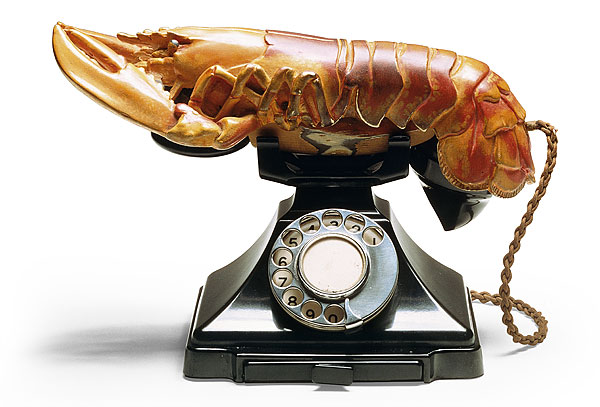 Dali |
 Lempicka |
 Schamberg |
The Dali work was completed in 1936, the Lempicka painting in 1930, and the Schamberg painting in 1916, forty years after Alexander Graham Bell uttered his now-famous words, “Mr. Watson, stay there, I want to text you.”
8 Oops, sorry, wrong number. I meant 9.
9 Number Nine, 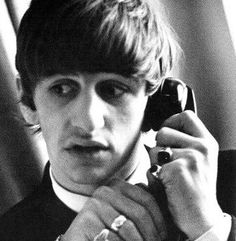 Number Nine, Number Nine…
Only one Beatles song (No Reply) features the word telephone in its lyrics. Four others mention phone, and nineteen include the word call. By comparison, the word love is found in 98 of their recordings and you in 186. Credit The Internet Beatles Album.
* Having arrived at the star key, I should act naturally and pay tribute to Ringo Starr (see photograph above). You know, it don’t come easy but I couldn’t let this pass me by.
0 Help us crack this phone. Hey, go pound sand. Really, help us crack this phone, it’s a national security issue. Sure, you say everything is a national security issue, but we have customers to consider. Damn you, Apple. We’re cool. [Long pause.] You still want us to hack that phone? No, we’re cool. Got someone else. Talk to you later. Wait a minute… how did you do it? No, really, it’s cool. Next time.
Apple vs. FBI: when auras of invincibility meet.
# Most agree that the tones generated by telephone keypads (click the link to play the tones) are artificial and annoying. Nonetheless, some of those two-pitch tones are more pleasing to the ear than others. What explains this? To put it simply, or not so simply, as Drs. Bowling and Purves of the Universities of Vienna and Duke, respectively, put it:
In light of present evidence, the most plausible explanation for consonance and related tonal phenomenology is an evolved attraction to the harmonic series that characterize conspecific vocalizations, based on the biological importance of social sound signals.
Sounds good to me, but I’d like to hear from you. Text AGREE to 28801 if you agree, or AGREE to 28802 if you do not. Data rates may apply.

This is among my absolute favorites of yours. Reminds me of RD in college, for some reason. Re #4, yes, you’re dreaming. All those people who need a cell phone occasionally but can’t afford one would be locked out. Unless, of course, the application included the question, “Are you planning to use this for nefarious ends?” and anyone who answered “Yes” would face the surcharge. 6. Buying $6 wine is asking for trouble. 9. The Internet Beatles Album is now my favorite new site. And here’s today’s challenge…Which Beatles song has the most unique words? My guess is “I Am The Walrus.” 0. Here is the oldest citation of “pound sand” I could find: “The late 19th century phrase pound sand in a rathole originated on campus and meant to be reasonably intelligent. It was usually found in the negative phrase not enough sense to pound sand in a rat hole. 1896 W.C. Gore Student Slang 14: pound sand, not to know enough to To be hopelessly stupid. ‘He can’t help us, for he doesn’t know enough to pound sand.’ 1899 Ade Fables in Slang (1902) 154: Somebody that wasn’t afraid to Work, and had Gumption enough to pound Sand into a Rat-Hole.” Again, great post. That is all.
Thanks Rob, glad you enjoyed it. Do me a favor, and email me the link to whatever site you use to find citations – or is it a subscription service? I often see references to LEXIS/NEXIS and wonder what that’s about and wish I had access to it.
Re: #4. Another solution might be to impose legal liability on the manufacturers and sellers of such phones. After all, if those phones are used regularly to engage in criminal activities, one could argue that certain harms generated by the users of those phones are “reasonably foreseeable” to firms who profit off such phones …
Thank you for your comment, Enrique. I can certainly see this happening in the USA at some point (until the telecom industry lobbies Congress to hold manufacturers harmless, as is now the case with guns). But is legal liability of the type you suggest that common in Europe?
That is a good question. In addition to EC law, most countries in Europe have comprehensive “civil codes” that establish a general duty to avoid harm, so we would have to research how courts in, say, France (where the November 2015 attacks occurred) have interpreted the scope of this duty.
It would seem then that this (economical cellphone service) is yet another victim of abuse of “the commons” (such as convenient air travel) where the cost of the abuse is borne by the non-abusers (manufacturers, legit users, general public). How do we make such abuse (terrorism) harder to execute by making it more costly to the perpetrators? — or is parasitism/opportunism always part and parcel of terrorism, culminating in a race to the bottom on both sides?