Yearly Archives: 2014

As I mentioned in an earlier post, David Walton was an English professor at Carnegie-Mellon University in the early 1970s while I was a student there.  His creative writing class introduced me to works such as Slaughterhouse Five, Catch-22, Trout Fishing in America and One Flew Over the Cuckoo’s Nest.  Once I had Slaughterhouse Five in my head, all I wanted to do was to write like Vonnegut — start my sentences with “So” and end them with “it goes” and stuff the middles with the resigned sound of nothing.  But I digress.

I treasured that class.  It seemed to embody everything college was supposed to be about, as depicted in college admission brochures.  I remember several beautiful fall afternoons in Pittsburgh when our class gathered on the lawn next to the Fine Arts building, the eighteen or so of us sitting in a circle and sharing our thoughts about our readings and writings.  And I remember Walton’s habit of tapping the filter end of his cigarette on his classroom desk for a minute or so, to pack down the tobacco before he lit up.  As I was also a smoker at the time, I copied his habit.  I was young, impressionable and looking for impressions to try on for size.
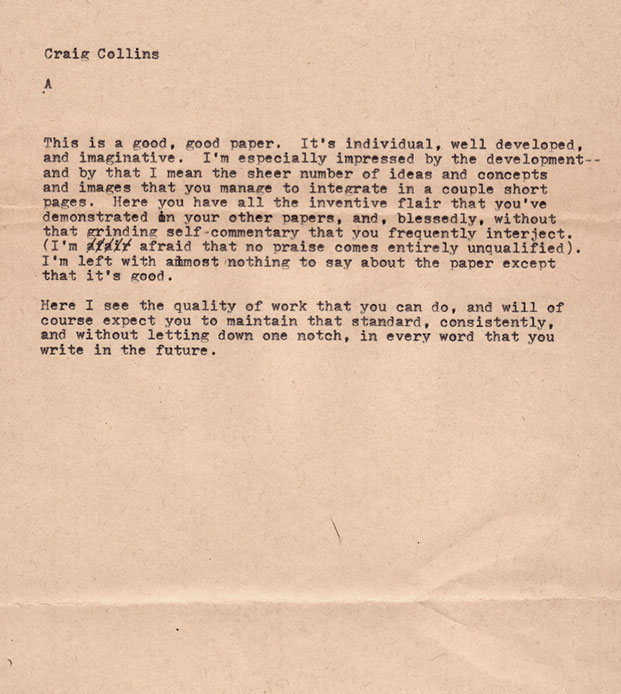
A Grade from WaltonI didn’t ace his class but it didn’t matter.  I pretty much wrote what I pleased.  I took some risks, and I was also complacent and self-absorbed, befitting a seventeen-year-old.  Befitting his role, Walton gave me personal and detailed feedback, some positive and some not.  His complaint about my frequent “grinding self-commentary” would not discourage me from signing up for his advanced writing class three years later.  I took it as a minor point-of-pride that I was the only engineering student in his class.  (I guess we were supposed to prefer being in the lab or doing some nerdy thing with slide-rules.)

David Walton was the only professor that I sort-of-wished I could have had a friendship with as an adult.  But that is the stuff of fantasy, as he knew little about me except for my writing, and I knew next-to-nothing about him, save for his attitude, his mannerisms and his critiques, typewritten on unbleached paper, which I have kept to this day.

Some weeks ago, I had the idea of contacting David Walton and inviting him to visit my blog, to show him how grown-up and all I have become over the past forty years, and how the grinding self-commentary he so lamented persists to this day.  (Yep, that shows him!) But then I had a rare moment of other-thinking: how could I ask David Walton to read more of my writings without having read a single word of what he has written?

To resolve this inequity, I did a search and found that David Walton has not only won the Flannery O’Connor Award for Short Fiction but has published three works, the latest being Ride in 2003.   So I bought a paperback copy of Ride.  And I have just finished it.

 • • • • •

This is where the trouble starts.  I figured I would read his book, share my impressions in this blog, and then contact David Walton and refer him to this post, where he would not only read my tribute to his novel but discover here the more than three-hundred splendid examples of how I write these days.  He would be thoroughly entertained, I would be duly flattered, and who knows, maybe it would lead to us having a beer together in Pittsburgh someday.

But questions arose.  First, how could I write an objective review of his novel if I had read it mainly to gain favor with him?  But let’s say I managed to be critical.  How could I ask him to visit my site, only for him to be greeted by a bad review, after which he is expected to read and lavish his comments on my blog?   And what qualifies me to review his book anyway?  I am no English professor.  I never tried to write a book.  David Walton has written books, short stories and reviews.  Who am I to tell him anything about character development or the difference between a story and a plot?  Whatever I had to say, I would only be putting myself in the position of having him review the soundness of my review.

As a result, I decided I am not going to write a review.*   This does not mean, however, that I no longer care what David Walton thinks about the blog.  I still intend to contact him and ask him to check it out, including this post.  He probably will not be entertained, and I will more likely be embarassed than flattered, but who knows, maybe it will lead to us having a beer together and exchanging a few pleasantries in Pittsburgh (or Asheville) someday.

_________

* Just a footnote.  I moderately enjoyed the novel.  The main character is Ray, an out-of-work history professor trying to teach developmentally-disabled people how to ride the bus from their group home in Pittsburgh to their West Versailles workshop and back.  I did not find Ray all that admirable — he came across to me as self-important, self-absorbed and ironically, considering the nature of his assignment, directionless.  Someone with grand thoughts and mundane ambitions.  Quite human.  As I read, I kept wondering what if anything of Ray’s character or situation was autobiographically inspired.
I appreciated the references to Pittsburgh landmarks, but I found the details of the bus rides — who got on, who got off, what Ray saw out the window — tedious after a while.  Too many bit-part characters to remember, especially when most of them did not participate in the story other than sit on the bus.  And my favorite character, the nearly-blind Morris, was written out of the storyline three-quarters of the way through, leaving Ray and his client Elliott to do what they needed to do to mop up the ending.
Ray (or should I say, Elliott) accomplishes his task in the end, but the narrative was so understated that I did not feel a sense of satisfaction reading about it.  I even started to hope for a Rod Serlingesque plot twist, where it is discovered that Ray is actually a resident of the group home, has an obsessive-compulsive fascination with bus routes, and relentlessly drills the other clients on this topic, with the remaining details revealed to have been a product of Ray’s juvenile imagination.  But no, no such surprise — the novel ends with Ray reflecting on the “lesson from his travels.”
I had other quibbles, but this footnote is not the place to air them.  Well, maybe one.  Describing Ray taking “a welcome and protracted dump” in a department store men’s room — I don’t think that detail was essential to the story.  Really, I don’t want to read about anyone’s bathroom activity or even acknowledge that people spend time there.  I know that I don’t.
All in all, it wasn’t a bad book.  Its premise had promise.  If you plan to read it, I would recommend you do so in three sittings or less.  This, I think, will keep you engaged in the main storyline and help you motor past the numerous loose ends that dangle and blind alleys that beckon.
If David Walton ever reads this footnote, I fear that any chance of my having a beer with him in Pittsburgh will have been poured down the drain.  So it goes.
Be the first to comment | Read other posts in Book Notes
Tacit
When no one
   is listening
   so quiet
When you walk into the woods
   by the creek
   and the water battles
   the rocks
When no one
   is listening
   and you live out loud
   thinkwalking and
   no one
   is listening
When no one
   oh wait
   maybe that person no
   a mistake
   I tried
When you sit next to the
   person with the
   interesting eyes
   who gives you nothing
   unless you work for it
   attention no
   listening no
   a mistake
   I tried
When no one
   is listening
   I said
   no one
   I said listen you
   I said listen
When you try to listen
   the quiet sky
   out of nowhere
   those angry eyebrows
   strafe you
   you be quiet
   as the sky
   as the clouds battle
When you get old
   and he is dead
   and you
   accept no one
   and no one
   is listening
When you hear yourself
   by yourself
   and you
   you discover
   you
   are not listening no
   no one
   so quiet
Be the next to comment | Read other posts in Creativity

• Those who are doomed to repeat the past may as well forget it.

• The Average American has 0.492 penises and 1.16 mammary glands, has a vocal pitch of 150 Hz (the E-flat below Middle C), watches the first half of The Walking Dead and then switches to the second half of Sunday Night Football, drives better than his or her spouse, and earns 89 cents for every dollar the Average American Man earns.

• One of my friends reposted this opinion opposing chivarly (to be read at your leisure).  My response is that everyday chivalry provides a framework by which I am able to do “little things” to show my spouse attention.  I am (and she is) as much a feminist as the next person.  If she didn’t appreciate the attention or felt offended by such gestures, then I wouldn’t do it and that would be the end of it.  The point is, how couples decide the favors they demonstrate to each other doesn’t have to be a dogmatic thing.  Some roles we play are traditional, others are not, but we are flexible and the number one thing is respect and love for each other, not adherence to an ism.

•  Something about me no one else knows: I like to play “Rain” on my car stereo when I’m taking it through the car wash.

• Girls born in France in October 2014 have a 50-50 chance of living long enough to celebrate New Year’s Eve 2100 at the Eiffel Tower.

• If only the behavior of complex social organisms were as predictable as the path traced by a projectile, such as a baseball thrown from an outfielder’s hand toward home plate.  The path of that baseball, once launched, is fully determined by the laws of physics.  Whether the runner racing toward home plate will be called safe or out depends on the ability of the catcher to predict the path of the baseball as it arcs toward him and then position himself so that he will be able to catch the ball and tag the runner with it before the runner reaches home.  The fact that we can do these kind of calculations in our heads says a lot about our mental capabilities, but it says even more about the predictability of physics, the umwelt we all take for granted.

• Speaking of baseball, something else that few people know about me: I have a replica Pittsburgh Pirates jersey that I wear when I attend Pirates games.  (I used to wear it on Halloween when we lived in a neighborhood with little kids, but that’s another story.)   Knowing my reverence for Roberto Clemente, my wife asked me why I did not have Roberto’s name and number (21) sewn onto the jersey.  First, I am not Roberto Clemente, second, I don’t deserve to wear his number, and third, millions of others think they do.

Roberto Clemente Stamps Roberto• Clemente is one of the few people (I cannot find the exact number) who has appeared on a U.S. postage stamp more than once.  I have original copies of both stamps.  I come across them from time to time, admire them and then wonder why I save them, my little shrine-in-a-drawer.  I could self-examine this to death or just accept it as part of being human, and for now I choose the latter.

Be the first to comment | Read other posts in Thoughts @ Large