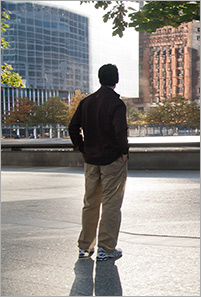
Ray always meant well.
It was only a few days after his art school graduation ceremony that Ray began watching his local news to find out who died that day in auto accidents, fires, and domestic violence. He would tell his mother he did this to “respect the lives of his fellow human beings.”
Not long afterward, Ray started thinking about the people in the small town where he and his mother used to live. He could not get the television news from his old town (the station was too far away) but he could read its online newspaper. He pored over the accounts of the fires, accidents and natural tragedies; the interests and charitable work of those who had perished; and the cherished memories of the survivors. Ray was not about to forget his former townspeople just because he was the one who moved away. That would be so arbitrary. It wasn’t right.
One day, while watching his own local news, it dawned on Ray that he knew nothing of the personal tragedies being suffered in the town just over the state line, only 30 miles away. Though he rarely visited there, Ray suddenly realized he had been ignoring these people, so close by, and surely as deserving of his attention as any of his neighbors, old or new. So Ray decided to add the tri-state online newspaper to his morning routine, and he read the accounts of their fires, accidents and untimely deaths with empathy and despair.
This suited Ray for a while, but only until September of the next even-numbered year: Ray had to register to vote in his new town. As he stood in line at the courthouse, moving his gaze over the murals of angels and vaunted historical figures from his adopted county, he saw that, as a citizen of his state and of his nation, his caring should extend to all those who share his borders — to do otherwise would be selfish.
Putting principle into practice proved to be a challenge for Ray: there were four large cities in the state where Ray and his mother had moved, and (as he discovered on the internet) there were over 70 metropolitan areas in the United States with 500,000 or more people. Nonetheless, with determination and conviction, Ray sat down and catalogued each city, bookmarked every one of their online newspapers (including The USA Today), and figured how early he needed to awaken each day to read them all. He wanted to clutch the pains of the victims in his fists and squeeze them until they were as white as his tired eyeballs.
After a few weeks, finally admitting to himself the difficulty of his situation, Ray asked to switch to the afternoon shift at the print shop so he would have enough time in the morning to scan his newspapers. It wasn’t enough. Since he was now at work when the evening news came on, Ray found he needed a DVR so he could watch the news when he got home. The DVR proved helpful: it meant Ray could fast-forward through the council meetings, the weather reports and the high-school sports, and only watch the stories of real import: fires, accidents, shootings, floods, tragedies.
I ran into Ray at the grocery store the other day and asked him how he was keeping up with things. He said, “Thanks for asking, but you know, my mom got sick and I’ve been taking care of her the past couple of months. So I had to give up all that other stuff, and Graphics let me take a leave, that was good of them. I just don’t have time to be sitting around drawing circles right now, you know? And, so, how are you doing?”