


Update July 25, 2011: See below for answer.
Here’s a puzzler for you. Let’s say you have a hot water circulating system in your house, designed to produce hot water nearly instantly when you open the faucet. This system is essentially a closed loop of piping with a pump in it.
Now, when the system is at rest (the pump is not running and there are no faucets open), all the water in the pipe is at the same pressure — the pressure of the water supply main. The question is, how will the pressure change if we simply turn on the pump? Specifically, what happens to the pressure (a) at the outlet of the pump, (b) at the connection to the water main, and (c) at the inlet of the pump?
Bonus: There is a shutoff valve on the water main where it connects to the piping loop. What happens to the pressures if we close this valve first and then start the pump?
If you would like to guess, please leave a comment. When a respectable period of time has elapsed (or when someone gets it right), I will post what I think are the answers.
Answer:
Hello again, household scientists, wherever you are. Here is an illustration of the system and my analysis of the problem. I should have included the sketch to begin with.
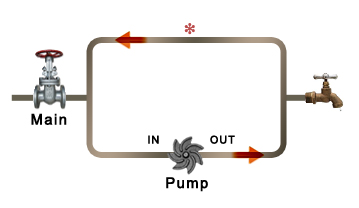 Let’s begin by pointing out that a pressure (or elevation) difference is needed to make a fluid flow from Point A to Point B. If there is no pressure difference, there is no flow, and vice versa.
Now consider the first situation, where the main water valve is open, all faucets are closed, and the circulating pump is started. The pump pulls water from its inlet (creating suction) and pushes water into its outlet pipe (increasing its pressure). So, the pump inlet pressure goes down and the outlet pressure goes up. What about the pressure at the water supply? Well, since there is no flow from the water main into the closed circulating loop, and there is no reverse flow from the loop into the water main (otherwise the loop would empty itself), this must mean there is no pressure difference between the water main and the piping loop at the point where they join together. So the answer: the pressure where the water main enters the loop is equal to the water main pressure; the pressure at the inlet of the pump is somewhat lower than the water main pressure; and the pressure at the outlet of the pump is somewhat higher than the water main pressure. The exact pressure readings depend on the friction caused by the walls of the pipe as the water circulates in the loop.
Now let’s consider what happens if we close off the water main before we start the pump. When we close the main valve, the water in the loop will remain at that (main) pressure indefinitely, as long as there are no leaks. But when we start the pump, the pressure at the inlet will decrease and the pressure at the outlet will increase, just like before. Somewhere in the circulation loop, the pressure will be the same as the original (water main) pressure, but this point will not necessarily be where the water main enters the loop. Instead, this will be the point in the loop where the friction on the outlet side of the pump is the same as the friction on the inlet side. If the pipe is the same diameter all the way around the loop, then you will find the original (water main) pressure at the midpoint of the loop (marked with a star in the illustration). The pressure will decrease from there to the inlet (suction) side of the pump. The pressure will be highest at the outlet of the pump and then decrease from there to the midpoint of the loop.
The difference between the pump inlet and outlet pressures will be the same in both cases.
I changed my mind: this puzzler wouldn’t stand a chance of being used on Car Talk.


I just always want a nice, hot shower. I don’t know how a lot of things work. I just want to push the button, turn the key and presto it is working! However, I am glad that someone thinks about these things, especially if it needs fixing.
Intuitively, I would guess that the pressure would remain the same everywhere, regardless of whether the pump is running (namely the pressure of the water main).
When the pump is running, it would circulate the water (imperfectly, since cold water would continue to flow from the main line), and any ‘extra’ pressure would be forced back into the water main (causing some of the heated water to be lost).
And if the main valve is closed, we would definitely have equal pressure everywhere, since it’s a totally closed loop (it would be the last-known pressure before we shut off the main valve).
What do you think?