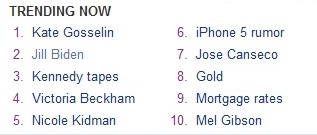
Today, folks who have money invested in the stock market saw the value of their holdings decline about 6 percent, as hedge-fund managers and day-traders acted on their hunches.

And here to your left are the topics that Yahoo says are “trending now”.  Seems that Yahoo only tracks people who care about actors, athletes and politicians.

Trendwise, Yahoo stock fell 5.5% today.

Be the first to comment | Read other posts in One-Foot Putts

Originally published July 11, 2011:

Today the “stock market” was down about 1.5%.   Would you rush to a department store and buy clothes if they were 1.5% off?

Financial gurus who subscribe to the “efficient market hypothesis” would like you to think that the stock market “knows” at every instant the correct price of everything offered for sale in the market.  If so, why does the price of stock vary so much on a day-to-day basis?  How can it be that something worth $100 yesterday is only worth $98.50 today?  What changed between then and now, other than the chemicals exchanged amongst the neurons in a stock trader’s brain?

Give me a break: the “market” has no idea what any price should be.  The market is a boat without an anchor, riding the tides.  As sentiment rises and falls, so do stock market prices.  Millions of people makes bets (and they are bets) based on sentiment every day.

In the end, we are all “greater fool” investors, ones who count on someone buying our asset at a higher price than what we paid for it.  As long as we all agree on this scheme, it works.  But if the game breaks down, if people stop believing that stock prices increase over time, then the market will crash, just as Tinkerbell’s light dimmed from lack of applause.

We (along with tens of millions of others) are counting on other people’s greed to finance our retirement.  Greed is a fairly good bet — not ironclad, but it has a long track record.

Be the first to comment | Read other posts in Finance

I’m not sure when or how we got our Taboo game, but we have played it for many years, usually when the children visit, and invariably over a glass of wine or two.  Officially, you need at least four players for Taboo (two teams of two) but sometimes that isn’t possible.  So I have developed rules for 3-player Taboo, as follows:

Every player plays for himself/herself.  The game consists of 12 rounds.  In each round, one player gives the clues, the second player guesses, and the third serves as referee and controls the timer.  If we name the players Alice, Bob and Chris, then the rounds proceed as follows:

Round Gives Clues Guesses Referee
1 Alice Bob Chris
2 Chris Alice Bob
3 Bob Chris Alice
4 Alice Chris Bob
5 Bob Alice Chris
6 Chris Bob Alice

Rounds 7-12 repeat the pattern of Rounds 1-6.  Extra rounds may be needed to break ties, but I will talk about that later.

It is possible for each player (including the referee) to score in every round.  The player giving the clues gets 1 point for every correct answer but gets a 1-point penalty for every word they pass or get buzzed on.  The player guessing the answers gets 1 point for every correct guess, but also gets a 1-point penalty for any word that is passed.  There is no penalty to the guesser if a clue gets buzzed — that applies only to the clue-giver.  Finally, the referee scores 1 point for every clue that gets buzzed.

For example, let’s say Alice is giving clues to Bob, and Chris is the referee.  Bob has five correct guesses, Alice passes on one word, and Chris buzzes Alice twice for illegal clues.   The scoring for that round is 2 for Alice (5 – 1 – 2), 4 for Bob (5 – 1), and 2 for Chris.

In this three-player version, there is a good chance that you will not need to play the final round to determine the winner.  If either Bob or Chris are leading going into Round 12, that person can simply refuse to play and walk away as the champion.

If your playing companions don’t care for that, you can all agree to play by the Skunk Rule: If the two active players in a round do not have at least one correct answer, then the team has been skunked and its players are penalized: their scores are reset to the lowest score of all players before the round was played, with a minimum penalty of 2 points.  The referee scores 1 point if a team is skunked.

If the leaders are tied after Round 12, they can agree to either end the game as co-winners  or else play three “overtime” rounds (Rounds 1-2-3) to break the tie, with the scores being added to the current totals.  In the latter case, the player who is behind after Round 12 can come back to win the game if he or she scores enough points in overtime.

Note: This is one of the most popular posts on this site, based on search results.  It even inspired one reader (see comments) to create a site to help manage the scoring and timing!

Read 4 comments and add yours | Read other posts in Life