Asked and Answered: 3.1
There is a ten-foot long alcove in our lower-level hallway — we call it the gallery. This is the one place in our house I can hang whatever I want (i.e., my own art) and switch it out whenever I want. To facilitate this, I installed a hanging system — basically a slotted rail mounted near the ceiling, with sliding wires and height-adjustable hooks. These systems cost more than you think they should (just search hanging systems to see which company is currently paying Google the most money to promote their wares).
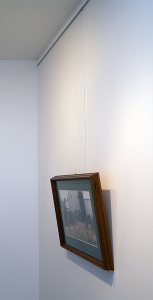 I was a bit surprised when I hung my first piece and saw how far forward it tilted (photo at right). It was not intuitive to me why hanging a fairly light 12″ x 16″ frame on a long wire should cause it to tilt so much. So naturally I googled it.
Unlike the latest Netflix binge-watch, the topic of tilted picture frames is not discussed much on the web. When it is mentioned, some surprisingly bad and/or misleading advice is often given. For example, consider this article in the San Fransisco Chronicle, “How to Keep Heavy Paintings Flush Against the Wall.” Written by a crafter, the author asserts: “A heavy painting tends to lean forward under its own weight, which isn’t attractive and can cause wall damage if it pulls its hanger from the wall.”
The second part of that sentence is true enough, but the notion that only heavy items lean forward is false, as my experience shows. Furthermore, the solution offered by the author may be well-intentioned but is half-baked at best. She instructs the reader to cut a piece of wire slightly wider than the frame, thread it through eye hooks on the sides of the frame, then “ensure the wire is taut to minimize the chances of the picture leaning forward.” Sounds reasonable until you consider the stress this would put on the frame.
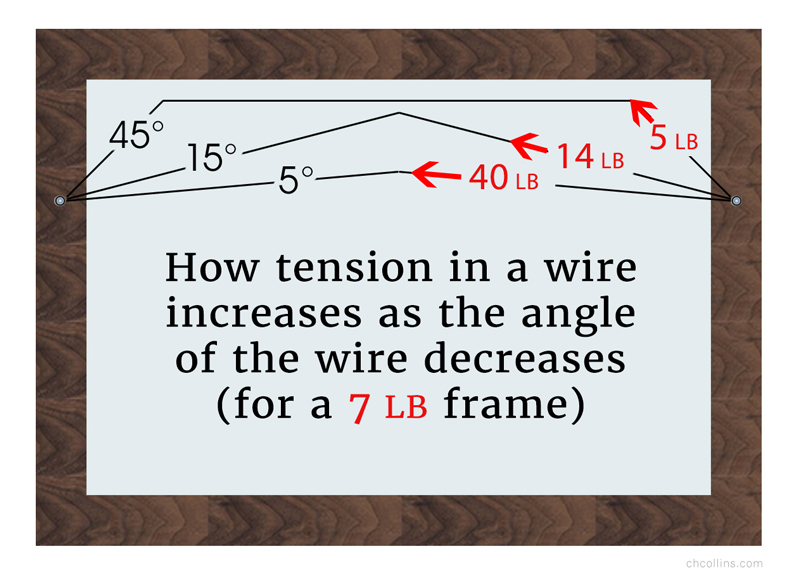
 The diagram at left shows how the wire tension increases markedly when a wire is strung taut. A 7-lb frame would generate exactly 7 pounds of tension when hung from a single vertical wire. But if you were to string the wire tightly across the frame and hang it on a hook, the 7-lb frame could produce 40 pounds of tension in the wire, pulling inward on each side of the frame and possibly damaging the art.
Stretching a wire tightly across a frame is about the worst thing you can do, especially with a heavy piece of art, says The Fine Art Trade Guild. This has not prevented people — even decorators and sellers of gallery systems — from recommending the practice. It is much better for the integrity of the frame, and the art, to leave some slack in the wire and hang the item from two widely-spaced hooks at 45-degree angles, as shown later.
All well and good, but it does not really answer my question: why do frames tilt forward? Having failed to find a good explanation on the internet, I decided to answer this myself. Bear with me, fascinated readers.
 This side-view (click to enlarge) may help you understand what is going on. Figure A shows a frame hung from a wire attached to an eyelet at its top-center. Now this is a really bad idea, because the eyelet would probably be pulled right out of the frame. But I show this to illustrate that there would be no cause for this frame to tilt. The real reason that a frame tilts forward (see Figure B) is because the wire is attached to the back of the frame, and the center-of-mass of the frame is in front of that point. This produces a torque that makes the frame tilt forward — it swivels at the attachment point until the center-of-mass is at its lowest possible position, denoted by the dot on the frame in Figure B.
 Most people in the Northern Hemisphere hang their pictures on a wall — I know I do. A wall pushes back against the bottom of the frame and affects its equilibrium position, such that it does not tilt forward as much a free-hanging frame would. The animation at left shows how a frame reaches its equilibrium position when hung on a wall in the traditional way.
Where one attaches the wire makes a difference in how much the frame tilts. The online world offers conflicting guidance on this. Most sites advise that you attach the wire to the frame one-third of the way down. Others say, one-quarter of the way down, or a certain number of inches from the top. Is there a definite answer here or only opinions? Or as Mitch Hedberg asked, with respect to belts and belt loops, who is the real hero?
The hero in this case is geometry, along with a small dose of physics and calculus. We are going to solve the frame-tilt problem for the benefit of man-and-womankind. Don’t worry, there are no equations involved — until the Appendix.
My Findings
 Here is the setup (click to enlarge). A frame of length F is hung on a wall by a wire. The slack in the wire (the maximum distance one can pull the wire away from the back of the frame) is W. The wire is attached to the frame B inches from the bottom of the frame and C inches from the center of the frame, and it pivots freely at the wall and the frame. The center-of-mass (denoted by a red dot) is halfway down the frame and distance D from the back of the frame, where I assume the glass is mounted. We know F, B, C, D and W and we want to find g, the gap between the top of the frame and the wall, when the frame is at equilibrium — i.e., the lowest possible location of the center-of-mass. In other words, we want an expression for the maximum value of y (= y1 + y2 + y3) and the corresponding value of g.
 It took a few hours and some brushing up on my trigonometry to find the right approach, but I got there (see Appendix). The chart at left summarizes how the slack in the wire and the position of the glass affects forward tilt, for frames of various heights. Here, I assumed the wire was attached one-third of the way down from the top of the frame, as most self-styled experts advise.
The solid lines in this chart correspond to 10-inch, 20-inch and 40-inch-high frames with the center-of-mass 1/2-inch from the back of the frame. You may be surprised to see that shorter frames tilt forward more than taller ones, when one follows the “one-third rule” and provides the same slack in the wire in each case.
The dashed lines in the chart show how moving the center-of-mass 1/8-inch to the front or rear of a 20-inch-tall frame impacts forward tilt. It may seem insignificant, but a 1/8-inch increase in the depth of the rabbet would widen the gap at the top of such a frame by 25%. It is simple physics — the farther the center-of-mass from the rear of the frame, the greater the torque and the more the frame tilts.
The next chart  (click to zoom) shows how fastening the wire at different points on a 20-inch-tall frame affects the forward tilt. Attaching the wire closer to the top always reduces tilt. Knowing this, one may ask, why not just forget the “one-third rule” and attach the wire one-sixth of the way down or three inches down from the top?
Here is one reason: the closer to the top that the wire is attached, the less slack one can allow without the wire being visible. So the “one-third rule” represents a compromise solution for traditional one-hook installations — some forward tilt is accepted for the sake of having more slack and lower tension in the wire.
Interestingly, the weight of the frame does not enter into the calculation. This means that a sheet of foamboard of the same dimensions and same center-of-mass as a wood frame will tilt the same amount when hung the same way.
So it is not true that “heavy” frames tilt just because they are heavy. Frames tilt forward more when the wire is attached closer to the center, when the slack in the wire increases, and when the frame is front-heavy. In typical hanging situations the forward tilt is usually less than 1/4-inch. But when the frame is suspended on a long wire, as gallery systems do, the tilt can be noticeable — 1 inch or more for a 20-inch-tall frame.
I provide a calculator at the end of this post that allows you to estimate the forward tilt of your own frame. Details below.
The Bottom Line
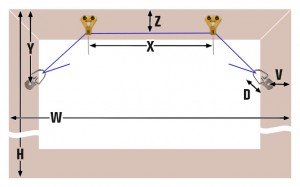 So what have we learned and what do I recommend? If you want to use hooks and wires and you want to hang pictures close to the wall without undue stress on the wire or frame, I suggest using two hooks and 45° wire angles, as illustrated in the diagram at right. This may look a little complicated but it is do-able.
In the original version of this post, I provided a formula to help you with the installation, but in practice, it didn’t go far enough. So I programmed a two-hook frame hanging calculator and posted it in a companion article titled (what else) The “Hang It with Two Hooks” Calculator. This online calculator suggests where to fasten the D-rings, how to install the wall hooks, and the length of wire to cut. This makes the task much easier.
Yes, two hooks present the added challenge of ensuring they are level, but this post is all about reducing forward tilt without stressing the wire or frame. If you are up to the task of carefully positioning two hooks, you might consider eliminating the wire altogether and hang the frame directly onto the D-rings. One drawback to this method is the visibility of the hardware; the other is the extra precision that is needed in mounting the hardware.
But what about my gallery hanging system with the long cables? Here, since we have to rely on a single hook, I suggest wiring the frame according to the one-third rule, with just enough slack so that the cable hook will engage the wire close to the top rail of the frame. Then attach an offset clip to the top rail, slightly off-center, and tuck the cable behind the clip. For a 20-inch-tall frame hanging 30 inches below a cable track, this will reduce forward tilt from nearly 1-1/4 inches to less than 1/2-inch.
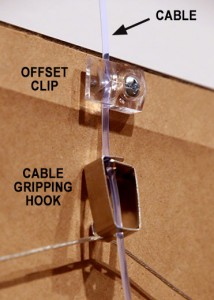 By reader request, I have added a photo (click to enlarge) of how the offset clip, cable, and cable hook are installed. This shows the rear of the frame with the cable threaded behind the offset clip. Here I have used a clear 1/8″ mirror clip instead of a metal clip.
Others have used Velcro strips for this purpose instead of offset clips, which is a nifty idea if you don’t mind attaching something to the dust cover with adhesive.
So now you know and so do I. Asked and answered indeed.
The Forward Tilt Calculator
Several readers asked that I create a calculator to estimate the amount of forward tilt for a particular frame. Because the calculation requires iteration (i.e., the answer cannot be found simply by plugging in the known quantities), I had thought this was impractical. However, I discovered that, with a reasonable starting guess, just one iteration is enough for two-decimal-place accuracy. So I offer the following one-iteration calculator.
The user enters four known quantities: the frame height; the rabbet depth (that is, the estimated depth of the center-of-mass of the frame); the wire-to-frame attachment point, measured from the top of the frame; and the amount of slack in the wire, defined as the distance one can pull the wire away from the back of the frame. The calculator returns the amount of forward tilt one can expect.
A Final Word
This post was updated April 7, 2020, with a cleaner derivation, a gap calculator and an animated illustration of why frames tilt forward. This is Part One of a four-part series on hanging frames with hooks and wires. You may also be interested in the follow-up articles, The “Hang It with Two Hooks” Calculator, The Physics of Hanging Pictures, and The “Hang It on Two Studs” Calculator.
If you have found this post informative or entertaining (as about 1000 people a month do), you might enjoy other posts on my blog. Check out my favorites, and consider exploring and subscribing. My “cup of coffee” invitations appear only on my articles about the physics of hanging pictures.
[ A NOTE FROM THE AUTHOR ]
If you find value in this post and would like to express your appreciation,
you can buy me a coffee or martini! Click below to add a tip to my coffee fund.
This takes you to my Buy Me A Coffee page. Thanks! – CHC
Appendix: Calculating the Forward Tilt in a Frame Hanging on a Wall
I provide a full derivation of the problem here. If you would rather not delve into that, please refer to the diagram above. We want to find the gap g between the frame and the wall, given the known variables F, B, C, D and W. To get there, we first need to find an expression for y = (y1 + y2 + y3), then use calculus to find the maximum value for y and back-calculate g.
I found it easiest to solve for y in terms of the angle formed by the bottom of the frame and the wall, then replace the sine of that angle with g/F (see the full derivation for details). This ultimately led to the following expression for y:

To find the maximum value of y, and the gap between the top of the frame and the wall at that location, we need to differentiate this equation with respect to g, then set dy/dg = 0 and solve for g by iteration:

This is how I generated the data for the graphs in the body of this report.