Category Archives: The Arts

Asked and Answered 3.3

This is the third and final article in my series about hanging picture frames.  The first post, Why Frames Tilt Forward, discusses why frames tilt at the top and what you should and should not do about it.   My next post, The “Hang It with Two Hooks” Calculator, presents an online calculator to help you hang pictures with less forward tilt, using two wall hooks and 45° wire angles.  This post completes the picture, so to speak.  Here I try to illustrate, with intuitive examples, the role of physics in picture hanging.  Most of all, I want to help you understand why it is a bad idea to string a wire tightly across a frame to keep it from tilting forward.

2hookicon2I will also discuss the picture-hanging hardware I like and why.  Finally, I will provide another online calculator — this one evaluates your frame’s margin of safety by estimating the tension in the wire and the tendency of your frame to bend.  Click the icon at right to go directly to my safety-factor calculator.

Physics-minded readers, relax.  This article is for general readership.  So I am not going to distinguish between mass and weight, I am ignoring the gravitational constant, and I will use pounds, not newtons, as the unit of force, because that is how the people around here hang pictures.

The Graphical Physical Tour

FIGURE 1

FIGURE 1

Everyone else can relax too.  I’m going to walk us through some basic physics that my wife and I learned in high school, before we started dating.  I’m sure she remembers all of this.

Let’s start with something simple.  In Figure 1 (click to zoom) we see a 1o-pound weight hanging from the ceiling via a wire.  The weight is at rest, neither rising or falling — this means that the upward force (or tension) in the wire must be exactly equal to the downward force w of the weight.  Hanging a 10-pound weight on a single wire produces 10 pounds of tension in the wire.

FIGURE 2

Onto our next example.  In Figure 2 (at right), the weight is the same as before (1o pounds) but it is now hanging by two identical wires instead of one.  Once again, the downward force w of the weight is balanced by the upward pull of the wires.  Because there are two wires, each individual wire carries just half the load.  So the tension in each wire is now w/2 (or 5 pounds in this case).

Okay, time to use your intuition.  If we were to weld together the two wires in Figure 2 at the top, would this change the tension?  No — the tension in each section of the wire would still be w/2.  Ponder this until you’re comfortable with the idea.

Now that (in our minds) the two wires are connected at the top, let us take one more step:  slice the weight down the middle, so that each end of the wire supports half the original weight.  This action should also have no effect on the tension in the wire.  Agree?

FIGURE 3

FIGURE 3

We are now prepared to consider this model of a frame suspended from one hook (Figure 3).  The total weight w is the same, but it is divided into two equal weights supported on either end of a single continuous wire.

The wire passes over pulleys at the top and sides. The top pulley represents the wall hook; the side pulleys are the D-rings attached to the frame.

The weights create forces that pull downward at the top and inward at the sides.  We will take a closer look at this in the diagram below (Figure 4) which focuses on the left side of the setup (the right side is a mirror image).  It may be helpful if you click on the figure to view it full size.

FIGURE 4

Once again, we have a system at rest: the weights are not rising or falling and the pulleys are not moving.  This means that the downward forces are balanced by equal and opposite upward forces — and the same is true for the horizontal forces.

Let’s zoom in on the force on the left side.  The weight w/2 exerts a downward force at the pulley, which must be offset by an equal force upward.  But the wire does not extend upward — instead it heads away from the pulley on a diagonal.  How can a diagonal wire produce an upward force?

It helps to imagine that the pull of the wire is composed of vertical and horizontal parts that add up, so to speak, to a total force (tension) in the diagonal direction.  In the figure, I denote the vertical and horizontal parts as Ty and Tx, respectively.  Because there is no net motion in the vertical direction, we know that Ty (the upward force) must equal w/2 (the downward force).

How do we find Tx, the force in the horizontal direction, and T, the tension in the wire?  Here, we have to use some trigonometry.  The wire tension T equals Ty times the cosecant (csc) of the wire angle α, and the horizontal force Tx equals Ty times the cotangent (cot) of the wire angle α.  If you did not take trigonometry in school, please accept this on trust.

Sorry for the math, but I wanted to show how the wire angle has a multiplier effect on the tension T.  The smaller the wire angle (that is, the closer to horizontal the wire is strung), the greater the multiplier.

I have listed the multipliers for various wire angles in Figure 4.  The first column of the table is the wire angle, the second column is the tension multiplier, and the third column is the horizontal force multiplier.  These multipliers apply to Ty (which is w/2 in this case).

From the table, we see that if the wire is strung only 5° from horizontal, then the tension in the wire will be more than eleven times w/2.  For our 1o-pound frame, the wire tension would be 57.3 pounds and the inward pull on each side of the frame would be 57.1 pounds!

But if we were to string the wire 45° from horizontal, the wire tension would be 7.1 pounds and the force pulling in on the side would only be 5 pounds.  This shows why one should not string a wire tightly across a picture frame to reduce its forward tilt.

I like the idea of using two wall hooks and 45° wire angles, as discussed in my other posts, because it reduces both the wire tension and the inward pull on the frame.  But this does not mean that horizontal forces go away.  In any two-hook installation, there will be a net horizontal force on each hook, pulling them toward the center of the frame.

Figure 5: Forces on Wall Hook (Two-Hook Installation)

FIGURE 5

The diagram at left (Figure 5) depicts one wall hook in a two-hook setup.  The left end of the wire extends diagonally down to the frame, and the right end leads to the other hook.  The wire tension T is the same everywhere along the wire.

In the figure, the black arrows represent the forces that the wire exerts on the hook.  The net force on the hook Tz (red arrow) results from adding together the horizontal and vertical components of these forces.

Again, using some trigonometry, we find that the force Tz will always be somewhat higher than Ty (the exact formula is shown in Figure 5).  The direction of this force relative to vertical is one-half the wire angle.  In the case of our preferred 45° wire angle, the overall force on each hook would be 0.54 times the frame weight and the force would be directed 22.5° inward from vertical.   The horizontal component of this force would be 0.21 times the frame weight.  If one were to use a steeper wire angle — say, 60° from horizontal, as  some people suggest — it would increase the lateral force on each hook by almost 40%.

That’s it for the hard-core physics.  Let’s talk about what this means for picture framing.

[ A NOTE FROM THE AUTHOR ]

If you find value in this post and would like to express your appreciation,
you can buy me a coffee or martini!  Click below to add a tip to my coffee fund.

This takes you to my Buy Me A Coffee page. Thanks! – CHC


Two-Hook Hardware

I do not intend to review all the various hardware available for hanging pictures.  Instead, I am going to focus on the parts and methods for a two-hook, low-forward-tilt installation. So the parts of interest here will be D-rings, wall hooks and wire.

FIGURE 6Let’s start with the hardware you use to attach the wire to the frame.  I much prefer D-rings (far left) because they lay flat and lead to less forward-tilt than eye-screws (right).  Also, D-rings are fastened to the frame with #6 or #8 screws which are larger and have deeper threads than the eye-screws that amateur framers often use.  This offers more resistance to sideways forces.

Next, the wall hook.  As I mentioned just a minute ago, each hook in a two-hook setup is subject to a lateral force.  When using 45° wire angles, the horizontal force on each hook will be about 20% of the weight of the frame.  But wall hooks are designed for vertical loads, not horizontal ones.  The wide base of the two-nail hook (Figure 5) offers extra stability in this situation.  I have not tested different brands but New England carpenter Doug Mahoney did, and Doug recommends the Floreat hangers sold by Ziabicki Imports.  I suggest you read his article on picture hangers – very thorough.

Finally, the wire.  I am always amazed by the types of wire I see on frames, old and new. Incredibly, I have seen framers re-use the wire from the customer’s old frame, even when the old wire was corroded and kinked.  I have also seen them use the thin consumer-grade wire that you find in drugstores and supermarkets.  Why do reputable people cut corners on a commodity like wire after so much money was put into the rest of the frame?

The strength of wire depends mostly on its thickness (gauge) and on its construction, i.e., the number of strands in the wire.  It is hard to find technical data (vs. marketing claims) on the breaking strength of picture-hanging wire.  I wrote to Wire & Cable Specialties, the Pennsylvania-based manufacturer of the Super Softstrand vinyl-coated stainless steel wire that I like to use — they replied that the breaking strength for this wire was about 2.5 times the so-called “maximum picture weight” that is printed on the spool. 

The following chart shows Super Softstrand breaking strengths for their various wire sizes, based on what they call the “maximum picture weights”:

Wire Size “Maximum Weight” Breaking Strength
#2 15 lb 37 lb
#3 20 lb 50 lb
#4 25 lb 62 lb
#5 43 lb 107 lb
#6 60 lb 150 lb

But where does “maximum picture weight” come from?  The tension in a picture-hanging wire depends not only on the weight of the picture but the slack in the wire, which depends on how the framer wires it.  Wire manufacturers can’t predict how a picture will be hung.  But they do know the forces it takes to irreversibly stretch and break their wires.  Why they don’t simply cite those numbers is beyond me.

“Wire size” for picture-hanging wire is another vague term that has less to do with gauge than its weight rating.  I have one spool ach of the #4 and #5 Super Softstrand.  I almost always use the #5 wire unless I’m hanging something very small and light.  The #5 is a seven-stranded wire that measures about 0.040 inches diameter (equivalent to 18 gauge) without the vinyl coating, and about 0.060 inches including the coating.  In my opinion, the #5 wire is as easy to thread and knot as any other size.

Unless you frame thousands of pictures, you will not save much money using thinner wire: you can buy 500 feet of #5 wire or 1125 feet of #3 wire for about $30 (2021 prices).  If the average frame needs 30 inches of wire, and you framed 200 pictures a year, you would spend $30 a year on #5 wire vs. $13 on #3 wire.  This works out to about 9 cents a frame.  Framers, I ask you, is it really worth 9 cents to use a cheaper, weaker wire?

The Picture Frame Safety Factor Calculator

At last, the calculator.  This calculator lets you estimate the tension in the wire and the inward deflection of the sides of the frame, based on your dimensions and wiring setup.  This necessarily involves a number of assumptions, which I will discuss after presenting the calculator.

To evaluate the safety factors in your frame, you will need to enter the dimensions shown in the figure below:

Picture Frame Safety Factor Dimensions

First, indicate whether you have one wall hook or two.  (Before doing this, you might want to consult The “Hang It with Two Hooks” Calculator for my two-hook recommendation.)  Next, select whether you will enter the weight of your frame or let the calculator estimate the weight from its construction.

Now enter the frame dimensions, starting with the overall width and height (W and H) and the total length of wire (L).  If you are using D-rings, enter the length (D) from the hole to the tip.  But if your wire is attached directly to the frame, enter zero for that value.

Next, enter the distance (B) between the D-ring fastening screws (or wire fastening points if there are no D-rings).   If you indicated you are using two wall hooks, you will be asked to enter the distance (X) between the hooks.

Finally, enter the dimensions of the frame molding and the breaking strength of the wire.  It is possible you may not know these values, so here is some guidance:

For the cross-section of the molding, enter the face width of the molding (F) and the average thickness of the molding (T).  Frame moldings can have complicated profiles, so do your best to estimate average thickness.  The more curves in the molding profile, the greater uncertainty there will be in the estimated deflection.

For the breaking strength of the wire, enter the value if you know it; otherwise enter 2.5 times the rated weight.  If you don’t know that, make a conservative guess such as 50 lbs. or less.  Corroded or kinked wire is likely to have a lower breaking strength than new wire — any wire is only as strong as the weakest point along its length.

When you are finished, click CALCULATE to validate your entries and show the results. The calculator will estimate the tension in the wire and tell you what percentage of the breaking strength this represents.  (With wire and cable, it is common to use a 5x safety factor, which implies the tension should be no more than 20% of its breaking strength.)  The calculator will also estimate the inward deflection of the sides of your frame.  I suggest that if the deflection is more than one-third the typical clearance (1/16th-inch all around) between the frame and its contents, then you are in danger of damaging the artwork and/or glass.  Do not count on the glass to reinforce a frame: it is the job of the frame to support the art and the glass.

As promised, here is a list of my assumptions:

  1. The estimated weight (if selected) assumes 2.5 mm soda-lime glass (if selected) with 2.5 specific gravity, wood frame molding with 0.4 specific gravity, and other materials at 0.002 lb / in².
  2. Elongation of the wire due to tension in the wire is ignored.
  3. The force pulling inward on the side of the frame is assumed to be concentrated at a point one-third of the way down from the top of the frame.  The corners of the frame are assumed to be stationary.
  4. The calculator does not evaluate the integrity of the miter joints or the fasteners.
  5. The side of the frame is assumed to bend as if it had a rectangular cross-section.
  6. The amount of bend in the frame is inversely proportional to the elastic modulus of the wood.  The elastic modulus is assumed to be 1,500,000 lbf / in², which is a mid-range value for typical framing woods (see reference).

If the calculator warns you about tension or excessive bending of your frame, I suggest you buy some #5 vinyl-coated wire and consult The “Hang It with Two Hooks” Calculator to find a more frame-friendly wiring method.  Also, be aware that the taller the frame or the narrower the molding, the more that its sides will bend inward for a given tension.

And now I must add my usual disclaimer.  This calculator makes it easy for you to estimate the safety factors in your framing situation — but because of the assumptions involved, the results should only be treated as estimates.   The calculator may indicate a problem where there is none, or it may fail to warn you that a problem exists.  I offer this calculator as a convenience but I assume no liability for damage of any kind, even if my suggestions are followed exactly.  You bear full responsibility for choosing to use this information.

That concludes my three-part series on framing with wall hooks and wires.  I believe this is one of the most exhaustive (hopefully not exhausting) treatments of this topic that you will find on the internet.  I have tried to make it as accessible as possible.  Please let me know if you find the calculator useful, or if you have problems or discover bugs while using it.

Read 21 comments and add yours | Read other posts in Asked & Answered, The Arts

Asked and Answered 3.2

Click to Use CalculatorTwo years ago, I posted an article here called Why Frames Tilt Forward, explaining why the top of a picture frame tilts away from the wall and what one should and should not do to address this.

The mistake that most people make (and a remedy that even some frame shops prescribe) is to fasten the wire tightly across the frame so that there is almost no slack in it.  But as I pointed out in my article, this can put considerable strain on the wire and the frame when the picture is hung.

If you don’t believe that a professional framer would make such a mistake, let me share a little story.  We recently took a favorite picture of ours to a local frame shop for reframing so that it would better suit our décor.  It was a large frame, about 46″ wide and 34″ high.  When we picked up our frame, I noticed how taut the wire was, and I mentioned this fact to the owner.  I also told her about my blog post on this topic.  She seemed disinterested.

Rather than argue with her, I decided I would rewire it when I got home.  As I was carrying the frame into our bedroom by its wire (the only practical way to carry such a large piece), the wire snapped and the corner of the frame hit the floor.  Luckily, I was carrying it only eight inches or so above the floor and, luckily, the floor was carpeted; otherwise, the frame or the floor or both would have been damaged.   Rest assured, I was not carrying the frame in such a way that it bounced around and tested the wire.

I rewired the frame with my own hardware, my own wire and according to my own rules, and I am confident that it will now not fall, bend or break.

On our next visit to the framer, I told this story to the owner, who remained unconcerned. Her response was that a frame should not be carried by its wire.  Apparently, she was not  familiar with the concept of a safety factor.  I thought her excuse was as flimsy as her wire.

Clearly, this frame shop is winging it.  They are content to string a wire across the frame and call it a day.  They are not mindful of physics — and they will not have a second chance to demonstrate this to me.

So… how do you know whether your frame shop is using their heads?

• • • •

But enough of cautionary tales.  In Why Frames Tilt Forward, I suggested that one way to achieve a low-tilt and low-tension installation is to use two wall hooks and 45° wire angles  (see figure below).  My instructions, however, were not so easy to follow — I know, because I tried to follow them myself.  The main difficulty was figuring out exactly how much wire to cut, something my instructions had not spelled out.Two Hook Frame Hanging Diagram

This is an ideal application for an online calculator — no fancy math, just basic geometry.  So, to help my readers, I have programmed my formulas into the wiring calculator below.  The user enters the outside dimensions of the frame (W and H), the size and position of the D-rings fastened to the frame (D and V), and the desired distance from the top of the frame to the bottom of the wall hook (Z).  The calculator returns the vertical position of the D-rings (Y), the spacing of the wall hooks (X), and the length of wire to cut, which includes three inches at each end for making knots.  To make things easier, some default values are suggested and results are rounded to the eighth-of-an-inch.

Notice that my illustration suggests the use of D-rings as well as double-nail wall hooks.  D-rings are preferable to screw-eyes because D-rings lay flat against the back of the frame, reducing the propensity for the frame to tilt forward.   And the wide base of double-nail wall hooks can help distribute the lateral forces associated with a two-hook installation.  More on this in the final post of this series, The Physics of Hanging Pictures.

In my low-tilt, low-tension scheme, the D-rings are placed one-fifth of the frame height below the top, for frames that are 30 inches tall or less.  (For frames taller than 30 inches, the calculator transitions to the one-sixth rule.)  The wall hook spacing and the wire length follow directly from this. 

However, if the calculated wall hook spacing is less than one-third of the D-ring spacing, the calculator suggests values for a one-hook installation instead.  In the one-hook case, the wire angle varies with frame height, but the angle will be at least 33° above horizontal.

One final note:  If you are not using D-rings, then set D equal to 0 and set V equal to the horizontal distance from the edge of the frame to the wire attachment point.  Y will be the distance from the top of the frame to the wire attachment point.

Click CALCULATE after editing your entries to view the installation instructions.

In a two-hook installation, there may be less slack in the wire than you expect.  To avoid frustration, try this: center the frame over the left hook and engage the wire into the hook, then shift the frame all the way to the right and engage the wire into the right hook.

I must end with a disclaimer.  This calculator makes it easy for a person to hang a picture with low forward tilt by using two hooks and 45° wire angles.  But whether this method is suitable in your situation is a judgment only you can make.  You bear full responsibility  for your installation.  I provide this calculator as a convenience but I assume no liability for damage of any kind, even if the suggestions offered in this post are followed exactly.

With that out of the way, happy hanging.  Returning readers may click the calculator icon at the top of the post to go directly to the picture-hanging calculator app.  For more insight on the physics of picture framing and hanging, you also might like to read the third article in this series, “The Physics of Hanging Pictures.”

And as always, your suggestions and feedback are welcome.

[Update 09-22-2017:  In the calculator, I increased the length of the wire to knot and twist from 2 inches per side to 3 inches per side.  There was no need to be so skimpy.]

[Update 06-05-2020:  In the calculator, I raised the mounting position of the D-rings for frames taller than 30 inches, transitioning from the one-fifth rule to the one-sixth rule.  This will help taller frames lay flatter.]

[Update 09-16-2021:  I have been asked by a few commenters how to hang a frame on hooks nailed into two wall studs, if the studs are not centered with respect to the desired location of the frame.  I finally decided to tackle the problem and have posted my solution (along with a calculator) in the article The Hang It on Two Studs Calculator.]

[ A NOTE FROM THE AUTHOR ]

If you find value in this post and would like to express your appreciation,
you can buy me a coffee or martini!  Click below to add a tip to my coffee fund.

This takes you to my Buy Me A Coffee page. Thanks! – CHC


Read 44 comments and add yours | Read other posts in Asked & Answered, The Arts Tagged , , , , |

Asked and Answered: 3.1

There is a ten-foot long alcove in our lower-level hallway — we call it the gallery.  This is the one place in our house I can hang whatever I want (i.e., my own art) and switch it out whenever I want. To facilitate this, I installed a hanging system — basically a slotted rail mounted near the ceiling, with sliding wires and height-adjustable hooks.  These systems cost more than you think they should (just search hanging systems to see which company is currently paying Google the most money to promote their wares).

Frame Tilt - Gallery Rail SystemI was a bit surprised when I hung my first piece and saw how far forward it tilted (photo at right). It was not intuitive to me why hanging a fairly light 12″ x 16″ frame on a long wire should cause it to tilt so much. So naturally I googled it.

Unlike the latest Netflix binge-watch, the topic of tilted picture frames is not discussed much on the web. When it is mentioned, some surprisingly bad and/or misleading advice is often given. For example, consider this article in the San Fransisco Chronicle, “How to Keep Heavy Paintings Flush Against the Wall.” Written by a crafter, the author asserts: “A heavy painting tends to lean forward under its own weight, which isn’t attractive and can cause wall damage if it pulls its hanger from the wall.”

The second part of that sentence is true enough, but the notion that only heavy items lean forward is false, as my experience shows. Furthermore, the solution offered by the author may be well-intentioned but is half-baked at best. She instructs the reader to cut a piece of wire slightly wider than the frame, thread it through eye hooks on the sides of the frame, then “ensure the wire is taut to minimize the chances of the picture leaning forward.” Sounds reasonable until you consider the stress this would put on the frame.

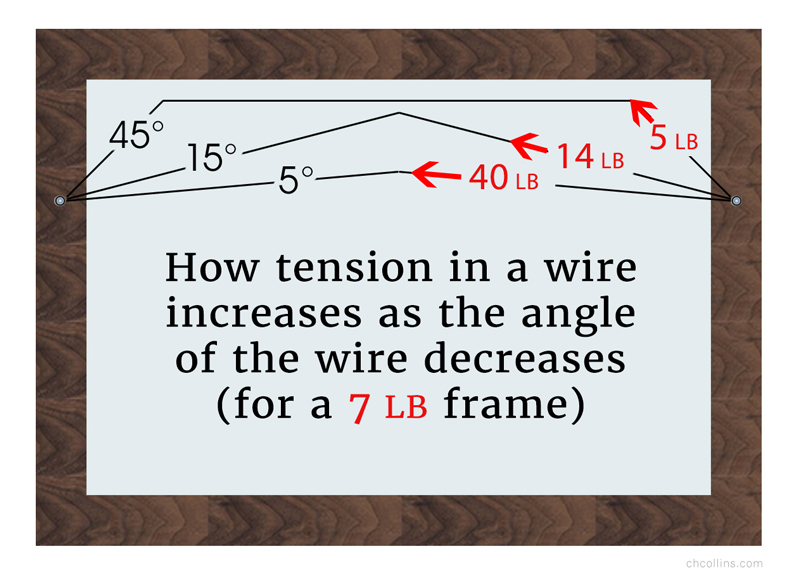
The diagram at left shows how the wire tension increases markedly when a wire is strung taut. A 7-lb frame would generate exactly 7 pounds of tension when hung from a single vertical wire. But if you were to string the wire tightly across the frame and hang it on a hook, the 7-lb frame could produce 40 pounds of tension in the wire, pulling inward on each side of the frame and possibly damaging the art.

Stretching a wire tightly across a frame is about the worst thing you can do, especially with a heavy piece of art, says The Fine Art Trade Guild.  This has not prevented people — even decorators and sellers of gallery systems — from recommending the practice. It is much better for the integrity of the frame, and the art, to leave some slack in the wire and hang the item from two widely-spaced hooks at 45-degree angles, as shown later.

All well and good, but it does not really answer my question: why do frames tilt forward? Having failed to find a good explanation on the internet, I decided to answer this myself. Bear with me, fascinated readers.

This side-view (click to enlarge) may help you understand what is going on. Figure A shows a frame hung from a wire attached to an eyelet at its top-center. Now this is a really bad idea, because the eyelet would probably be pulled right out of the frame. But I show this to illustrate that there would be no cause for this frame to tilt. The real reason that a frame tilts forward (see Figure B) is because the wire is attached to the back of the frame, and the center-of-mass of the frame is in front of that point. This produces a torque that makes the frame tilt forward — it swivels at the attachment point until the center-of-mass is at its lowest possible position, denoted by the dot on the frame in Figure B.

Why Frames Tilt Forward -- Animation by CHCollins Most people in the Northern Hemisphere hang their pictures on a wall — I know I do. A wall pushes back against the bottom of the frame and affects its equilibrium position, such that it does not tilt forward as much a free-hanging frame would. The animation at left shows how a frame reaches its equilibrium position when hung on a wall in the traditional way.

Where one attaches the wire makes a difference in how much the frame tilts. The online world offers conflicting guidance on this. Most sites advise that you attach the wire to the frame one-third of the way down. Others say, one-quarter of the way down, or a certain number of inches from the top. Is there a definite answer here or only opinions? Or as Mitch Hedberg asked, with respect to belts and belt loops, who is the real hero?

The hero in this case is geometry, along with a small dose of physics and calculus. We are going to solve the frame-tilt problem for the benefit of man-and-womankind. Don’t worry, there are no equations involved — until the Appendix.

My Findings

Here is the setup (click to enlarge). A frame of length F is hung on a wall by a wire. The slack in the wire (the maximum distance one can pull the wire away from the back of the frame) is W. The wire is attached to the frame B inches from the bottom of the frame and C inches from the center of the frame, and it pivots freely at the wall and the frame. The center-of-mass (denoted by a red dot) is halfway down the frame and distance D from the back of the frame, where I assume the glass is mounted. We know F, B, C, D and W and we want to find g, the gap between the top of the frame and the wall, when the frame is at equilibrium — i.e., the lowest possible location of the center-of-mass. In other words, we want an expression for the maximum value of y (= y1 + y2 + y3) and the corresponding value of g.

Chart showing forward tilt of a picture frame varies with frame height and depth of the glassIt took a few hours and some brushing up on my trigonometry to find the right approach, but I got there (see Appendix). The chart at left summarizes how the slack in the wire and the position of the glass affects forward tilt, for frames of various heights. Here, I assumed the wire was attached one-third of the way down from the top of the frame, as most self-styled experts advise.

The solid lines in this chart correspond to 10-inch, 20-inch and 40-inch-high frames with the center-of-mass 1/2-inch from the back of the frame. You may be surprised to see that shorter frames tilt forward more than taller ones, when one follows the “one-third rule” and provides the same slack in the wire in each case.

The dashed lines in the chart show how moving the center-of-mass 1/8-inch to the front or rear of a 20-inch-tall frame impacts forward tilt. It may seem insignificant, but a 1/8-inch increase in the depth of the rabbet would widen the gap at the top of such a frame by 25%. It is simple physics — the farther the center-of-mass from the rear of the frame, the greater the torque and the more the frame tilts.

The next chart Chart showing how the wire attachment point affects the forward tilt of a picture frame(click to zoom) shows how fastening the wire at different points on a 20-inch-tall frame affects the forward tilt. Attaching the wire closer to the top always reduces tilt. Knowing this, one may ask, why not just forget the “one-third rule” and attach the wire one-sixth of the way down or three inches down from the top?

Here is one reason: the closer to the top that the wire is attached, the less slack one can allow without the wire being visible. So the “one-third rule” represents a compromise solution for traditional one-hook installations — some forward tilt is accepted for the sake of having more slack and lower tension in the wire.

Interestingly, the weight of the frame does not enter into the calculation. This means that a sheet of foamboard of the same dimensions and same center-of-mass as a wood frame will tilt the same amount when hung the same way.

So it is not true that “heavy” frames tilt just because they are heavy. Frames tilt forward more when the wire is attached closer to the center, when the slack in the wire increases, and when the frame is front-heavy. In typical hanging situations the forward tilt is usually less than 1/4-inch. But when the frame is suspended on a long wire, as gallery systems do, the tilt can be noticeable — 1 inch or more for a 20-inch-tall frame.

I provide a calculator at the end of this post that allows you to estimate the forward tilt of your own frame. Details below.

The Bottom Line

frame-calc-diagSo what have we learned and what do I recommend? If you want to use hooks and wires and you want to hang pictures close to the wall without undue stress on the wire or frame, I suggest using two hooks and 45° wire angles, as illustrated in the diagram at right. This may look a little complicated but it is do-able.

In the original version of this post, I provided a formula to help you with the installation, but in practice, it didn’t go far enough. So I programmed a two-hook frame hanging calculator and posted it in a companion article titled (what else) The “Hang It with Two Hooks” Calculator. This online calculator suggests where to fasten the D-rings, how to install the wall hooks, and the length of wire to cut. This makes the task much easier.

Yes, two hooks present the added challenge of ensuring they are level, but this post is all about reducing forward tilt without stressing the wire or frame. If you are up to the task of carefully positioning two hooks, you might consider eliminating the wire altogether and hang the frame directly onto the D-rings. One drawback to this method is the visibility of the hardware; the other is the extra precision that is needed in mounting the hardware.

But what about my gallery hanging system with the long cables? Here, since we have to rely on a single hook, I suggest wiring the frame according to the one-third rule, with just enough slack so that the cable hook will engage the wire close to the top rail of the frame. Then attach an offset clip to the top rail,Offset Clip slightly off-center, and tuck the cable behind the clip. For a 20-inch-tall frame hanging 30 inches below a cable track, this will reduce forward tilt from nearly 1-1/4 inches to less than 1/2-inch.

Illustration of using offset clip when hanging frames from a cableBy reader request, I have added a photo (click to enlarge) of how the offset clip, cable, and cable hook are installed. This shows the rear of the frame with the cable threaded behind the offset clip. Here I have used a clear 1/8″ mirror clip instead of a metal clip.

Others have used Velcro strips for this purpose instead of offset clips, which is a nifty idea if you don’t mind attaching something to the dust cover with adhesive.

So now you know and so do I. Asked and answered indeed.

The Forward Tilt Calculator

Several readers asked that I create a calculator to estimate the amount of forward tilt for a particular frame. Because the calculation requires iteration (i.e., the answer cannot be found simply by plugging in the known quantities), I had thought this was impractical. However, I discovered that, with a reasonable starting guess, just one iteration is enough for two-decimal-place accuracy. So I offer the following one-iteration calculator.

The user enters four known quantities: the frame height; the rabbet depth (that is, the estimated depth of the center-of-mass of the frame); the wire-to-frame attachment point, measured from the top of the frame; and the amount of slack in the wire, defined as the distance one can pull the wire away from the back of the frame. The calculator returns the amount of forward tilt one can expect.

A Final Word

This post was updated April 7, 2020, with a cleaner derivation, a gap calculator and an animated illustration of why frames tilt forward. This is Part One of a four-part series on hanging frames with hooks and wires. You may also be interested in the follow-up articles, The “Hang It with Two Hooks” Calculator, The Physics of Hanging Pictures, and The “Hang It on Two Studs” Calculator.

If you have found this post informative or entertaining (as about 1000 people a month do), you might enjoy other posts on my blog. Check out my favorites, and consider exploring and subscribing.  My “cup of coffee” invitations appear only on my articles about the physics of hanging pictures.

[ A NOTE FROM THE AUTHOR ]

If you find value in this post and would like to express your appreciation,
you can buy me a coffee or martini!  Click below to add a tip to my coffee fund.

This takes you to my Buy Me A Coffee page. Thanks! – CHC


Appendix: Calculating the Forward Tilt in a Frame Hanging on a Wall

I provide a full derivation of the problem here. If you would rather not delve into that, please refer to the diagram above. We want to find the gap g between the frame and the wall, given the known variables F, B, C, D and W. To get there, we first need to find an expression for y = (y1 + y2 + y3), then use calculus to find the maximum value for y and back-calculate g.

I found it easiest to solve for y in terms of the angle formed by the bottom of the frame and the wall, then replace the sine of that angle with g/F (see the full derivation for details). This ultimately led to the following expression for y:

To find the maximum value of y, and the gap between the top of the frame and the wall at that location, we need to differentiate this equation with respect to g, then set dy/dg = 0 and solve for g by iteration:

This is how I generated the data for the graphs in the body of this report.

Read 67 comments and add yours | Read other posts in Asked & Answered, The Arts