In the stoppage-time minutes of the Iran-USA World Cup match last week (USA won the match 1-0), a desperate Iran player blatantly grabbed the jersey of a USA player trying to advance the ball downfield. The referee rushed to the scene of the crime, brandishing a yellow card as if it were some kind of soccer taser. While his card did not deliver a shock, it otherwise served its purpose: play resumed, USA held on to win, and Iranian players lay on the field afterwards in disgust and despair.
But this post is not about the geopolitics of soccer. It is about how different sports handle infractions of their rules, and what that might say about their participants and audiences.
• • •
Let’s start with baseball. In baseball, quaintly enough, it is harder to bend the rules than to break them. By this I mean, the innately slow pace of the game allows for transparency of play and hawkish oversight by its umpires. As such, misdeeds in baseball tend not to be spontaneous acts (e.g., basepath interference) but premeditated ones such as altering bats, sign-stealing, spitballs and body-juicing, violations that are harder to detect in real time.
Baseball’s balk rule, which penalizes deceptive pitching moves when runners are on base, may be the most common in-game foul — but even then, only 122 balks were called in the 2430 MLB games played this year, and no team had more than 8 in the 162-game season. By comparison, each NFL team last year had an average of 21 offensive holding penalties over a 17-game season, which goes to show how relatively law-abiding baseball is.
Real-time rule violations rarely affect the outcome of baseball games. The foul most likely to impact a team is when a star player or manager is ejected for arguing with the umpires or participating in the occasional bench-clearing brawl. There are several notable brawls every season, but rare enough that you can place bets on when the next one will happen. Penalty-wise, baseball is rather tame and lame.
• • •
On the other side of the behavior spectrum lies basketball, a supposedly non-contact sport which sees no irony in allowing players five free personal fouls a game (the sixth causing a player’s ejection). Foul management and intentional fouls dominate end-game strategy. Star players sit on the bench late in the game in fear of getting their sixth fouls. The final two minutes of barely-competitive games consist of the behind-team purposely fouling the ahead-team, hoping the ahead-team will not sink their foul shots and the behind-team can score ten unanswered points. Such games invariably end in a whimper of free throws.
I am not a big basketball fan anyway (can you tell?) so all the fouling is just another nail in the game’s coffin to me. Offensive infractions like charging and traveling are rarely called, which encourages star players to make foul-inducing drives to the basket, giving them a chance to score three or even four points on a two-point play. I guess this is the sport the NBA wants — a playground game with a pro veneer and fan-pleasing point totals.
• • •
Basketball has its slap-your-arm-while-you-shoot fouls. The equivalent penalty in NHL hockey is called a high-stick. In the interest of letting words speak for themselves, this is how high-sticking is described in Wikipedia:
A penalty is assessed if a player strikes another player with a high stick. The player is given a minor penalty unless his high stick caused an injury, in which case the referee has the option to assess a double-minor, major, game misconduct or match penalty. It is the referee’s discretion which penalty to assess: the rule calls for a double minor for an accidental injury, or a match penalty for a deliberate attempt to injure (whether the opposition player was actually injured). Injury is usually decided by the high stick causing bleeding, but the presence of blood does not automatically mean an extra penalty is awarded. Some referees have been known to award an extra penalty without the presence of blood if the referee determines that the injury sustained was sufficient to warrant a double-minor penalty.
Yes, we all know hockey is violent, but when the presence or absence of blood determines the severity of a penalty, can the sport be thought of as anything more than a fight on ice? There is even a dedicated Wikipedia article on “Fighting in Ice Hockey” in which they note that the NHL does not eject players for fighting per se but for certain in-fight violations, whatever those might constitute.
One might suppose that hockey fans attend games to see the physicality, but a recent study disputes that, citing a negative correlation between fighting and attendance. We shall see. The 2022-2023 NHL season has already given its fans 116 fights (as documented here) in just over 400 games.
Hockey has a smattering of rules about blue lines, red lines, icing and other technicalities, but hockey fans don’t know or care much about that stuff. Just get to the punch line.
• • •
Then there’s golf. Golf is clearly not a contact sport (not when it comes to my golf swing) and so you would think that rule infractions would be both minor and rare. And they are, for the most part. But the Golfing Gods, perhaps taking their cue from the heavenly ones, expect golfers to call violations on themselves! Who would have come up with that twist except the inventors of a game designed to be played by masochists?
“I hereby penalize myself because I breathed too hard as I was preparing to hit my ball!” Which is basically what happened to Tom Kite in the Hall of Fame Classic in 1979 while he was getting ready to putt. Kite noticed that his ball had moved, he informed his opponent, and then he assessed himself a one-stroke penalty. Kite wound up losing the tournament by, yes, one stroke. Poor Tom. Welcome to golf.
I can fathom penalties for carrying more than the allowed number of clubs (14) or striking a moving ball (Phil Mickelson’s signature shot). But it does get silly when a ball wobbles due to unseen forces and the player is held to be at fault. This leads me to conclude that golf is essentially a fundamentalist religion. No wonder the Saudis wanted a piece of it.
• • •
Did you know that golfers (see Tom Watson, 1980) are obliged to take a two-stroke penalty if they give advice to another player? (Which might be a good idea in real life!) Again, compare this to the NFL, where player-to-player advice is given all the time, mainly the kind that advises one’s adversary where he can stick something. In-your-face advice of that nature is termed taunting in the NFL, and a taunting penalty (61 of them were called last season) will set your team back 15 yards. In this case, words aren’t cheap.
Football infractions are divided between the procedural (false starts, illegal formations and shifts, offsides, delay of game) and the physical (holding, pass interference, illegal blocks, roughing, use of the helmet). On average, each team is flagged for 6 penalties a game and probably commits three times that many. All told, there are over 130 different ways to get a penalty (see below, from the NFL rulebook) and if you’ve been a fan long enough, you’ve probably seen most of them.
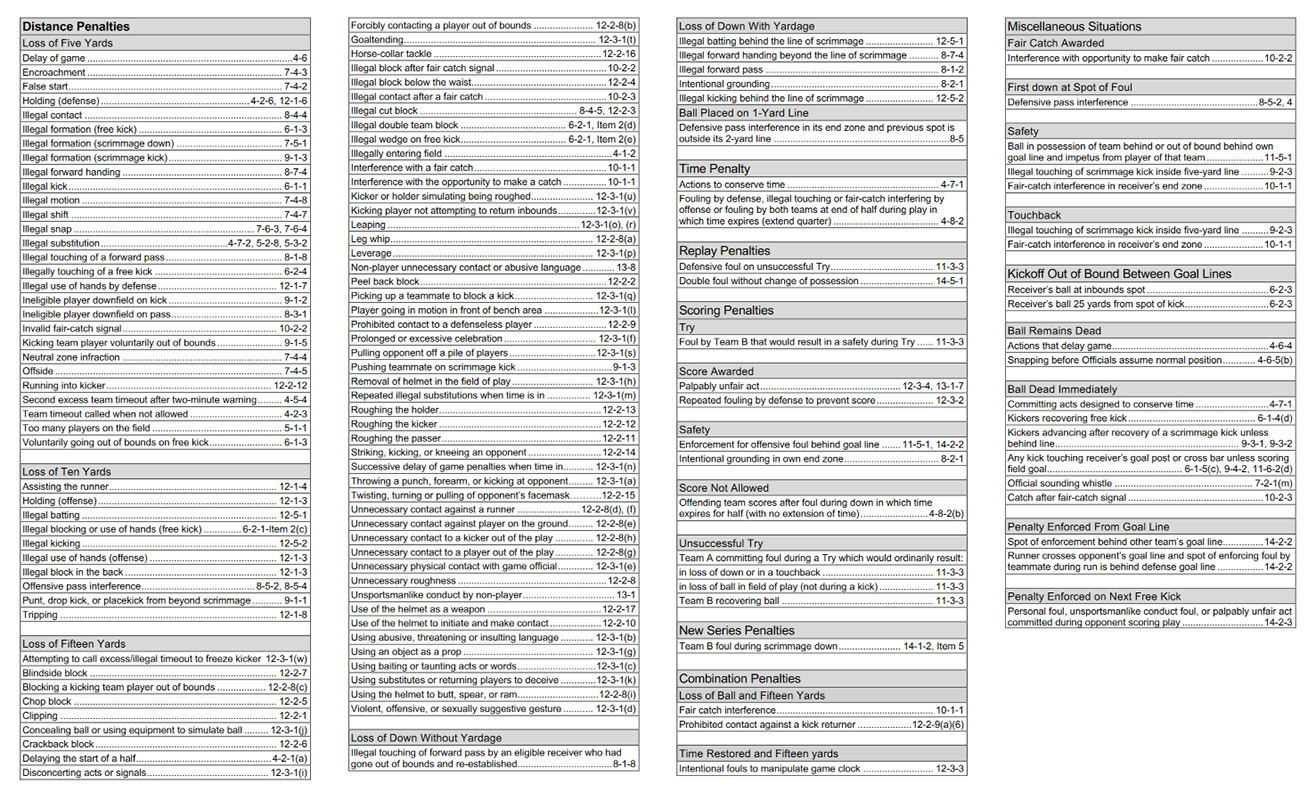 Summary of NFL Penalties
But the in-game penalties are not the end of the story. So far this season, over 60 players have been fined for unsportsmanlike conduct and injurious on-field acts, a number that is dwarfed by the number of players (102) who have suffered concussions this year.
The penalty — or lack thereof — that confuses me the most is defensive pass interference. Rule 8.4.3 says … a defender cannot initiate contact with a receiver who is attempting to evade him. A defender may use his hands or arms only to defend or protect himself against impending contact caused by a receiver. Ha! On the passes I see, the defender always seems to have his hands all over the intended receiver as they scramble downfield, and nothing is flagged except the most blatant tugs and shoves. Maybe Rule 8.4.3 should just say, Boys will be boys.
• • •
Life also has its rules, and penalties. Which leads me to ask, which sports rule-book is most like life? Are our day-to-day infractions largely procedural in nature or are they mostly personal fouls? When we do make a life mistake, is our penalty self-administered (guilt) as in golf? Or do we get away with as much as we can until someone throws a flag, as in football? When we hurt another person, do we make a great show of falling to the ground in pain ourselves, as soccer players do? In the final minutes of our lives, do we sit on the bench and reflect on the number of fouls we have accumulated, as in basketball?
The game of life we play is not a game, its rules are unwritten and arbitrary, and winning is not its typical outcome. We invented sports and their varied rules and penalties to help us harness the world and tame just a bit of the chaos we deal with every day.