Back in our younger, more innocent and surely more ignorant days in early August, 2001, President George W. Bush was relaxing at his Crawford, Texas ranch when he was handed the CIA-prepared briefing titled, “Bin Laden Determined to Strike in US.”
The final paragraphs of the briefing were its most ominous: “FBI information … indicates patterns of suspicious activity in this country consistent with preparations for hijackings or other types of attacks, including recent surveillance of federal buildings in New York.
CIA and the FBI are investigating a call to our Embassy in the UAE in May saying that a group of Bin Ladin supporters was in the US planning attacks with explosives.”
Bush’s team had a month — actually many months — to act on such information. But what did it do? Did it task the FBI and CIA with finding and capturing the Al Qaeda operatives in this country at all cost? No. Did it increase airport or aircraft security? Another no. “The FAA conducted 27 special security briefings for specific air carriers between May 1, 2001 and September 11, 2001. Two [of those briefings] discussed the hijacking threat overseas. None discussed the possibility of suicide hijackings or the use of aircraft as weapons. No new security measures were instituted.”
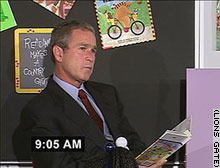 Bush “did not recall discussing” that August briefing with Attorney General Ashcroft or whether National Security Advisor Rice had done so. “[Bush] said that if his advisers had told him there was a cell in the United States, they would have moved to take care of it. That never happened.“
As CIA Director George Tenet recalled in 2015: “To me it remains incomprehensible still. I mean, how is it that you could warn senior people so many times and nothing actually happened? It’s kind of like The Twilight Zone.”
• • • •
Which brings us to our present tragedy, the COVID-19 pandemic, which is also kind of like The Twilight Zone except a lot more scary. Besides the death and economic destruction, what should really scare us are the lessons we have yet to learn, two painful decades later.*
And just as with the September 11 attacks, we are unlikely to learn the true depth of this nation’s ill-prepared and incoherent response to this pandemic until some future Congress creates a 9/11-style commission. This is because federal health officials are under orders to treat coronavirus-related meetings as classified.
Nonetheless, there are some facts about our COVID-19 response fiasco that we do know, thanks to The Washington Post and other sources. We know that a China official officially informed Robert Redfield at the CDC about the Wuhan outbreak on January 3, and that Redfield relayed this to HHS Secretary Alex Azar, and that Azar duly informed the NSC at the White House. That is when the U.S. pandemic clock started to tick.
On Monday, January 6, the CDC issued a “Level One” travel advisory for Wuhan, China. Here is the text of that advisory (now available only via Internet Archive):
What can travelers do to protect themselves? Travelers should
• avoid animals (alive or dead), animal markets, and products that come from animals
• avoid contact with sick people.
• wash hands often with soap and water.
There is a cluster of cases of pneumonia in Wuhan, China. As of January 5, 2020, local, provincial, and national health commissions in China have reported a total of 59 cases with no deaths.
The CDC offered no other advice to U.S. residents. But it did add a warning to clinicians: “Symptomatic patients with a history of travel to Wuhan City … should be asked to wear a surgical mask as soon as they are identified and be evaluated in a private room with the door closed. Personnel entering the room to evaluate the patient should use contact precautions and wear an N95 disposable facepiece respirator.”
Again, the CDC issued this advisory on January 6 — in the event, I imagine, that such a patient might show up in the U.S. But like Trump said, who could have imagined that? No one, at least not within social distance of the Oval Office.
• • • •
On Friday, January 17, the CDC initiated entry-screening for travelers from Wuhan at (only) three U.S. airports: San Francisco (SFO), New York (JFK), and Los Angeles (LAX). Four days later, the first confirmed U.S. coronavirus case arrived — in Seattle.
From the time the CDC learned of the outbreak to when it began limited entry-screening, 4,000 people had already entered the United States directly from Wuhan.
Meanwhile, HSS Assistant Secretary Robert Kadlec was trying to use academic channels to obtain a sample of the virus from the Wuhan Institute of Virology. But on January 24, China officials blocked the transfer. Unfortunately, “[there was] no indication that [HSS] officials sought to escalate the matter or enlist Trump to intervene,” according to The Post.
Soon after that, as Axios reported, “President Trump’s economic adviser Peter Navarro warned his White House colleagues the novel coronavirus could take more than half a million American lives and cost close to $6 trillion.” Navarro’s January 29 memo (which Trump claims he never read) called for “an immediate travel ban on China” — this led Trump to issue a set of travel restrictions that he could tout as a ban. (Since that “ban” there have been 279 flights from China to the U.S.) That said, there is debate whether even a total travel ban would have been effective by then.
• • • •
The point of this essay is not, however, to recount every misstep and wasted opportunity for our government to exert some control over the situation and possibly save more lives. Rather, it is to note that our Achilles heel as a nation remains the same as it has always been, at least in my lifetime — hubris and complacency, along with a twisted dogma that puts individual economic liberty, as an abstraction, ahead of living, breathing individuals.
Consider Hurricane Katrina. One would think that, after that disaster, our leaders would have learned the importance of close cooperation between state and federal entities and would never again let jurisdiction issues compromise public safety. Yet here we are again, millions of Americans laboring under a patchwork of state-wise declarations and actions on public-health issues like essential businesses and the proper size of public gatherings. When U.S. health officials do issue guidelines, Trump undermines them. As if Floridians have different interests than Georgians in terms of distaste for suffering and the value of their neighbors’ lives.
(Hurricane Maria, in the first year of his presidency, provided clear enough evidence of how Trump himself distinguishes among Americans in his distaste for their suffering and how he differentially values their lives. But anyway.)
While Hurricane Katrina may have taught FEMA how to better deploy resources such as line crews, trailers and generators, our federal and state governments still hew to arbitrary lines that prevent them from mounting the best responses to national threats. (I consider constitutionally-drawn lines as arbitrary as any other. Just harder to erase.)
That is, assuming our government even plans for such threats. That is where our hubris lands us, time and time again. We will never be attacked on our own soil — we remember Pearl Harbor! We will never undergo a pandemic — we have the best health care system in the world! We could never suffer another Great Depression — America has the strongest economy and the sharpest economists! And of course, no one would dare attack one of our nuclear power plants, pipelines or refineries, or the internet that now controls everything. Inconceivable!
Plans? Who needs plans? In America, fame and glory come from action, not prevention. America loves the swashbuckler, the man who valiantly steers the ship out of the storm after all appears lost. America has no use for navigators, those who would keep the ship out of harm’s way to begin with. That is why we will spend $934 billion on our military this year but only $10 billion, combined, on the CDC and the HSS Office of Preparedness and Response. (We will also spend just $8 billion on domestic cybersecurity, with that sum split among 25 departments and agencies. We really do hate planning ahead.)
Even those relatively small sums are fought over by the right-wing diehards who would starve our government in order to save their bizarro ideal of it. And only with the greatest reluctance do those same zealots agree to spend money to rescue the nation from the very perils resulting from their neglect. Thanks to their pigheaded dogma, we are left to lurch from one crisis to the next, few of those foreseen and none adequately prepared for.
It is sad to hear conservatives maintain that every problem has a free-market solution, when it is so obviously wrong. Such people are not simply hammers who see only nails, they are delusional and a danger to society at times like this.
It is actually frightening to me how clear it has become, that so many Americans place money ahead of lives. It goes beyond Texas Lt. Governor Dan Patrick, who basically said that old people should take one for the team and die already, rather than put a downer on the economic party. It is the same mindset that, like a virus of its own, has infected the brains of Rush/Hannity followers and causes them to say batshit like, “The COVID-19 death toll is actually much lower because all those old people were going to die anyway.” Trump and his base, your neighbors and mine, have the Fox News Fever and are sweating bullets now that the money-machine they worship has been gummed up by something they can’t see and haven’t experienced. (Sort of like Jesus. But anyway.)
Every step of the way, Trump has feared taking any action that might imperil the one thing he could lay claim to, the (once) record-high stock market: “At times, he voiced far more authentic concern about the trajectory of the stock market than the spread of the virus in the United States, railing at the chairman of the Federal Reserve … with an intensity that he never seemed to exhibit about the possible human toll of the outbreak.” I assume that someone has since let Trump know “that ship has sailed” with respect to the stock market and the best he can do now is act like a swashbuckler.
• • • •
One last thought about American hubris and complacency. It affects everyone, even those you think you trust. On a February 18 appearance on C-SPAN, Dr. Anthony Fauci said:
“We have handled travel-related cases very well. We have 15 cases… [and] we now have 14 extra people… from the cruise ship… but we have done identification, isolation and contact tracing. So, to our knowledge, there aren’t individuals in society in the United States that are infected. We don’t think so. We don’t know 100% because they could have kind of come in under the radar screen. So what we’re doing to mitigate that is, we’re taking five cities… and going into clinics where people present with flu-like symptoms but don’t have the flu… so why do they have flu-like symptoms? We’re going to test them for coronavirus and if they do [test positive], it would indicate we’re missing some, if they don’t it means we’re in good shape.”
This shows how even our top health official was flying on a wing and a prayer, expressing more optimism than the facts warranted, even when he was not speaking to the President. Trump was able to cherry-pick from what he heard and shovel it to the American public, because he was still not receiving a clear mayday call. I say this not to excuse Trump but to point out that this was a shared failure, a system failure. If Dr. Fauci could not make his voice heard above Fox News, then perhaps he should have resigned. But he hasn’t.
Most of my readers are old enough to remember the space shuttle Challenger explosion in January, 1986. NASA formed a commission to investigate the cause of the disaster, and the famed physicist Richard Feynman was appointed to it. He found the proximate cause of the explosion, which was the failure of O-ring seals due to sub-freezing temperatures. But the real cause, Feynman warned, was a system failure:
[Safety] criteria are altered so that flights may still be certified in time. [The shuttles] therefore fly in a relatively unsafe condition, with a chance of failure of the order of a percent (it is difficult to be more accurate). Official management, on the other hand, claims to believe the probability of failure is a thousand times less. One reason for this may be an attempt to assure the government of NASA perfection and success in order to ensure the supply of funds. The other may be that they sincerely believed it to be true, demonstrating an almost incredible lack of communication between themselves and their working engineers. In any event this has had very unfortunate consequences, the most serious of which is to encourage ordinary citizens to fly in such a dangerous machine, as if it had attained the safety of an ordinary airliner.
As Feynman made plain, it went beyond O-rings, the proximate cause, and it always does. How can we have a robust health-defense system when it so easily bends to the whims of small-government congressmen and bullying presidents? How can we mount a credible response to disease threats when we pick fights with those who control the supply chains for our drugs and medical supplies? How can we hope to save Americans from pandemics when some states stay open for business while neighboring states shut themselves down, all depending on the political affiliations of their governors?
The Feynman Rule — if I may so coin it — is that an investigation must move up the chain until one finds the system problem(s). There are several of them in this case, and they will not be easy to address, as they are baked so firmly into American politics and culture.
I am not savvy enough to offer prescriptions. But this presents an enormous opportunity for a Democratic presidential nominee to show how his administration would improve our preparedness, how it would secure and domesticate our supply chains, how it would knock down the barriers keeping our government from doing its constitutional duty, that is, provide for the common defense and promote our general welfare.
___________________
* On and on and on it goes, the briefings, the bill-signings, the Fox News appearances, all designed to make political theater smell something like competence. But the play remains the same, just staged with different players. Donald Trump assumes the dual role of Bush/Cheney, merging Bush’s cluelessness with Cheney’s arrogant conniving. Pence plays Rudy Giuliani, hero for the one day he seems to be in charge of something. Dr. Anthony Fauci is the new Colin Powell, standing tall in the middle of the muck but hoping his reputation keeps his uniform clean. Dr. Deborah Birx debuts as Condi Rice, the woman smarter than the President but who gets used by him anyway to present a credible warlike stance. Please, let this play close after Act I.


 To explore this situation, we’re going to do a little thought experiment here at the stay-at-home office of Asked and Answered. Here’s the setup. You and 999 other drivers are going to take a 60-mile trip on the same stretch of interstate highway. The posted speed limit is 60 mph, but most of you drive some other speed. In our scenario (see diagram), 30% of drivers drive at 60 mph; 30% drive at 65 mph; 30% drive at 70 mph; and the remaining 10%, the most aggressive ones, drive at 80 mph. We will assume that the four types of drivers enter the on-ramp in random order and at a steady rate of 4 cars per minute.
 The chart at right is a simplified example of a time-space diagram. Travel time is on the horizontal axis and total distance traveled in that time is on the vertical axis. Each of the colored lines (refer to color scheme above) represents a trip made by one of the drivers in our scenario. In this example, one driver of each speed-type drove the 60-mile trip, with the drivers starting out 5 minutes apart from each other. The silver car started first, followed by green, blue and finally red.
 One more example before we turn to the original question. The chart at right shows the trip-lines for 40 cars on a 60-mile trip. Four of every five drivers (silver) drive 60 mph; the fifth (pink) drives 90 mph. From the line crossings, we see that the typical pink car passes 10 silver cars, while a silver car encounters 2 or 3 pink ones.
 A few things to note here. First, based on her encounters on the road, every driver thinks that her own driver-type is decisively in the minority. This is because she will neither pass or be passed by anyone driving at the same speed. While she may follow another car of similar speed for many miles, her own vehicle and the one she sees right in front of her would be the extent of her experience with like drivers.
 In case you were still wondering what it meant.
