Yearly Archives: 2018

I headed out this afternoon to our local Walmart near the Madison County line to buy a mailing tube for a photo print.  Here were the highlights from the trip:

• On the way to Walmart, I drove past the restaurant at the bottom of the hill where we used to buy our pizzas.  The WE DELIVER neon sign in the window was lit up as usual.  One time when I was picking up a pie there, I commented to the owner about the sign and asked him when they had started delivery service.  He told me that they don’t deliver and hadn’t done so in years.  I noticed that the sign had its own electrical plug.  The owner has never bothered to unplug it.  Perhaps he delivers, in his own way.

• When I got to Walmart, I headed to the section where the office supplies were.  Were is the operative word, since they used to be there but not anymore.  But luckily there was an associate nearby — she told me that the office supplies had been relocated to the corner of the store.  I asked her about mailing tubes specifically and she replied, yes, they are there.  Of course, when I got to the office supplies section, I found no mailing tubes.

• As I headed back to my car, I passed a woman wearing a T-shirt emblazoned with the words GOD ABOVE ALL ELSE in faded five-inch capital letters.  It was homemade.

• I headed over to the nearby Publix market on the off-chance that they had mailing tubes. Turning into the lot, I followed what was probably the largest pickup truck I’ve ever seen. Its bulging jet-black body showed no sign of ever having picked up anything other than its owner.  And in the window behind the driver’s seat was this stark black-and-white decal: NOT SPONSORED BY MOMMY & DADDY.

• Publix had no mailing tubes either (it was an off-chance, after all) so I decided to head downtown to Staples.  Driving southbound into Asheville on I-26, one is greeted by a sign at the I-240 interchange that promises VISITOR INFORMATION if one stays to the left:I stayed to the left, not because I need information but because that is the fastest way to get to Staples.  But information-seeking visitors who heed this sign are presented with a more difficult choice just 1000 feet down the road:

Oh Gracious Lord!  Which way should one turn for VISITOR INFORMATION?  Should one head Downtown or follow the Expressway?  Unlike the last fork, there is no helpful signage here.  As a visitor looking for information, what path would you choose?

I think most people, if using their common sense instead of their GPS or Gracious Lord, would choose the Downtown ramp.  But those people would be wrong.  To get to the Asheville Visitor Center from southbound I-26, one must use the I-240 eastbound ramp, then quickly merge into the left lane of I-240 and cross two lanes of expressway traffic in less than 1500 feet to exit the freeway and navigate to the Visitor Center via city streets.

Apparently, visitors to Asheville are more than able to execute this challenging maneuver, as we seem to have no lack of their kind in these here parts.

• I get to Staples, pick up my mailing tube and fall into line behind a scrawny woman standing next to a rather beat-up Canon Pixma MX492 printer box at her feet.  There was one associate at the checkout.  I think, oh no, I’m going to be in line forever, but then I say to myself, GOD ABOVE ALL ELSE, and suddenly another checkout associate shows up!  (OK, I made up part of that last sentence.  It was the part in capital letters.)  Anyway, the scrawny woman starts to explain to the new associate why she is returning the printer.  Something about paper jams and error 5100.  The associate asks, do you have a receipt?  No.  Okay then, how about the credit card you used?  I used a debit card, she says.  Okay, says the associate, we will credit it to your debit card.  Some keystrokes later, the associate asks, are you sure this is the debit card you used to buy the printer?  Meanwhile, I am now purchasing my mailing tube from the other associate, who wants to know whether I have a Staples Rewards Card.  I say no and tune out the scrawny woman’s printer return story.

• As I was driving home from Staples, I thought of the time a few years back when I was walking into Lowes (across from Walmart near Madison County) and was approached by a thirty-something woman holding an item I cannot now recall.  She wanted me to take her item to the Returns Desk, get a cash refund and then come back out and give her the cash.  She had no receipt.  I told her I could not do that and resumed walking into the store.

• When I got home from Staples, I checked walmart.com and found that my local Walmart does not even carry mailing tubes in-store.  All in all, it was a disconsolate trip through the little town I live in.   At least I can say it was not sponsored by mommy or daddy.

Read 4 comments and add yours | Read other posts in Life

In spite of what my title suggests, this post is not another tired whine about how ZEN is not a valid Scrabble word even though JEEP is.  (ZEN is a proper noun, hence unplayable, whereas JEEP… well, you figure that out.)  Instead, this post presents an assortment of should-be-words, complete with definitions, that have popped up in my seven-letter tray during Scrabble games.  I encourage fellow Scrabblers to try playing these words against friendly opponents, especially after a second bottle of wine has been opened — who knows, these words sound so good they just might go unchallenged.

All of these come directly from my letter tray to you:

POTIFTO (n): a tuberous vegetable unsure of whether it is a yam or a sweet potato

EARKITE (n): Barack Obama on a parasail

EFFOTEL (n): worst hotel you ever stayed in

ITOILET (n): the last place a person drops her iPhone before buying a new one

AOUEIII (int): universal bungee-jumping cry

TOETURE (n): the act of tickling a person’s pedal extremities to make them talk

RETOPIA (n): an idyllic place where enlightened Buddhists live their second lives

PREGOLD (adj): pertaining to the year prior to becoming eligible for Medicare

RAMENZA (n): drug approved in 2003 for treating allergic reactions to Japanese noodles

BEGTIME (n): the several-minutes-long period when one’s child, after being tucked in for the night, pleads for one more story to be read

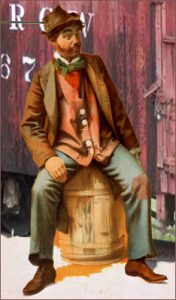
TRAMPUI (n): honey-flavored liqueur favored by hobos

RAILODE (n): boxcar-themed poetry favored by hobos

SHPUZKA (n): loose outergarment worn in anticipation of drama, as in, “You cad!  I’ve never been so insulted!  Waiter, bring me my shpuzka and get me a taxi!”

QINEDAY (n): day of the week (in the European Union, between Monday and Tuesday) when U need not follow Q

ASSIBOU (n): the rude offspring of a donkey and a reindeer

Read 2 comments and add yours | Read other posts in Creativity

Asked and Answered 4.0

I am one of those annoying persons who is kind and cooperative in everyday interactions but whose competitive bloodlust rises to the fore when Scrabble is involved.  Ask my wife.  She stopped playing Scrabble with me years ago, even after I began to spot her 100 points. That was little help, as far as she was concerned, because it only made me dig my heels in that much harder to overtake her.

I play online now, as I assume most players do, because who stops by your place to play Scrabble these days?  I am a good casual player but not tournament-level by any means — not that I care to be.  I have only recently begun to learn the two-letter-words and I am constantly surprised by the odd three-letter-words my opponents play.

Things were different in the analog days.  Back then, diligent players had to memorize the accepted words, because consulting a dictionary was verboten except to answer challenges. (VERBOTEN is an official Scrabble word, by the way.)  But there are no challenges in the online version — instead, players are allowed (and expected) to check whether words are valid before playing them.  And the two-letter-word list is now just a feature of the game.  So no one really needs to memorize much.

That said, there is still a place for vocabulary skills in online Scrabble, tempered as always by the luck of the draw of one’s letters.  And that, at long last, brings me to the point of this article.  I just completed a game with an anonymous online opponent named Micki.  Here is the board we played:

Scrabble Board - The 100 Billionth PersonYou can see that Micki defeated me, 339 to 308.  What you do not see is that Micki drew and played all five of the highest-scoring letters (Q, Z, J, X, K), along with seven of the ten next-highest-scoring letters (two each of F, H, V, W, Y) as well as the two blanks, each of which confer a 15 to 30 point advantage [Thomas, 2011].  Now perhaps I am biased, but this seemed to me to represent an especially good string of luck — for my opponent.

The competitive person that I am asked, what are the chances of such a lopsided draw?  The nerd that I am set about to answer it.

• • • •

At first I thought I would need to program a computer simulation of thousands of games with random word lengths, to see how likely it would be that a real game would have such a one-sided letter draw.  But then I made a few simplifying assumptions.  (That is what old engineers eat for breakfast, simplifying assumptions.  For us, they go down as easily as, say, eggs Benedict did for the last Pope.)

My first simplifying assumption was that each player will likely draw half of the stockpile of letters over the course of the game.  This assumption allows us to neglect the number of tiles drawn on a play-by-play basis.  Once we stipulate that each player will draw 50 of the 100 tiles over the course of the game, we can focus on the distribution of tiles between the two players, as if all the tiles were shuffled and dealt out to the players like a deck of cards.

To further simplify the problem, we can imagine that the special, high-scoring letters are dealt out first, followed by the low-scoring letters, using the following process.  Start with the Q.  To see which player gets the Q, the dealer flips a coin.  If the result is heads, the Q is dealt to my pile, otherwise it is dealt to my opponent.

The dealer repeats this process for the remaining high-scoring letters and the two blanks, seven tiles in all.  Since the chance of my being dealt a tile after a coin flip is 1/2, then the chance that I would be dealt all seven of the special tiles is 1/2 to the 7th power, or 1/128.  Needless to say, this is also the chance that my opponent would be dealt all seven tiles.

Though not common, landing all the best-scoring tiles is not as rare as I had first assumed. But wait — my opponent not only also played the top seven tiles but also seven of the ten four-point tiles.  So we need to do a bit more math.

In the second phase of the process, the dealer takes the ten four-point tiles and again flips a coin to determine which player is dealt each tile.  What is the chance that I will be dealt exactly three of the ten tiles?  Interestingly, I found that this specific problem was asked and answered on Mathematics Stack Exchange.  The general formula is

prob(k heads in n tosses) = C(n,k) * p k * (1-p) n-k

where C(n,k) is the number of combinations of n things taken k at a time (explained here) and p is the probability of a single event, which in our case is 1/2.  For n = 10 and k = 3, the answer is 15/128, or a little better than one chance in nine that I would be dealt three of the ten four-point tiles.*

So the overall likelihood of Micki’s lopsided draw is the product of the two probabilities we calculated, that is, 1/128 * 15/128 = 15/16384.  Expressed as odds, this would be 1091 to 1, or about the same likelihood as getting bumped from an airline flight due to overbooking.  If one looks at it this way, yes, I was a bit unlucky (or Micki lucked out, take your pick).

The big difference between one-sided Scrabble games and overbooked airline flights is that my bad luck did not result in my getting beaten up and hauled out of my recliner, kicking and screaming — instead, I wrote this post.  So there.  I’m vindicated.  But I still lost.

______________

* Some readers with penchant for details may be asking, wait, what about the rest of the tiles?  How does the dealer make the piles come out even, when one player has been dealt most of the special tiles?  Easy.  Take the remaining tiles, shuffle them and deal them out until one player has 50 tiles, then deal whatever is left to the other player.  For good measure, make sure the unlucky player gets most of the I’s and U’s.
Read 3 comments and add yours | Read other posts in Asked & Answered