Originally published July 11, 2011:
Today the “stock market” was down about 1.5%. Would you rush to a department store and buy clothes if they were 1.5% off?
Financial gurus who subscribe to the “efficient market hypothesis” would like you to think that the stock market “knows” at every instant the correct price of everything offered for sale in the market. If so, why does the price of stock vary so much on a day-to-day basis? How can it be that something worth $100 yesterday is only worth $98.50 today? What changed between then and now, other than the chemicals exchanged amongst the neurons in a stock trader’s brain?
Give me a break: the “market” has no idea what any price should be. The market is a boat without an anchor, riding the tides. As sentiment rises and falls, so do stock market prices. Millions of people makes bets (and they are bets) based on sentiment every day.
In the end, we are all “greater fool” investors, ones who count on someone buying our asset at a higher price than what we paid for it. As long as we all agree on this scheme, it works. But if the game breaks down, if people stop believing that stock prices increase over time, then the market will crash, just as Tinkerbell’s light dimmed from lack of applause.
We (along with tens of millions of others) are counting on other people’s greed to finance our retirement. Greed is a fairly good bet — not ironclad, but it has a long track record.


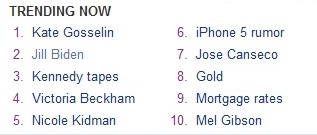 And here to your left are the topics that Yahoo says are “trending now”. Seems that Yahoo only tracks people who care about actors, athletes and politicians.